
BY:SpaceEyeNews.
Mars lacks the global magnetic shield that surrounds Earth. Yet Mars auroras can form through a surprisingly familiar process. Scientists found that small magnetic regions above the Martian crust create a miniature version of Earth’s auroral cycle. NASA’s MAVEN spacecraft collected the measurements behind this discovery before its mission ended. The result explains how electrons gain energy and produce localized ultraviolet glows in the Martian atmosphere. It also changes how researchers view the connection between Mars, the solar wind, and the planet’s magnetic past.
Mars Auroras Follow a Familiar Magnetic Cycle
On Earth, auroras appear when energetic electrons travel along magnetic field lines and enter the upper atmosphere. Their interaction with atmospheric gases produces glowing emissions.
A much larger magnetic process controls that movement. Scientists call it the Dungey cycle, after British physicist James Dungey. Magnetic fields carried by the solar wind connect with Earth’s magnetic field on the planet’s daytime side.
The connected field lines then move toward Earth’s long magnetic tail. Another connection occurs there, releasing energy and accelerating electrons back toward the atmosphere. The process also circulates plasma and produces electrical currents throughout Earth’s magnetic environment.
Researchers have now identified a miniature version of this cycle on Mars. The Martian process also includes magnetic reconnection, electrical currents, plasma circulation, and accelerated electrons. However, it operates over small areas rather than an entire planet.
According to the peer-reviewed study, Earth’s magnetic field is about 100 times stronger. Its Dungey cycle also operates across distances roughly 20 times larger. Despite these differences, the basic physical process remains remarkably similar.
Ancient Martian Crust Creates Local Magnetic Bubbles
Mars no longer generates a planet-wide magnetic field. Its internal dynamo stopped operating billions of years ago. Without that global shield, the Martian atmosphere became more exposed to the solar environment.
However, the planet did not lose every trace of its ancient magnetism. Some Martian crust formed while the global magnetic field still existed. As molten rock cooled and solidified, it preserved a magnetic imprint.
These magnetized areas now create small magnetic environments above the surface. Scientists sometimes describe them as miniature magnetospheres. The strongest patches sit mainly across the southern hemisphere.
Unlike Earth’s global field, these regions do not fully surround Mars. They remain linked to specific areas of the crust and rotate with the planet. Their shapes and interactions also change as solar-wind conditions shift.
Researchers had previously detected localized Mars auroras above some of these magnetic areas. Those observations suggested that reconnection allowed external electrons to enter the Martian atmosphere. However, reconnection alone could not explain how the electrons gained enough energy to produce the auroral emissions.
The latest research supplies that missing explanation.
MAVEN Measurements Completed the Picture
Scientists reconstructed the process using measurements from three instruments aboard NASA’s Mars Atmosphere and Volatile Evolution spacecraft, better known as MAVEN.
The spacecraft’s magnetometer recorded the direction and strength of local magnetic fields. Researchers used those observations to identify magnetic disturbances and calculate currents flowing along the field lines.
MAVEN’s Solar Wind Electron Analyzer measured electrons across a range of energies. The data revealed energized electrons moving toward the Martian atmosphere. Their behavior resembled the electron acceleration associated with discrete auroras on Earth.
The most difficult evidence came from MAVEN’s SupraThermal and Thermal Ion Composition instrument, or STATIC. It measured the movement of charged particles in the Martian ionosphere. Researchers pushed the instrument close to its measurement limits to detect the necessary plasma flows.
Those flows provided the final piece. Their directions matched the circulation expected from a small Dungey-like cycle. The currents, accelerated electrons, magnetic configuration, and ionospheric movement formed one consistent system.
The main case examined measurements collected on February 25, 2017. MAVEN passed above some of Mars’s strongest crustal magnetic fields near the evening boundary between day and night. Researchers also studied additional examples to determine whether the explanation applied beyond one isolated event.
The findings appeared in Nature Communications on July 23, 2026.
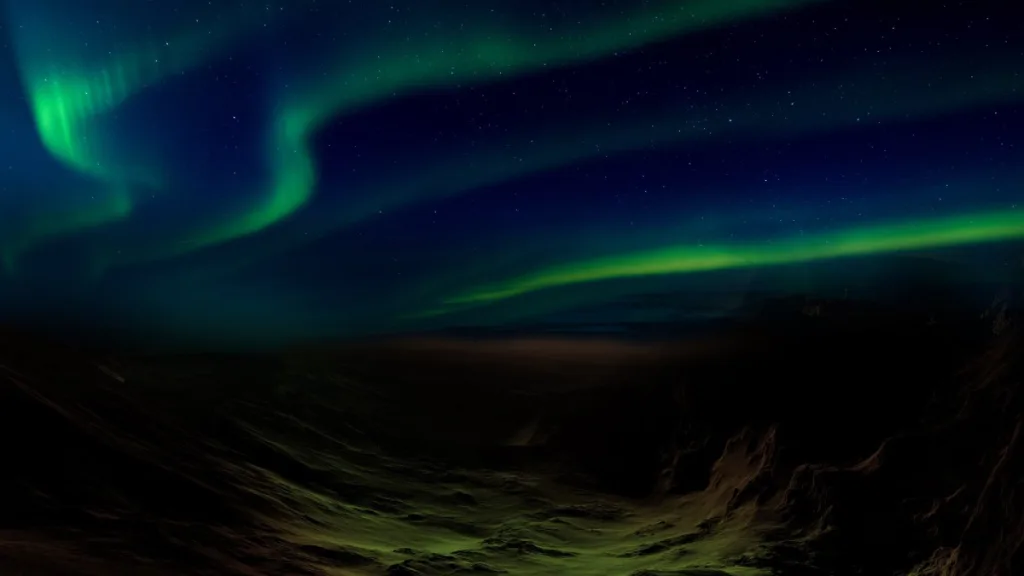
Newfound auroras on Mars defy easy explanation.
What Would Martian Auroras Look Like?
The discovery does not mean Mars regularly develops vast green curtains like those photographed over Earth’s polar regions. Martian discrete auroras remain highly localized. Their locations depend on crustal magnetism, planetary rotation, and solar-wind conditions.
Many important Martian auroral emissions also occur in ultraviolet wavelengths. Human eyes would not see those wavelengths without specialized equipment.
The study examined electrons capable of producing ultraviolet emissions from carbon monoxide in the upper atmosphere. MAVEN’s Imaging Ultraviolet Spectrograph had previously detected comparable emissions.
Therefore, the phenomenon is physically similar to an Earth aurora, but its appearance, location, and scale differ greatly.
NASA’s illustration linked to the announcement also needs context. It shows charged solar particles interacting with Mars and contributing to atmospheric loss. It is an artistic visualization, not a direct photograph of the newly explained auroral process.
Why Mars Auroras Matter for Future Exploration
Understanding Mars auroras gives researchers a better view of how the solar wind interacts with the planet. These interactions influence charged-particle circulation, upper-atmospheric behavior, and long-term atmospheric change.
The discovery also provides clear targets for future spacecraft. Instruments can concentrate observations above the powerful crustal fields in the southern hemisphere. Researchers may then track how auroral activity changes under different solar conditions.
This knowledge could support future robotic and crewed exploration. Better models of Martian space weather can help mission teams understand the environment around orbiters and surface operations. However, the study does not identify a new immediate danger to astronauts.
The result also carries wider significance. Similar cycles may operate on other worlds with localized magnetic fields. Auroras could therefore help scientists remotely investigate magnetic structures that spacecraft cannot measure directly.
MAVEN Continues Delivering Discoveries
NASA launched MAVEN in 2013, and the spacecraft entered Mars orbit in 2014. Its main purpose was to examine the planet’s upper atmosphere and interaction with the solar environment.
NASA lost contact with MAVEN on December 6, 2025. After several recovery attempts, the agency declared the spacecraft unrecoverable and concluded the mission on June 3, 2026.
Nevertheless, its scientific legacy continues. Researchers can examine years of archived observations and connect measurements in new ways. This discovery demonstrates how mission data can answer major questions even after spacecraft operations end.
Conclusion: Mars Auroras Connect Two Different Worlds
The newly identified magnetic cycle explains how localized Mars auroras receive their energy. Ancient magnetic patches reconnect with solar-wind fields, circulate plasma, produce electrical currents, and accelerate electrons into the atmosphere.
Earth performs this process through a powerful global magnetosphere. Mars recreates it through isolated remnants preserved in its crust. The scale differs, but the underlying physics remains familiar. By revealing that connection, MAVEN has helped scientists understand how two neighboring planets followed very different evolutionary paths. Its archived data may continue uncovering clues about Mars and magnetic environments across the Solar System.
Main Sources:
NASA Science – MAVEN Illuminates New Understanding of Auroras at Mars:
https://science.nasa.gov/missions/maven/nasas-maven-illuminates-new-understanding-of-auroras-at-mars/
Nature Communications – Miniature Dungey-like Cycle at Mars:
https://www.nature.com/articles/s41467-026-75019-3