
BY:SpaceEyeNews.
Mars Magnetic Field Loss Changed Everything
Mars was not always the frozen desert we see today. Long before its dry plains, thin air, and cold surface became familiar, the Red Planet may have had rivers, lakes, and a thicker atmosphere. It may also have had one of the most important features a rocky planet can own: a global magnetic shield.
That shield came from deep inside Mars. Like Earth today, early Mars likely had a working internal dynamo. This dynamo generated a magnetic field that helped protect the planet from the solar wind. That stream of charged particles flows from the Sun and constantly interacts with planets across the solar system.
Then the shield faded.
Mars magnetic field loss did not destroy the planet in one sudden event. It did something slower, and in many ways more dramatic. It opened the upper atmosphere to stronger solar influence. Over vast stretches of time, Mars lost much of its air. Surface water became harder to maintain. The planet cooled, dried, and changed into the world explored by orbiters, landers, and rovers today.
The story matters because it is not only about Mars. It is also about habitability. A planet can sit in a promising region around its star, yet still lose the conditions that make surface water stable. Mars shows how a world’s interior, atmosphere, gravity, and star can all shape its future.
Mars Once Had a Planetary Shield
The strongest evidence for ancient Martian magnetism sits inside the planet’s oldest rocks. Spacecraft measurements have shown that parts of the Martian crust remain strongly magnetized. These magnetic signatures appear most clearly in ancient terrain, especially in the southern highlands.
That matters because rocks can preserve magnetic memory. When molten material cools, minerals inside it can align with the magnetic field around them. Once the rock hardens, that alignment can remain locked in place. In that sense, parts of Mars still carry a fossil record of a vanished planetary shield.
This tells scientists that early Mars once had a global magnetic field. It likely formed through motion inside the planet’s core. Earth still has this kind of internal engine today. Its active core helps generate a magnetosphere, which forms a protective bubble around the planet.
Mars no longer has that global shield. Instead, it has patches of crustal magnetism left behind from its early history. These regions do not protect the whole planet the way a global field would. They are more like broken remains of a once-larger system.
For early Mars, the magnetic field may have helped keep the solar wind at a distance. That protection would not have made the planet safe forever. But it likely gave Mars a better chance to hold onto a thicker atmosphere during its youth.
Why the Martian Shield Faded
Mars is smaller than Earth. That simple fact shaped its destiny.
Smaller planets lose internal heat faster. As Mars cooled, the deep motion that powered its ancient dynamo likely weakened. Once that inner engine slowed down, the global magnetic field could no longer survive in the same way.
This is one of the most important parts of the story. Mars magnetic field loss was not only an atmospheric event. It began as an interior change. The planet’s core, mantle, and heat history all played a role.
When the dynamo faded, Mars lost its planet-wide magnetic protection. The solar wind could then interact more directly with the upper atmosphere. Over time, charged particles from the Sun helped remove atmospheric gases into space.
That process did not erase the atmosphere overnight. It slowly changed the balance. Mars kept losing air, while other processes also changed its climate and surface. The planet became less able to support stable liquid water at the surface.
Earth offers a useful contrast. Our planet still has an active magnetic field, stronger gravity, active geology, and a dense atmosphere. These features work together. Mars had a different path. Its smaller size made it more vulnerable to long-term atmospheric escape.
MAVEN Caught Mars Losing Air
The idea that Mars lost atmosphere to space is not just a theory built from ancient rocks. NASA’s MAVEN mission directly studied this process from orbit.
MAVEN stands for Mars Atmosphere and Volatile Evolution. Its main purpose was to understand how Mars loses gas from its upper atmosphere and how the Sun affects that loss.
One of MAVEN’s major findings was clear. Mars is still losing atmosphere today. NASA reported that solar wind strips gas from Mars at about 100 grams per second under typical conditions. That number may sound small. Yet planetary time changes the meaning of small numbers.
A few grams each second can become a major loss over millions and billions of years. The early Sun also matters. When the Sun was younger, it was more active. Solar radiation and solar wind effects were likely stronger. That means Mars may have lost atmosphere much faster in the distant past than it does today.
MAVEN also showed that solar activity can increase atmospheric escape. When solar storms disturb the Martian environment, the rate of loss can rise. This helped confirm that the Sun plays an active role in shaping the planet’s atmosphere.
This evidence supports the larger picture. Once the magnetic shield faded, Mars became more exposed. The solar wind could affect the upper atmosphere more directly. Over time, that helped transform the planet.
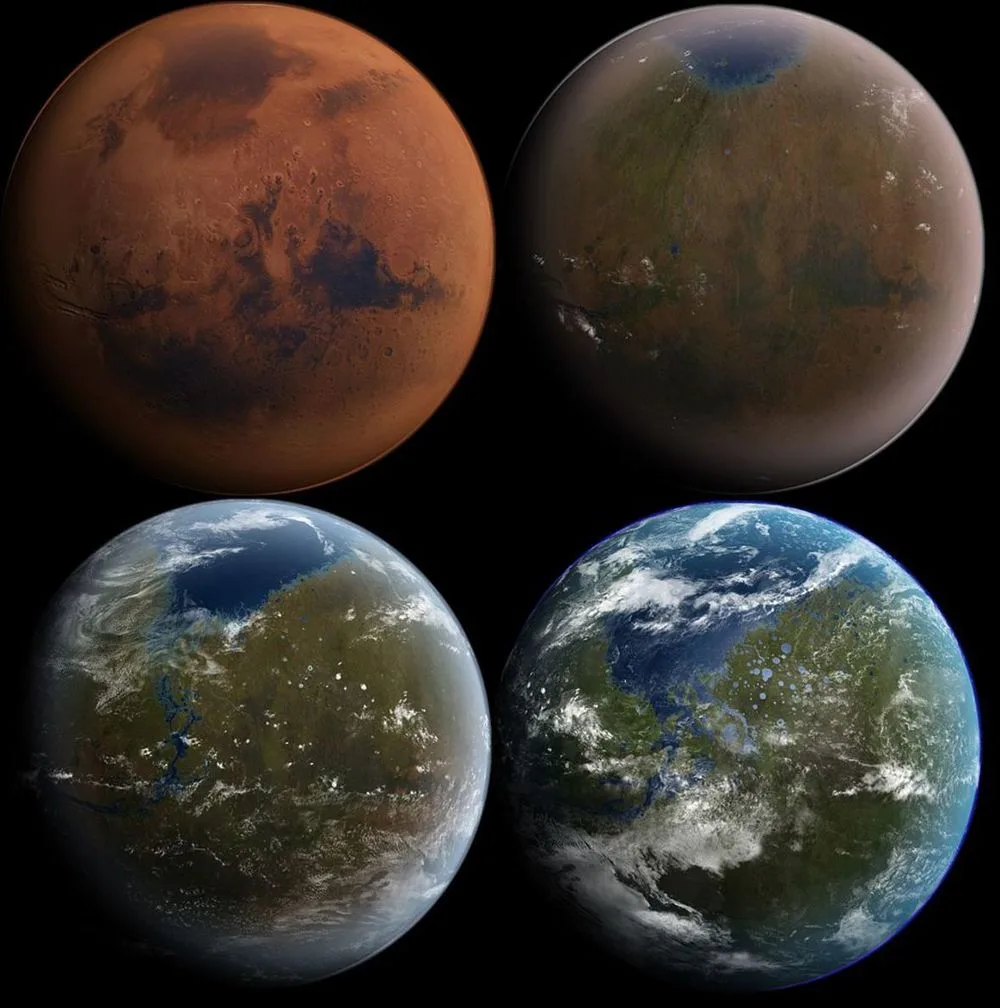
Bad News for Terraforming: Mars’ Atmosphere Is Lost in Space.
The Slow Leak That Changed a Planet
The most important correction is this: Mars did not lose its atmosphere and water in one quick collapse.
Popular versions of the story sometimes make it sound like the magnetic field vanished, then the atmosphere and oceans disappeared almost immediately. That is misleading. The real process took far longer.
In geology, “brief” can still mean hundreds of millions of years. To humans, that timescale is almost impossible to imagine. For Mars, it was long enough to reshape the planet.
Mars magnetic field loss was a turning point, not a single switch. It made atmospheric escape easier. It allowed the solar wind to interact more strongly with the upper atmosphere. But it worked together with other forces.
Mars also has weaker gravity than Earth. That makes it easier for gas molecules to escape into space. The planet also lost heat, changed chemically, and moved into a colder climate state. Surface water became less stable as pressure dropped.
So the better story is not “Mars lost its shield and instantly became a desert.” The better story is this: Mars lost a major layer of protection, then slow planetary change took over.
That makes the story more powerful, not less. It shows how small effects can become world-changing when they continue for deep time.
Where Did Mars’s Water Go?
Mars once had water on its surface. Orbiters and rovers have found ancient river valleys, lake beds, deltas, and minerals that formed in the presence of water. These clues point to a very different Mars in the distant past.
But the missing water story is more complex than simple escape into space.
Some water was likely broken apart by sunlight in the upper atmosphere. Hydrogen could then escape into space more easily. This process helped remove part of Mars’s water inventory over time.
Yet not all Martian water vanished upward. NASA-funded research has shown that a large amount of ancient Martian water may be locked inside minerals in the crust. In this process, water reacts with rock and becomes part of hydrated minerals. Instead of escaping, it becomes stored underground.
That changes how we should think about ancient Mars. The planet did not simply dry out through one pathway. Its water had several fates. Some escaped to space. Some froze. Some moved underground. Some became trapped in minerals.
Carbon dioxide also followed a complex path. Some of it likely escaped. Some may have become stored in rocks. These processes helped thin the atmosphere and weaken the planet’s greenhouse effect.
As the atmosphere thinned, liquid water became harder to keep on the surface. Lower pressure makes surface water unstable. A colder climate also increases ice and frost. Over time, the wet chapter of Mars faded.
From a Wetter World to a Frozen Desert
Early Mars may have had conditions that could support habitable environments. That does not mean life existed there. It means some places may have had the right ingredients for life as we understand it.
Rovers have found ancient environments that once had water, energy sources, and chemistry of interest. Curiosity explored ancient lake deposits in Gale Crater. Perseverance studies Jezero Crater, where an ancient river delta once formed. These places help scientists read the planet’s lost environmental history.
Mars’s changing atmosphere sits at the center of that story. A thicker atmosphere could have supported warmer conditions and more stable surface water. As the atmosphere became thinner, Mars lost much of that ability.
The planet also became more exposed to radiation at the surface. Without a global magnetic field and thick atmosphere, the surface environment became harsher. That made long-term surface habitability much more difficult.
Still, Mars remains scientifically rich. Its rocks preserve clues from a time when the planet looked very different. Ancient sediments, minerals, and magnetic signatures all help reconstruct that lost world.
The Red Planet is not just a cold desert. It is a record of planetary change.
Why Mars Magnetic Field Loss Matters Beyond Mars
Mars is one of the best natural laboratories for studying habitability. It is close enough for spacecraft to explore in detail. It also preserves evidence of a major planetary transformation.
That makes Mars valuable for exoplanet science. When astronomers study rocky planets around other stars, they often focus on the habitable zone. That is the region where liquid water could exist on a planet’s surface under the right conditions.
But Mars reminds us that location is not enough.
A planet also needs to hold onto its atmosphere. It may need enough gravity, enough internal heat, and enough protection from its star. It may also need geological systems that help regulate climate over long periods.
A magnetic field is not the only factor. Venus has no Earth-like global magnetic field, yet it has a dense atmosphere. Mars shows a different outcome because its size, gravity, chemistry, and solar exposure all worked together.
That is why Mars magnetic field loss should be seen as one major part of a larger system. It helped expose the atmosphere. It likely accelerated atmospheric escape. But it did not act alone.
For future studies of distant worlds, this lesson matters. A rocky planet can look promising at first. Yet if it cannot keep its air, surface habitability may fade.
What Scientists Still Need to Learn
Many questions remain open.
Scientists still study exactly when the Martian dynamo faded. They also study how fast the atmosphere changed after that point. The timing matters because it affects how long Mars may have had stable habitable environments.
Researchers also want to know how much water escaped to space and how much remains trapped in the crust. This question connects directly to Mars’s climate history. It also affects the search for ancient life.
Future sample studies could help. Martian rocks returned to Earth would allow scientists to examine minerals, chemistry, and possible ancient environmental records in far greater detail. Laboratory tools on Earth can do work that spacecraft instruments cannot fully match.
Orbiters and rovers will also continue to help. They can map minerals, study surface features, analyze ancient sediments, and track the planet’s atmosphere.
The magnetic shield is gone. But the evidence it left behind still shapes the search.
Conclusion: Mars Magnetic Field Loss Still Shapes the Search for Life
Mars magnetic field loss was one of the great turning points in the Red Planet’s history. It marked the fading of a planetary shield that may once have helped protect a thicker atmosphere from the Sun.
After that shield disappeared, the solar wind had a stronger path to the upper atmosphere. Over deep time, Mars lost much of its air. Surface water became harder to sustain. The planet cooled, dried, and became the cold desert we see today.
Still, this was not a sudden disaster. It was a slow transformation driven by several forces. Magnetic field loss, weak gravity, atmospheric escape, crustal chemistry, and climate change all played a role.
That is why Mars matters so much. It shows how habitability can rise, weaken, and leave evidence behind. It also reminds scientists that the search for life beyond Earth must look beyond water alone.
A planet needs the right place, the right atmosphere, and the ability to keep both for long enough.
Mars lost that balance. Its rocks now hold the story.
Main Sources:
NASA — NASA Mission Reveals Speed of Solar Wind Stripping Martian Atmosphere
https://www.nasa.gov/news-release/nasa-mission-reveals-speed-of-solar-wind-stripping-martian-atmosphere/
NASA — MAVEN Reveals Most of Mars’ Atmosphere Was Lost to Space
https://www.nasa.gov/news-release/nasas-maven-reveals-most-of-mars-atmosphere-was-lost-to-space/
NASA JPL — New Study Challenges Long-Held Theory of Fate of Mars’ Water
https://www.jpl.nasa.gov/news/new-study-challenges-long-held-theory-of-fate-of-mars-water/
NASA Goddard — Mars Global Surveyor Magnetic Field Investigation
https://mgs-mager.gsfc.nasa.gov/
NASA JPL — Magnetic Stripes Preserve Record of Ancient Mars
https://www.jpl.nasa.gov/news/magnetic-stripes-preserve-record-of-ancient-mars/
NASA — MAVEN Observes the Disappearing Solar Wind
https://www.nasa.gov/missions/maven/nasas-maven-observes-the-disappearing-solar-wind/