BY:SpaceEyeNews.
🚀 Mars Nickel Discovery Perseverance Uncovers a Hidden Chemical Story
The Mars nickel discovery Perseverance has revealed something unexpected beneath the surface of ancient Martian rocks. Deep within formations shaped billions of years ago, NASA’s Perseverance rover detected unusually high concentrations of nickel—an element rarely found in such abundance on planetary surfaces.
These الصخور formed roughly three billion years ago, when water still moved across Mars. The discovery comes from Jezero Crater, a region long believed to have hosted a vast lake system. What scientists are now seeing is not just evidence of water, but signs of a far more chemically complex environment than previously understood.
This finding does not confirm past life. However, it strengthens the case that early Mars may have offered conditions where life could have emerged.
🧪 Mars Nickel Discovery Perseverance Data Breakdown
📍 Ancient Rocks from Neretva Vallis
The Mars nickel discovery Perseverance centers on a key location inside Jezero Crater. The rover explored Neretva Vallis, an ancient river inlet filled with sediment layers that have remained preserved for billions of years.
These layered rocks act as a geological archive. They record the environmental conditions of early Mars with remarkable clarity. Scientists targeted this region because it once supported flowing water, making it ideal for preserving chemical signatures.
🔬 What the Instruments Revealed
Using a combination of laser spectroscopy, infrared sensing, and X-ray analysis, Perseverance examined 126 rock samples. Nickel appeared in 32 of them. Some concentrations reached as high as 1.1% by weight, marking the highest level ever measured in Martian bedrock.
This result stands out immediately. Under normal conditions, nickel migrates into a planet’s core during its formation. Its presence near the surface suggests that these rocks experienced unusual processes after they formed.
⚗️ A Signal of Chemical Complexity
The Mars nickel discovery Perseverance points to a history of chemical transformation. Water likely interacted with minerals over long periods, redistributing elements and altering the الصخور.
Such processes require time, stability, and the right environmental conditions. In other words, Mars once hosted dynamic systems capable of reshaping its surface chemistry in ways that still surprise scientists today.
🌍 Mars Nickel Discovery Perseverance and Earth-Like Patterns
🧱 Familiar Mineral Signatures
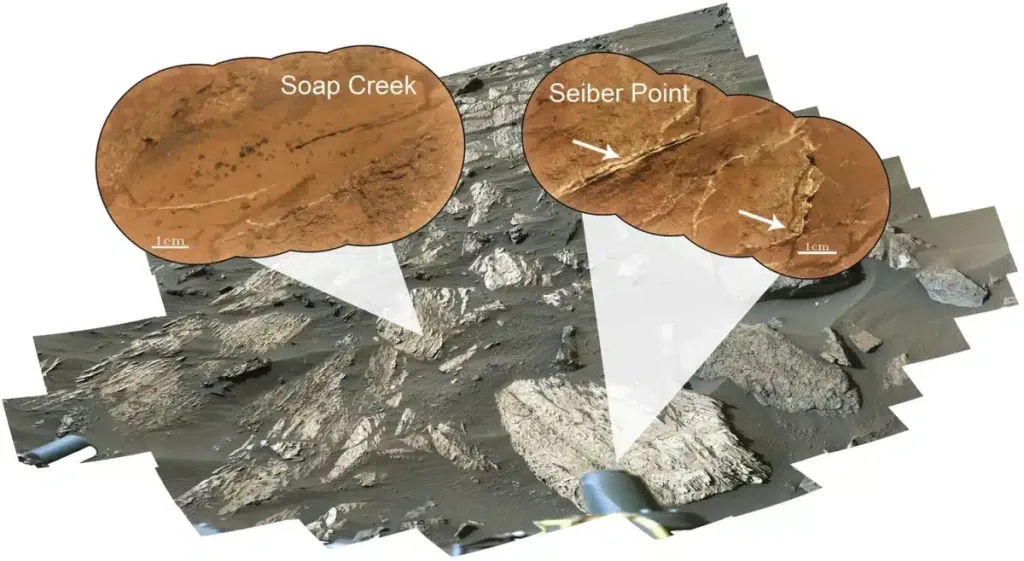
Beyond nickel, the analyzed rocks contain iron sulfides and sulfate minerals such as jarosite and akaganeite. These minerals appear together in patterns that look strikingly familiar.
On Earth, similar formations develop in environments where oxygen levels remain low. These conditions often exist in ancient sedimentary systems shaped by water and chemical reactions.
🧬 Echoes of Microbial Environments
The Mars nickel discovery Perseverance becomes even more compelling when compared to terrestrial analogues. On Earth, iron sulfide-rich environments are frequently linked to microbial activity. Microorganisms interact with iron and sulfur, leaving behind mineral signatures that persist for billions of years.
At the same time, scientists remain cautious. These patterns do not require life to form. Chemical processes alone can produce similar results under the right conditions.
Still, the resemblance matters. It suggests that early Mars shared environmental characteristics with early Earth, at least on a chemical level.
🌊 Water, Minerals, and Organic Signals
Water remains central to this discovery. The rocks formed in a setting where liquid water once flowed and interacted with minerals over extended periods.
In addition, the same region contains organic carbon compounds. These compounds do not confirm biology, but they add another layer of complexity to the environment.
Taken together, the evidence points to a chemically active system. Mars was not always the cold and inactive world seen today.
🧬 Mars Nickel Discovery Perseverance and Habitability Clues
⚠️ Conditions Without Confirmation
The Mars nickel discovery Perseverance does not provide proof of life. Instead, it highlights conditions that could support microbial existence.
Three critical elements appear together:
- Evidence of past water
- Presence of organic compounds
- Availability of reactive metals like nickel
This combination reflects environments where life thrives on Earth. It also raises new questions about what may have been possible on ancient Mars.
🔋 The Role of Nickel in Biology
Nickel is not just another element. On Earth, it plays a role in biological systems, especially in microbial metabolism. Certain enzymes depend on nickel to function.
If similar processes ever occurred on Mars, the presence of accessible nickel would have been significant. The discovery suggests that this element existed in forms that could interact with surrounding chemistry.
❓ An Unresolved Origin
Despite the progress, the source of the nickel remains uncertain. Scientists propose two main possibilities. It may have originated from volcanic الصخور that broke down over time. Alternatively, it could have arrived through a nickel-rich meteorite.
Both explanations remain plausible. Further analysis will be needed to determine which process played the dominant role.
🚀 Mars Nickel Discovery Perseverance and Future Exploration
🛰️ From Water to Chemistry
The Mars nickel discovery Perseverance reflects a broader shift in Mars exploration. Early missions focused on confirming the presence of water. Today, the focus has moved toward understanding the chemistry that existed within that water.
This shift marks a more precise phase of exploration. Scientists now aim to identify environments where chemical conditions align with potential habitability.
📦 High-Value Targets for Sample Return
The discovery also increases the importance of future sample return missions. Rocks collected from Jezero Crater may hold critical information when studied on Earth.
Advanced laboratories can analyze these samples in far greater detail. They can detect subtle chemical patterns that remain beyond the reach of rover-based instruments.
As a result, nickel-rich الصخور identified by Perseverance are likely to become priority targets.
🔭 Refining the Search for Life
Each new finding narrows the search. The Mars nickel discovery Perseverance directs attention toward environments shaped by water, mineral interaction, and organic chemistry.
Instead of searching broadly, scientists now focus on specific conditions that increase the chances of meaningful discoveries. This approach improves the efficiency of future missions and deepens our understanding of Mars.
🧠 A New Piece in the Mars Puzzle
The Mars nickel discovery Perseverance adds a significant piece to the puzzle of Mars’ history. It reveals a planet that once supported complex chemical systems, with conditions that resemble early Earth in key ways.
At the same time, major questions remain. The origin of the nickel is still unresolved. The full extent of chemical interactions is not yet clear.
What makes this discovery powerful is not just what it shows—but what it suggests. Mars continues to reveal a past that is richer and more complex than expected.
So here’s the real question: are we getting closer to finding signs of past life, or simply uncovering how Earth-like Mars once was?
🔗 Sources:
- https://dailygalaxy.com/2026/04/rover-found-mars-rocks-contain-something/
- https://www.nature.com/articles (Nature Communications – referenced study)
- https://mars.nasa.gov/mars2020/ (NASA Perseverance Mission)