BY:SpaceEyeNews.
Mars Sample Return Canceled — A Turning Point in Space Exploration
The phrase Mars Sample Return canceled now defines one of the most significant shifts in modern space exploration.
For decades, **NASA pursued a bold vision: bringing Martian rock and soil back to Earth for detailed study. That vision has now come to an abrupt end.
This decision reshapes the global space race. It raises urgent questions about long-term exploration goals and the limits of large-scale missions. At the same time, it creates a rare opening for China National Space Administration to move ahead.
Scientists long viewed sample return as the most direct path to answering one of humanity’s biggest questions: did life ever exist on Mars? With that path now uncertain, the stakes have shifted—and the world is paying attention.
Mars Sample Return Canceled — A Mission Decades in the Making Ends
For years, NASA worked toward a complex but groundbreaking objective. The mission aimed to retrieve samples already collected by the Perseverance rover and deliver them safely to Earth.
Executing that plan required a chain of tightly coordinated missions. A lander would touch down on Mars. A small rocket would launch the samples into orbit. Another spacecraft would capture them and return them home. Every step demanded precision, timing, and new technology.
Why Returning Samples Matters More Than Any Rover Mission
Rovers can analyze rocks on the surface. However, Earth-based laboratories offer far greater precision. Scientists can run advanced tests that are impossible to perform remotely.
These samples could reveal chemical traces of ancient life. They could also unlock details about Mars’ climate and geological history. For many researchers, this mission represented the gold standard of planetary science.
Despite that importance, mounting challenges brought progress to a halt. Costs rose sharply. Timelines stretched. Eventually, Mars Sample Return canceled became unavoidable.
Why NASA Pulled the Plug on Mars Sample Return
The cancellation reflects a combination of financial and technical pressures. Costs climbed beyond $10 billion, placing the mission among the most expensive scientific efforts ever planned.
At the same time, the engineering demands remained extreme. The mission required launching a rocket from Mars and completing orbital docking without human control. Each step carried significant risk.
Delays added further strain. As timelines slipped, confidence in the program weakened.
Congress Steps In — Funding Cut Changes Everything
The turning point came when lawmakers withdrew support. Without funding, development could not continue.
Budget priorities shifted toward other programs. As a result, NASA had no viable path forward. The phrase Mars Sample Return canceled quickly moved from possibility to reality.
This outcome sends a clear message. Even the most ambitious missions must align with financial and political realities.
Scientific Fallout After Mars Sample Return Canceled
The response from the scientific community has been direct and deeply concerned. Many researchers see this decision as a major setback.
Years of planning and collaboration now face uncertainty. Momentum in Mars exploration has slowed. For some scientists, the cancellation represents a missed opportunity that may take years to recover.
What This Means for Future Mars and Moon Missions
The implications go beyond a single mission. If a robotic sample return proves too complex, larger goals come into question.
NASA continues to plan future crewed missions to Mars. However, this development highlights the scale of the challenge. It suggests that future programs will require new approaches, stronger coordination, and sustained support.
Even so, interest in Mars remains strong. Data continues to flow from ongoing missions. Yet without physical samples, a critical piece of the puzzle is missing.
China’s Tianwen-3 After Mars Sample Return Canceled
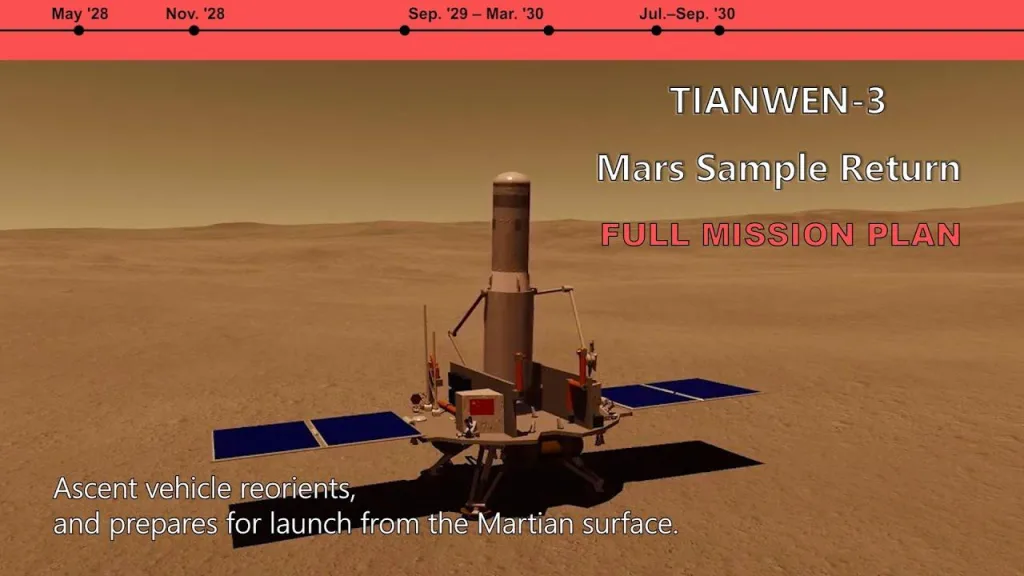
While NASA recalibrates, China is accelerating its plans. The Tianwen-3 mission aims to return Martian samples by around 2031.
That timeline could place China ahead in one of the most important scientific races of this era.
China’s recent achievements reinforce this possibility. From lunar exploration to Mars operations, its space program has steadily expanded its capabilities.
What Happens If China Returns Mars Samples First?
If China succeeds, the impact will be profound. It would become the first nation to bring material from Mars to Earth.
Such an achievement carries both scientific and symbolic weight. It would reshape perceptions of leadership in space exploration.
More importantly, it could define who leads the search for evidence of life beyond Earth.
The Bigger Picture After Mars Sample Return Canceled
The phrase Mars Sample Return canceled reflects a broader shift in space exploration. Ambitious missions now face tighter constraints and higher expectations.
Space agencies must balance innovation with affordability. At the same time, global competition continues to intensify.
Can Mega Missions Survive Rising Costs?
Large-scale missions demand long-term investment. When costs rise too quickly, support becomes difficult to maintain.
This reality may push agencies toward new strategies. Smaller, modular missions could become more common. International partnerships may also play a larger role.
As a result, the future of exploration may look very different from past decades.
What Comes Next for NASA After Mars Sample Return Canceled
NASA now faces a critical moment. The agency must redefine its path while maintaining its role as a global leader in space exploration.
Several options remain on the table. A simplified version of the mission could emerge in the future. Alternatively, NASA may focus more heavily on lunar programs before returning to Mars.
Is This a Pause or a Long-Term Shift?
Some experts view this decision as temporary. Others see it as a deeper strategic shift.
The outcome will depend on funding, technology, and long-term priorities. If conditions change, the mission concept could return in a new form.
For now, the focus is on adapting to a changing landscape.
Conclusion — Mars Sample Return Canceled Changes the Race
The announcement that Mars Sample Return canceled marks a defining moment in the story of space exploration.
It highlights the limits of even the most advanced programs. It also shifts momentum toward new players and new opportunities.
As China advances its plans, the balance of leadership may evolve. The race to uncover signs of life on Mars continues—but the path forward has changed.
The question now is simple, yet profound:
If the first evidence of life on Mars is discovered, who will be the one to reveal it?
Sources:
- https://dailygalaxy.com/2026/04/nasa-pulls-plug-on-mars-mission/
- https://www.livescience.com/space/mars-sample-return
- https://www.space.com/nasa-mars-sample-return-program-status
- https://www.nasa.gov/