
BY:SpaceEyeNews.
Mercury’s volcanic history may have begun much deeper inside the planet than scientists once believed. A new study estimates that silicon dioxide makes up only about 37% of its surface material by mass. That figure is up to 25% lower than previous estimates. The finding suggests that Mercury’s ancient volcanic rocks came from mantle material that melted at greater depths and higher temperatures. Yet researchers have not sampled the planet directly. Instead, they built a new way to read its chemistry from infrared light. The result offers a fresh view of how Mercury formed its crust and then became largely inactive.
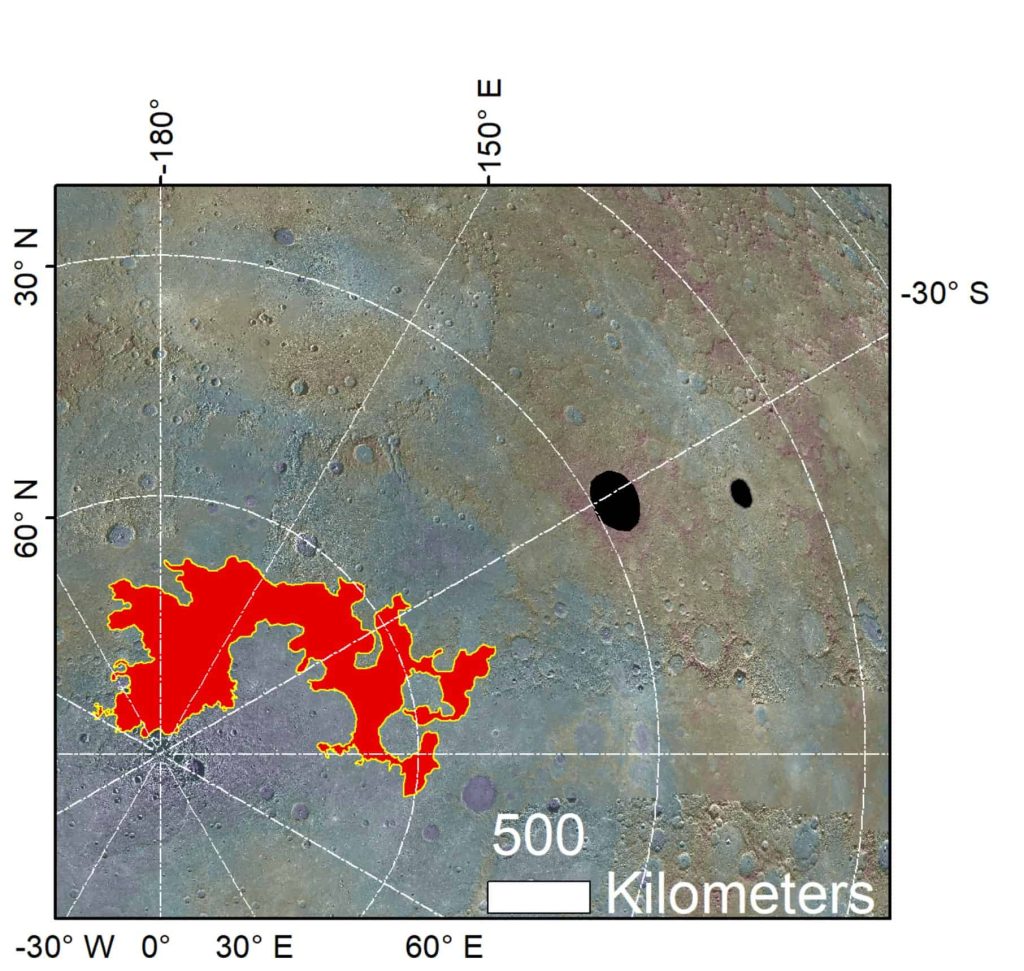
A view of Mercury’s north polar chaotic terrain (Borealis Chaos) and the Raditladi and Eminescu craters where evidence of possible glaciers has been identified. Credit: NASA.
Mercury’s Volcanic History Starts With a 37% Surprise
Silicon dioxide, or silica, can record how magma formed, cooled, and changed before reaching a planet’s surface. Earlier models placed Mercury’s silica abundance higher. The new study calculates a surface average of about 37% by mass.
The Max Planck Institute for Solar System Research led the study with the universities of Münster and Göttingen. Planetary Research published it on August 27, 2026.
This revision affects the type of melting that could have produced Mercury’s extensive volcanic terrain. A silica-poor surface points toward a young planet with a hotter interior and a different chemical path.
However, the estimate describes surface material observed remotely. It does not prove that Mercury’s entire crust has the same composition. Local regions may differ, and future orbital maps should reveal those variations.
Low Silica Points to Deeper Mantle Melting
As a molten mantle solidifies, early-forming minerals take comparatively little silica from the remaining liquid. Silica therefore becomes more concentrated in the melt over time.
Mercury’s low surface value suggests a different route. Its ancient volcanic rocks may have come from mantle material that melted more completely and at greater depths. Those conditions require higher temperatures. In this interpretation, Mercury’s visible surface preserves evidence of an unexpectedly hot early interior.
Lead author Christian Renggli said the rocks formed from “more deeply melted mantle material than previously assumed.” Surface chemistry may therefore preserve processes from billions of years ago.
Another Explanation Remains Possible
The researchers also identify another scenario. Mercury may once have contained more silicon dioxide but gradually lost oxygen, leaving less silicon bound as silica.
For now, deeper melting provides an important interpretation, not a direct view beneath the crust. Both explanations depend on Mercury’s unusual chemical environment. Better mineral maps will help scientists test which process best matches the planet’s different regions.
Glass Beads Revealed Mercury’s Surface Chemistry
No spacecraft has landed on Mercury or returned its rocks to Earth. Researchers must interpret infrared light collected by telescopes and spacecraft instead.
To improve that interpretation, the team created glass beads about half a millimetre wide. Each bead contained a precisely controlled amount of silicon dioxide. The researchers then measured its infrared properties in the laboratory.
Iris Weber of the University of Münster compared the beads with calibration weights. Their known compositions connect changes in the infrared signal with silica content. Scientists can then estimate an unknown surface composition from afar.
The method offers an independent way to constrain silica. Earlier estimates relied heavily on elemental ratios and assumptions about how those elements combined.
The Moon Provided a Crucial Reality Check
Before studying Mercury, the team tested its method on the Moon. This step mattered because scientists possess both detailed lunar observations and real samples from known locations.
NASA’s Lunar Reconnaissance Orbiter has mapped thermal infrared radiation across the Moon. The Apollo, Luna, and Chang’e programs also returned lunar samples. The team created a global silica map and compared its calculated values with those samples.
The results reproduced major lunar chemical differences. This agreement gave the team confidence to apply its calibration to Mercury observations, including Bok Telescope data from Arizona.
The lunar test strengthens the result, but it cannot remove every uncertainty. Remote observations cover much larger areas than individual samples. Regional variation can also affect the estimate. The 37% figure should guide further exploration rather than end the debate.
BepiColombo Will Test Mercury’s Volcanic History
The strongest test may come from BepiColombo, the joint ESA–JAXA mission. ESA schedules orbital arrival for November 21, 2026. Routine science operations should begin in April 2027.
ESA’s Mercury Planetary Orbiter carries MERTIS, a thermal infrared spectrometer. It will map surface minerals, temperatures, and thermal properties. DLR operates it with partners that include the University of Münster.
During a December 2024 flyby, MERTIS collected more than 1.4 million spectra from over 37,000 kilometres away. Orbital operations will deliver sharper and more complete measurements.
What the New Maps Could Reveal
Higher-resolution data could show whether the low silica estimate applies across Mercury or only to regions visible from Earth. Differences between terrains may reveal several stages of melting and crust formation.
That comparison could show whether Mercury produced its crust in one dominant episode or through several chemically distinct phases.
The maps could test whether deep mantle melting alone explains Mercury’s chemistry. Variations in silica and other minerals may also expose the effects of oxygen loss.
Why Mercury’s Volcanic History Matters
Mercury became largely geologically inactive much earlier than Earth. Its volcanic activity likely ended about one billion years after the planet formed. That early shutdown allowed its surface to preserve a record from the Solar System’s distant past.
The new estimate suggests that this record began with deeper and hotter melting than expected. It also shows how laboratory experiments can unlock older observations.
Mercury’s volcanic history now has a testable new chapter. Its surface appears to carry the chemical signature of an intensely heated young interior, although oxygen loss remains possible. BepiColombo can determine how widely that signature appears and how it changes across the planet. Those results may refine not only Mercury’s story, but also our understanding of how small rocky worlds cool and evolve.
Main Sources:
Daily Galaxy — Scientists Uncover a Surprising Secret Beneath Mercury’s Ancient Crust
Max Planck Institute — Mercury’s Crust Formed by Extreme Volcanism
Original Study — The SiO₂ Abundance on the Surfaces of the Moon and Mercury
European Space Agency — BepiColombo Factsheet
German Aerospace Center — BepiColombo: Exploring the Planet Mercury