BY:SpaceEyeNews.
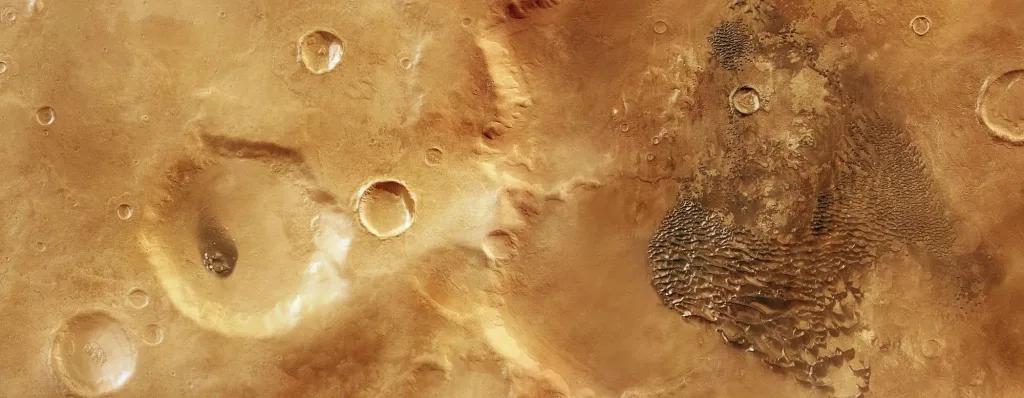
The metallic dunes on Mars look like enormous waves of polished chrome frozen across an ancient crater. However, these striking formations contain no exposed metal. They are giant dunes made from dark volcanic sand, with bright seasonal frost covering parts of their slopes.
The European Space Agency’s Mars Express orbiter captured the latest view of the dunes inside Kaiser Crater. ESA released the image on July 15, 2026. The spacecraft collected the original data on October 5, 2025, using its High Resolution Stereo Camera.
Beyond their science-fiction appearance, these dunes offer valuable evidence about Martian winds, seasonal frost, sand movement, and the planet’s changing surface.
What Makes the Metallic Dunes on Mars Shine?
At first glance, the formations appear almost silver. Some ridges resemble liquid metal that suddenly hardened across the crater floor. Yet their unusual appearance comes from a sharp contrast between dark sand and bright frost.
ESA explains that frost deposits cover the south-facing slopes of many dunes. These brighter surfaces reflect sunlight. Meanwhile, the darker sand absorbs more light. Together, the contrasting materials create the shiny effect seen from orbit.
Lighting also changes how the ridges appear. Shadows emphasize the dune crests, while illuminated frost highlights their curved surfaces. The result is a landscape that looks metallic, even though it consists mainly of sand and ice.
NASA has previously observed seasonal carbon dioxide frost across Kaiser Crater’s dunes. Some images also show water ice mixed with carbon dioxide ice. During warmer periods, this frost changes directly from solid ice into gas through a process called sublimation.
As the frost disappears, dark sand becomes visible again. This seasonal cycle can create streaks, flows, and changing patterns across the dune slopes.
Dark Volcanic Sand Changes Mars’ Familiar Color
The sand beneath the frost also contributes to the dunes’ unusual appearance. Much of Mars looks rusty because fine dust containing iron oxides covers large areas of its surface.
Kaiser Crater’s dunes look different. NASA identifies the material as basaltic sand produced through the erosion of volcanic rocks. Basalt often contains dark minerals, including pyroxene and olivine.
As a result, the dune field can appear dark brown, black, or blue in enhanced-color spacecraft images. These colors contrast sharply with the brighter crater floor and surrounding reddish terrain.
Mars Express therefore reveals a more varied world than the familiar image of a uniform red desert. Volcanic minerals, dust, frost, rock, and changing sunlight can produce dramatically different landscapes across the planet.
The source of all the basaltic sand remains uncertain. Researchers know that larger rocks must have eroded into smaller particles. However, they have not fully determined where that erosion occurred or how such large amounts of sand reached the crater.
Martian Winds Built Towering Dunes
The metallic dunes on Mars are not small ripples. ESA reports that some rise more than 100 meters above the surrounding ground. Individual formations stretch across large areas, while connected ridges form fields several kilometers wide.
Martian winds gradually created these structures by moving sand across the crater floor. Wind pushes grains up a dune’s gentler side. The particles then fall over the crest and slide down the steeper slope.
Repeated movement slowly shifts the entire dune. NASA observations show that dunes inside Kaiser Crater continue to move, confirming that the landscape remains active today.
The field includes different dune shapes. Curved barchan dunes usually form where sand supplies are limited and winds tend to blow from one main direction. Longer transverse ridges develop when more sand is available across a wider area.
Together, these forms help researchers reconstruct local wind behavior. Their shape, alignment, and direction of movement act as records of atmospheric activity.
NASA imagery indicates that some Kaiser Crater dunes are migrating westward. Even within Mars’ thin atmosphere, winds can move loose grains and reshape major surface features over long periods.
Kaiser Crater Acts as a Natural Sand Trap
Kaiser Crater lies in Noachis Terra, one of the oldest regions on Mars. It sits west of the enormous Hellas Planitia impact basin in the planet’s southern hemisphere.
NASA measures Kaiser Crater at about 207 kilometers, or 129 miles, across. ESA has used a slightly smaller estimate based on the boundary shown in its mapping. Therefore, describing the basin as roughly 200 kilometers wide provides a practical comparison.
The crater’s deep depression plays an important role in creating the dune field. Sand transported into the basin becomes trapped by its surrounding walls. Much of the material cannot easily escape.
However, the crater floor remains visible between many dunes. That suggests there is not enough sand to form one continuous blanket across the entire basin.
Instead, local winds gather the available particles into separate dunes and larger clusters. Over time, the crater has become a natural laboratory where researchers can study the interaction between topography, sand supply, frost, and atmospheric movement.
Seasonal Frost Continues to Reshape the Dunes
Wind is not the only process changing Kaiser Crater. Seasonal frost can also alter the dunes, especially during late winter and spring.
NASA’s Mars Reconnaissance Orbiter has documented gullies forming along steep dune faces. When sunlight warms carbon dioxide frost, the ice changes into gas. This activity can loosen surface material and send dark sand sliding down the slopes.
Some flows travel around small ripples rather than crossing them directly. That behavior shows how even minor surface features can redirect moving sand.
These seasonal changes do not mean liquid water currently flows across the dunes. Carbon dioxide sublimation provides a strong explanation for many of the observed streaks and gullies.
Still, the crater preserves older geological clues as well. ESA has identified lighter clay-bearing material in the region. Such minerals often form through interaction between rock and water.
Channels and gullies along the crater walls may also record several different processes. Many likely resulted from dry landslides. Others may relate to ancient ice or buried groundwater. Scientists must study each feature carefully before linking it to past liquid water.
Metallic Dunes on Mars Reveal an Active World
The metallic dunes on Mars are more than a visually dramatic discovery. Their dark volcanic sand records erosion and transport. Their shapes reveal wind direction. Seasonal frost creates new patterns, while sublimation moves material down steep slopes.
Kaiser Crater also preserves evidence from different chapters of Martian history. Ancient rocks point toward past geological activity, while migrating dunes show that change continues today.
Mars Express has studied the planet since arriving in December 2003. More than two decades later, its images continue to reveal unexpected details across the Martian surface.
What looks like frozen metal is actually a complex interaction between volcanic minerals, sunlight, frost, wind, and time. The scene offers a clear reminder that Mars is not a motionless red desert. It remains a dynamic planet whose surface continues to evolve.
Main Sources:
European Space Agency — Metallic Waves on Ancient Mars
https://www.esa.int/Science_Exploration/Space_Science/Mars_Express/Metallic_waves_on_ancient_Mars
European Space Agency — Mars Express Spies Metallic Waves in Mars’ Ancient Highlands
https://www.esa.int/ESA_Multimedia/Images/2026/07/Mars_Express_spies_metallic_waves_in_Mars_s_ancient_highlands
NASA Jet Propulsion Laboratory — Kaiser Crater Dunes
https://www.jpl.nasa.gov/images/pia25802-kaiser-crater-dunes/
NASA Jet Propulsion Laboratory — Southern Spring on Kaiser Crater Dunes
https://www.jpl.nasa.gov/images/pia25181-southern-spring-on-kaiser-crater-dunes/
NASA Jet Propulsion Laboratory — Defrosting Dunes in Kaiser Crater
https://www.jpl.nasa.gov/images/pia25188-defrosting-dunes-in-kaiser-crater/
NASA Jet Propulsion Laboratory — Glowing Gullies in Kaiser Crater Dunes
https://www.jpl.nasa.gov/images/pia20736-glowing-gullies-in-kaiser-crater-dunes/