BY:SpaceEyeNews.
Microscopic black holes remain elusive, but a deeper search at CERN has narrowed where certain theories could hold true. Researchers examined Large Hadron Collider data for unusual particle patterns that might reveal these fleeting objects. They found no convincing signal.
However, the search delivered more than another absence. It strengthened limits on specific theoretical models and demonstrated a promising machine-learning technique. Together, these advances help physicists investigate a stubborn question: could gravity behave very differently at distances far smaller than an atom?
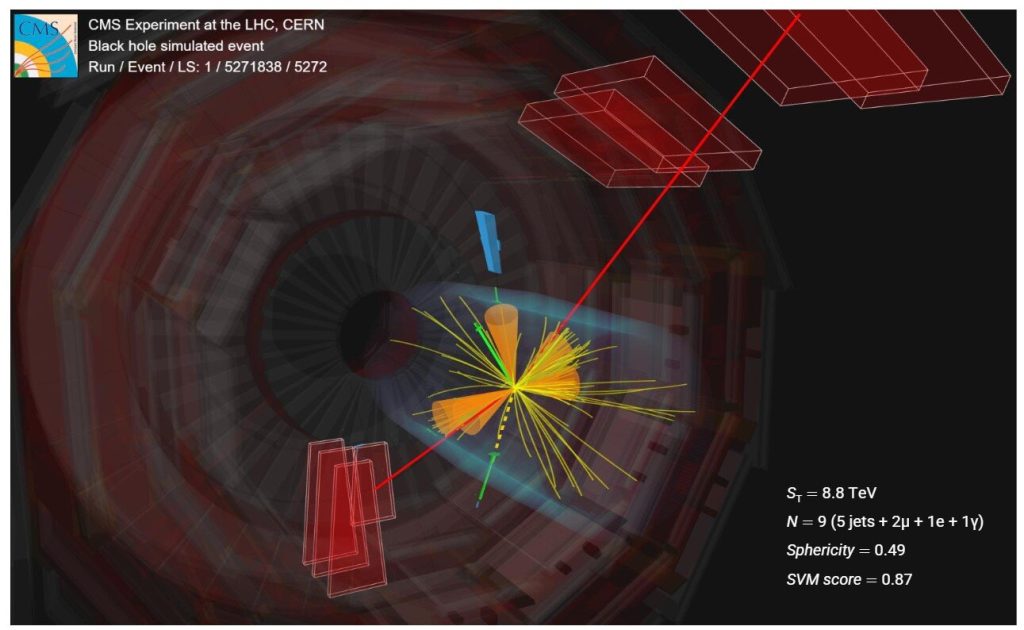
Event display of the final products from a simulated microscopic black hole evapora
Why microscopic black holes matter for hidden dimensions
For physicists, this search offers a possible route toward understanding quantum gravity. The challenge involves reconciling quantum descriptions of nature with gravity, rather than simply finding a smaller version of a familiar object.
Certain theories propose additional spatial dimensions that could change gravity’s behavior at tiny distances. Under those assumptions, the energy needed to form microscopic black holes might fall within the LHC’s reach.
That possibility connects the search to the hierarchy problem: the enormous separation between gravity’s fundamental scale and familiar particle scales. Extra dimensions offer one proposed explanation, but experiments have yet to establish their existence.
UC Santa Barbara researchers Tamas Vami and Danyi Zhang helped pursue this question through the CMS experiment. Their work tests particular predictions, giving theorists evidence about which possibilities remain viable.
Searching collision records for fleeting signatures
The team examined proton collisions that CMS recorded between 2016 and 2018. Those collisions took place at an energy of 13 teraelectronvolts, or TeV.
Rather than watching a tiny black hole directly, researchers searched for its predicted decay products. In the scenarios under study, such an object would disappear almost immediately, leaving numerous energetic particles.
The challenge of similar-looking events
One useful clue involves sphericity: how widely particles spread in different directions. A roughly spherical pattern can help identify events resembling the predicted signal.
Nevertheless, ordinary particle interactions can produce busy, energetic collisions too. A striking detector image alone therefore cannot establish a discovery.
Researchers must compare the observed patterns with the background that established physics predicts. They also examine measures of activity across each event, including the summed transverse momenta of reconstructed objects. These complementary checks help distinguish potentially interesting events from familiar processes.
Machine learning gives the search a sharper view
To improve that separation, the researchers used a method called phase-space distance. In accessible terms, it measures how similar or different two collision events look through their particle properties.
The method works with a machine-learning classifier called a support vector machine. It helps sort events according to whether their patterns resemble a hypothetical signal or the expected background.
Looking beyond sphericity alone
The researchers found that this approach outperformed using sphericity alone in their comparison. Instead of relying on one description of an event’s shape, it captures additional information about its structure.
That improvement matters because rare signals can resemble far more common interactions. Better separation gives scientists a more sensitive way to test their predictions.
The technique could also support searches beyond black holes. However, its value comes from improving the analysis; a classifier score is not evidence of discovery by itself.
What the microscopic black holes limits mean
The final CMS publication reports model-dependent exclusion thresholds ranging from 8.4 to 11.4 TeV for semiclassical black-hole masses. These results carry a 95% confidence level within the tested assumptions. CMS published results
The range does not describe objects that scientists observed. Instead, different models yield different lower mass limits because they predict different production and decay behavior.
Nor should readers confuse those limits with the energy of the proton collisions. One describes hypothetical black-hole masses in particle-physics units; the other describes the incoming collision energy.
Limits on models, not every hidden dimension
The distinction also matters when discussing extra dimensions. These findings constrain combinations of assumptions within specific models. They do not establish the universe’s total number of dimensions or rule out every extra-dimensional theory.
Likewise, the search does not show that all microscopic black holes are impossible. It excludes particular scenarios that would have produced detectable signals in this dataset.
That gives researchers a firmer basis for deciding which predictions deserve further investigation.
The final publication also updates earlier figures discussed in the university announcement. Its results take precedence over the preliminary analysis. This matters when comparing coverage: the rounded description of limits approaching 12 TeV should not become a universal cutoff.
Another target linked to matter’s origins
The analysis also searched for electroweak sphaleron transitions. Sphalerons are unstable configurations of particle fields, rather than a new particle species.
They interest physicists studying the universe’s matter–antimatter imbalance. Understanding such processes could help investigate how the early universe developed its matter content, although this search does not resolve that mystery.
Their predicted signatures can resemble the busy particle patterns associated with microscopic black-hole scenarios. Consequently, related analysis tools can help examine both possibilities.
Researchers found no convincing sphaleron signal either. They instead placed limits on how frequently the tested process could occur.
What future LHC data could change
Larger datasets give researchers more opportunities to identify rare processes. The High-Luminosity LHC upgrade aims to increase collision rates, helping experiments collect much more information. Higher luminosity does not mean a proportionate increase in collision energy. CERN’s LHC overview
Improved analysis methods will help scientists extract value from those additional records. Even so, more data cannot guarantee a discovery.
Future searches will still need reliable background estimates and careful comparisons with theoretical predictions. Their success depends on both the quantity of collisions and how effectively researchers interpret them.
Microscopic black holes remain an open question
The search for microscopic black holes has delivered stronger constraints and a more capable analysis method. Gravity’s deeper relationship with quantum physics remains unresolved. Yet each carefully tested prediction helps researchers decide where to look next, bringing greater precision to questions that experiments still cannot fully answer.
Main sources:
UC Santa Barbara — Physicists extend the search for quantum black holes at the LHC
CMS Collaboration — A search for microscopic black holes, string balls, and sphalerons in proton-proton collisions at 13 TeV
CMS Experiment — Are there quantum black holes that evaporate instantly?
CERN — Large Hadron Collider overview and upgrade information