BY:SpaceEyeNews.
Microscopic black holes remain elusive, but scientists have sharpened the search for these hypothetical objects inside the Large Hadron Collider. A CMS analysis found no convincing signal in its collision data. However, that absence places stronger limits on certain theories about hidden dimensions and gravity. Researchers also tested a new method for separating possible signals from ordinary particle activity. Together, these results offer something valuable: clearer guidance on what future experiments should investigate, and which proposed scenarios already conflict with observations.
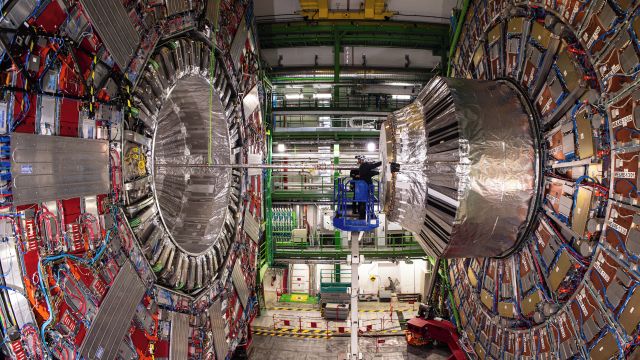
Inside the CMS detector at the LHC. | Credit: CERN.
Why Microscopic Black Holes Still Matter
The attraction lies in a difficult meeting point between gravity and quantum physics. Both frameworks work remarkably well in their established settings. Yet physicists still lack a complete, experimentally confirmed description of how they work together.
Tiny black holes could provide a way to investigate that overlap. Their small size would make quantum effects especially relevant. Detecting their decay products could therefore reveal behavior that existing experiments have never directly explored.
Could Hidden Dimensions Change Gravity?
Some theories propose additional spatial dimensions beyond those we experience. In these models, gravity could spread into the extra dimensions, helping explain its apparent weakness.
At extremely short distances, its influence could become much stronger. Under suitable assumptions, that might allow concentrated collision energy to produce microscopic black holes.
These possibilities remain theoretical. The search tests particular versions of those ideas; it does not assume that hidden dimensions exist.
How CMS Searches for Fleeting Black Holes
Scientists cannot simply photograph an object that would disappear almost immediately. Instead, they examine the particles that a hypothetical black hole would leave behind.
The analysis uses CMS data from proton collisions recorded between 2016 and 2018. Those collisions occurred at an energy of 13 trillion electron volts, or 13 TeV. The dataset totals 138 inverse femtobarns, a measure of accumulated collision data.
Researchers look for events containing numerous energetic particles. In the models under study, the particles can spread broadly through the detector. Their combined energy and arrangement help identify events worth examining.
Separating Possible Signals From Familiar Processes
Known physics also produces energetic particle events. Consequently, an impressive detector image does not establish the presence of a black hole.
The team must compare observations with the background expected from established processes. A convincing discovery would require evidence beyond those expectations. This analysis found no such excess.
That distinction also matters when viewing illustrations. Simulations show what a proposed signal might resemble, without demonstrating that nature actually produces it.
Machine Learning Improves the Search
A major feature of the work is its use of a technique called phase-space distance. This method compares collision events through the properties of their outgoing particles.
Researchers combine those comparisons with a machine-learning tool called a support vector machine. The tool helps separate potential signal patterns from the background of familiar events.
Rather than judging an event through one simple feature, the analysis can consider relationships among multiple particle properties. That gives researchers another way to identify subtle differences between competing explanations.
The university’s account says the method outperformed an approach based on sphericity alone. Sphericity describes how broadly particles spread in different directions.
The benefit extends beyond this particular search. Similar techniques could help researchers investigate other unusual processes with distinctive event patterns. Better discrimination makes existing collision data more useful, even when it produces no discovery.
What the Microscopic Black Holes Results Exclude
The full CMS analysis excludes semiclassical black holes below mass thresholds ranging from 8.4 to 11.4 TeV. The exact threshold depends on the model. Physicists express these mass values using energy units, following the relationship between mass and energy.
These figures differ from the 13 TeV collision energy. One describes constraints on hypothetical objects; the other describes the incoming proton collision system.
Earlier conference material reported a narrower range of 9.0 to 11.4 TeV. For the numerical result, the full CMS analysis provides the more complete reference.
Why the Limits Depend on the Model
Different assumptions predict different production rates and particle patterns. Therefore, one experiment can set several exclusion thresholds rather than a single universal boundary.
CMS reports these exclusions at a 95% confidence level. That does not mean there is a 95% probability that microscopic black holes cannot exist.
Instead, the result constrains specified scenarios under the analysis’s statistical framework. It leaves other masses and theoretical possibilities open.
For example, a model might predict a detectable number of events with particular properties. If the data lack those events, researchers can restrict that combination of assumptions. This process narrows the options without deciding every question about gravity or the structure of spacetime.
Terminology also deserves care. The technical analysis describes semiclassical black hole models, while public coverage often uses “quantum black holes” more broadly. The quoted limits should retain their specific context.
Why the Search Will Continue
Additional data can improve sensitivity to rare processes, provided those processes occur within the collider’s accessible conditions. CMS points to Run 3 data and the future High-Luminosity LHC as opportunities to extend these investigations.
Collecting more collisions differs from increasing the energy of each collision. A larger sample gives researchers more opportunities to observe uncommon events. It does not guarantee that a hypothetical object lies within reach.
Safety assessments also address this research. CERN’s conclusions draw on natural cosmic-ray collisions and the continued existence of astronomical objects. Those observations support the safety of LHC experiments, including hypothetical microscopic black hole scenarios.
Microscopic Black Holes: A More Focused Question
The search for microscopic black holes has produced stronger constraints and a useful analysis method. Its significance comes from testing specific ideas against real observations. Researchers now have a clearer view of which scenarios remain viable. Whether these objects can reveal a connection between gravity and quantum physics remains uncertain. Future searches will refine that question through more data and increasingly sensitive methods.
Main sources:
- CMS Collaboration — Full analysis and results
- CMS Experiment — Are there quantum black holes that evaporate instantly?
- UC Santa Barbara — Physicists extend the search for quantum black holes at the LHC
- Progress in High Energy Physics — Conference paper
- CERN — LHC safety assessment