
BY:SpaceEyeNews.
Astronomers believe the Milky Way may have consumed another galaxy more than 10 billion years ago. Now, scientists say they may have finally uncovered the hidden remnants of that ancient cosmic event. The discovery could reshape how researchers understand the early growth of our galaxy and reveal a missing chapter in the Milky Way’s history.
The newly identified ancient dwarf galaxy has been named “Loki.” Researchers discovered unusual stars that appear to be leftovers from this long-lost galaxy. Their findings suggest the Milky Way grew through far more dramatic mergers than scientists previously realized.
The research also highlights how modern telescopes and stellar mapping projects are transforming astronomy. Scientists can now trace the origins of stars and reconstruct collisions that happened billions of years ago.
Milky Way Ate Another Galaxy Through Ancient Cosmic Mergers
The modern Milky Way looks calm today. Yet its distant past was chaotic. Astronomers believe our galaxy formed by repeatedly merging with smaller dwarf galaxies over billions of years.
The Milky Way spans nearly 100,000 light-years. NASA estimates it contains between 100 billion and 400 billion stars. However, astronomers still debate how large the original Milky Way was before these ancient mergers began.
Researchers now think the Loki galaxy may represent one of the most important missing pieces in that story.
Ancient Stars Revealed the Hidden Evidence
Scientists identified a strange group of stars located unusually close to the Milky Way’s galactic disk. The stars immediately stood out because they contained extremely low amounts of heavy elements.
Astronomers call these objects “metal-poor stars.”
In astronomy, elements heavier than hydrogen and helium are known as metals. Early stars formed before the universe became enriched with heavier elements. Because of this, metal-poor stars often serve as cosmic fossils from the early universe.
The newly discovered stars appear to be older than 10 billion years.
That age surprised researchers because the galactic disk usually contains younger and more metal-rich stars. Ancient stars typically appear in the Milky Way’s outer stellar halo instead.
Gaia Helped Scientists Trace the Stars
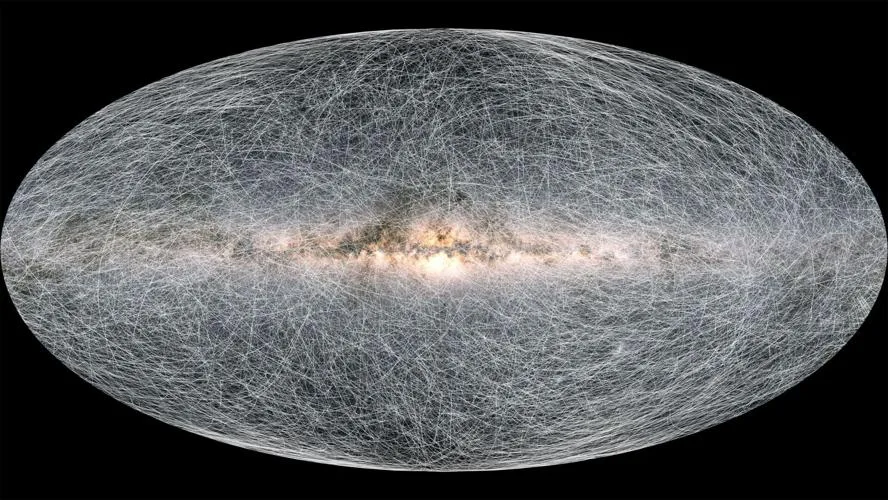
The discovery relied heavily on data from the Gaia spacecraft. The mission mapped the motions and compositions of more than 2 billion stars across the galaxy.
Researchers later used the Canada-France-Hawaii Telescope to examine the stars in greater detail.
Scientists found that all 20 stars shared similar chemical fingerprints. That detail strongly suggests they originated from the same dwarf galaxy before becoming absorbed into the Milky Way.
The stars also sit roughly 7,000 light-years from Earth.
Milky Way Ate Another Galaxy Called Loki
The research team named the lost dwarf galaxy “Loki” after the Norse trickster god. The name reflects the strange behavior of the stars and the difficulty researchers faced while trying to explain their origins.
Some of the stars orbit in the same direction as the galactic disk. Others travel in the opposite direction.
That unusual pattern puzzled astronomers.
Why the Orbital Motion Matters
Normally, stars from a single system tend to move together. The Loki stars do not follow that pattern completely.
Researchers believe the merger happened when the Milky Way was still very young and much smaller than today. At that time, the galaxy’s gravitational forces were weaker.
As the collision unfolded, stars from Loki likely scattered into different orbital paths.
Some stars settled into prograde orbits, moving with the galactic disk. Others ended up in retrograde orbits, traveling against it.
Scientists believe this merger likely happened only 3 to 4 billion years after the Big Bang.
That timing makes the discovery especially important because it could reveal how the Milky Way transitioned from a chaotic young galaxy into the stable spiral structure seen today.
Loki Could Rival Earlier Major Mergers
Astronomers already know the Milky Way experienced at least one major merger event in the distant past. One famous example is the Gaia-Sausage-Enceladus merger, which occurred between 8 billion and 10 billion years ago.
Many researchers believe that collision reshaped the structure of the Milky Way.
Now, scientists think Loki may have been similarly significant.
If future observations confirm the discovery, astronomers may need to revise current models of how the Milky Way formed and evolved.
Some experts also believe Loki’s remnants remained hidden for so long because they are buried deep inside the crowded galactic disk, where younger stars and cosmic dust make observations difficult.
Milky Way Ate Another Galaxy Through Galactic Cannibalism
Astronomers often describe these mergers as “galactic cannibalism.” The process happens when a large galaxy absorbs a smaller one through gravity.
Over time, the larger galaxy pulls stars, gas, and dark matter away from the smaller system.
The Milky Way likely experienced many such mergers during its lifetime.
The Milky Way Is Still Revealing Its Past
Every merger leaves behind clues. Some remnants appear as streams of stars moving together across space. Others remain hidden among billions of stars inside the galactic disk.
The Loki discovery shows that astronomers may still be missing major parts of the Milky Way’s formation history.
That possibility excites many scientists.
Modern stellar surveys now allow astronomers to reconstruct ancient collisions with remarkable precision. By analyzing chemical compositions and stellar motions, researchers can identify stars that once belonged to completely different galaxies.
Why Metal-Poor Stars Matter So Much
Metal-poor stars act like time capsules from the early universe.
These stars formed before generations of exploding stars filled space with heavier elements such as carbon, oxygen, and iron.
Because of this, their chemistry preserves information about conditions shortly after the Big Bang.
Astronomers use these ancient stars to understand how the first galaxies formed and evolved.
The Loki stars may therefore provide insight not only into the Milky Way’s history but also into the broader evolution of galaxies across the universe.
Gaia Is Transforming Galactic Archaeology
The Gaia mission continues to revolutionize astronomy.
By tracking stellar motions across the galaxy, Gaia allows researchers to effectively rewind cosmic history. Scientists can identify groups of stars that share a common origin even after billions of years of movement.
This field is often called “galactic archaeology.”
The approach helps astronomers uncover ancient structures that disappeared long ago.
Without Gaia’s massive star catalog, the Loki discovery may never have happened.
Milky Way Ate Another Galaxy and May Still Hide More Secrets
The idea that the Milky Way ate another galaxy billions of years ago is not entirely new. However, the possible discovery of Loki adds a fascinating new layer to that story.
Scientists may have uncovered the remnants of one of the galaxy’s earliest and most important mergers. The evidence suggests the Milky Way’s formation was more complex than previously believed.
The discovery also demonstrates how modern astronomy is uncovering hidden chapters of cosmic history.
Researchers expect future surveys and larger datasets to test whether Loki truly represents a single lost galaxy or several ancient mergers blended together over time.
Either way, the Milky Way still holds many secrets. Deep inside its billions of stars may lie the forgotten remains of galaxies erased by time long before Earth even existed.
Main Sources
CNN: https://edition.cnn.com/2026/05/23/science/milky-way-loki-galaxy
European Space Agency Gaia Mission: https://www.esa.int/Science_Exploration/Space_Science/Gaia
NASA Milky Way Overview: https://science.nasa.gov/universe/galaxies/milky-way/
Monthly Notices of the Royal Astronomical Society: https://academic.oup.com/mnras