BY:SpaceEyeNews.
🌌 Introduction: A Long-Standing Mystery at the Galactic Center
For more than twenty years, astronomers tracked strange objects circling the heart of our galaxy. These compact gas clouds orbit Sagittarius A* in stretched paths that puzzled scientists. Their origin remained unclear, even with precise infrared observations.
That question now has a strong answer. New research points to a nearby binary star system as the source. This insight does more than solve a mystery. It reveals how stars can supply material to a black hole and sustain activity at the Milky Way’s core.
🌠 The Extreme Environment Around Sagittarius A*
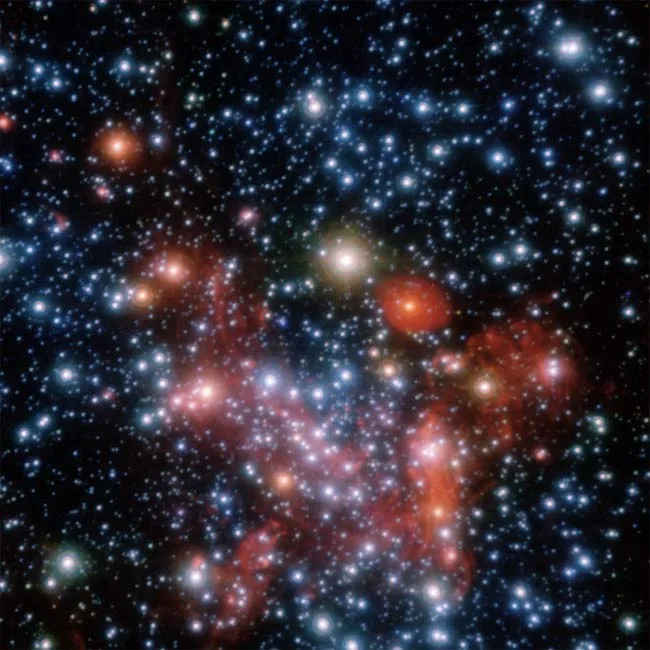
The Milky Way’s center is one of the most dynamic regions in space. Dense star clusters fill the area. Gas and dust move under intense gravity. At the core lies Sagittarius A*, shaping everything nearby.
Stars travel at high speeds here. Gas follows complex paths. Dust interacts with radiation and stellar winds. These conditions create a constantly evolving environment.
Why These Gas Clouds Matter
These clouds act as visible tracers of how matter moves near the black hole. Each cloud contains hot gas, mainly hydrogen and helium. Their brightness rises with density, which makes them detectable in infrared light.
One well-known example is G2. It follows a stretched orbit and shows a faint tail. That tail suggests interaction with surrounding material. Another object, G1, travels along a similar path.
A Steady Flow of Material
Even small amounts of gas can maintain activity at the galactic center. A cloud with a mass similar to Earth, arriving every decade, is enough to sustain current levels. This makes these structures key to understanding how matter reaches the black hole.
🧪 Tracing the Origin of the Gas Stream
For years, scientists proposed different explanations. Observations provided clues but not a complete picture.
The G Cloud Family
The main objects—G1, G2, and a tail structure called G2t—form a continuous stream. This structure suggests a shared origin rather than separate events.
Early Theories
Researchers explored several ideas:
- Stellar winds from massive stars
- Explosive events such as novae
- Tidal interactions with the black hole
Each explanation matched some observations but failed to explain the full structure.
Orbital Evidence Changes the Picture
High-resolution infrared data brought a breakthrough. By studying hydrogen emission lines, scientists reconstructed the orbits of these clouds.
The result was clear. All objects follow nearly identical paths. The alignment is too precise to be random. This confirms a single origin for the gas stream.
⭐ Binary Star Identified as the Source
Tracing the gas backward revealed a specific system: IRS 16SW. This massive binary star sits close to the galactic center within a disk of young stars.
How the System Produces Gas Clumps
Two massive stars orbit each other at close range. Each star generates powerful stellar winds. When these winds collide, they create a shock region between them.
In that region, gas compresses and heats up. Over time, it becomes unstable and forms dense clumps. These clumps detach and move inward.
Matching Observations
The detached clumps match observed gas clouds in structure and motion. Their density and trajectories align with real data.
Simulations support this process. Models show that wind collisions naturally produce compact gas clouds that behave like the observed objects.
Small Variations Explained
Minor differences between cloud paths still exist. These variations come from the motion of the binary system itself, which slightly alters how gas is released.
🔗 A New Model for Feeding the Galactic Center
This discovery connects several processes into one clear system. It explains how gas forms and moves toward the black hole.
Continuous Supply Mechanism
The process follows a consistent sequence:
- Massive stars produce strong winds
- Winds collide and form dense regions
- Gas breaks into compact clumps
- Clumps travel inward
This creates a steady flow of material rather than random infall.
Linking Stars and Black Holes
This mechanism shows a direct connection between stellar activity and black hole growth. Stellar winds shape gas dynamics. Gas dynamics guide material inward. The black hole completes the cycle by accreting that material.
A Connected Galactic Ecosystem
The Milky Way’s core now appears as a connected system. Stars, gas, and the black hole interact continuously. Each component influences the others.
For more insights into how black holes grow and behave, you can explore our coverage of supermassive black hole physics and recent discoveries related to Sagittarius A* on SpaceEyeNews.
🌌 Conclusion: A Clearer Picture of the Milky Way’s Core
The origin of these gas clouds is no longer uncertain. A nearby binary star system produces the material that feeds Sagittarius A*.
This finding reshapes our understanding of the galaxy’s center. It links stellar evolution, gas dynamics, and black hole activity into one process. It also shows how small, steady inputs can sustain a massive object over long periods.
Looking ahead, similar processes may exist in other galaxies. The Milky Way now provides a clear example of how stars and black holes remain closely connected.