BY:SpaceEyeNews.
The Milky Way disk flip may have changed the orientation of our galaxy by more than 90 degrees billions of years ago. New supercomputer simulations suggest this dramatic shift could explain why stars in the Milky Way’s halo rotate so slowly today.
Researchers reached this conclusion after studying the evolution of 25 simulated galaxies similar to the Milky Way. The galaxies with the slowest rotating stellar halos often shared two major events. They had experienced a direct merger with another galaxy. Their stellar disks had also undergone a large change in orientation.
The findings do not prove that the Milky Way flipped. However, they reveal a possible new chapter in our galaxy’s history. That chapter may even include a different ancient path for the Sun around the galactic center.
A Strange Clue in the Milky Way’s Halo
The mystery begins with stars far outside the Milky Way’s bright spiral disk. These stars form a large but thinly populated stellar halo around the galaxy.
ESA’s Gaia mission measured the positions and motions of stars with exceptional precision. Its observations showed that the Milky Way’s stellar halo rotates slowly compared with the main disk.
That unusual motion has puzzled astronomers. Much of the disk follows a clear and organized rotation around the galactic center. Halo stars, by contrast, often travel along tilted or highly elongated paths.
Many of those stars did not form inside the Milky Way. Smaller galaxies brought them in as the Milky Way grew. Their present motions preserve clues about events that occurred billions of years ago.
Still, ancient mergers alone may not fully explain the halo’s weak rotation. Researchers therefore examined whether the disk itself had changed direction.
Simulations Reveal a Possible Milky Way Disk Flip
Kirill Batrakov and colleagues at Durham University studied 25 galaxies from the Auriga simulation project. Auriga uses detailed cosmological simulations to recreate the formation of Milky-Way-sized galaxies.
These virtual galaxies evolve from the early universe to the present day. The simulations include gravity, stars, gas, dark matter, black holes and other processes that influence galactic development.
Researchers followed each simulated galaxy across billions of years. They then compared the rotation of its stellar halo with major events in its history.
A clear pattern appeared. Galaxies with the slowest rotating halos had often experienced both a direct merger and a disk flip. In these cases, the disk’s orientation changed by more than 90 degrees.
This does not mean the entire galaxy rotated like a solid object. Galaxies consist of stars, gas and dark matter moving under gravity. Their structures can slowly change as new material enters the system.
A Milky Way disk flip would therefore represent a large shift in the disk’s rotation axis. The plane containing most of the galaxy’s stars and gas would gradually settle into a new orientation.
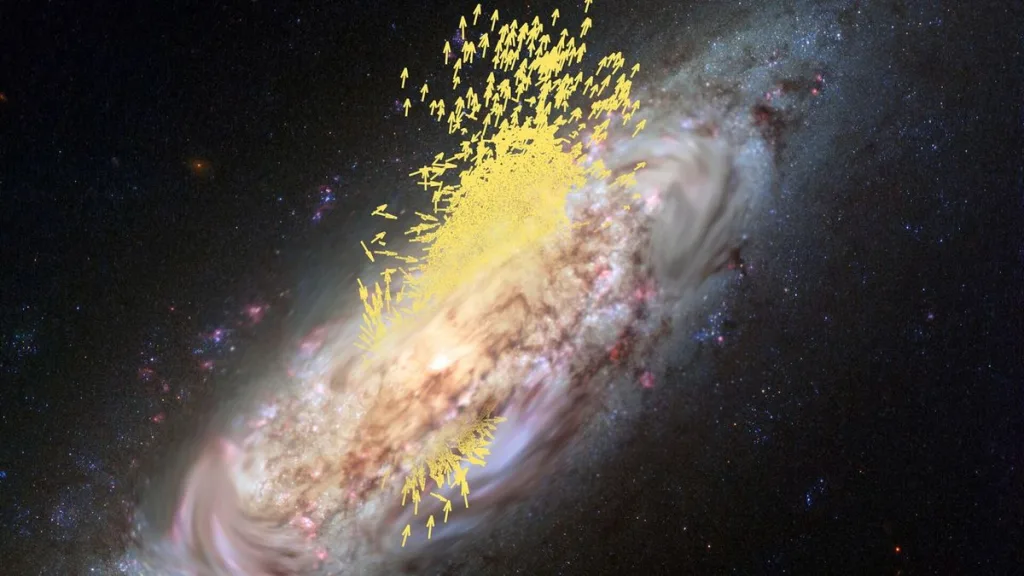
Our Milky Way galaxy appears to have flipped 90 degrees long ago. But why?
Why the Halo Would Keep Its Old Motion
A disk and a stellar halo do not always respond to change at the same speed.
When a disk reorients, the surrounding halo may continue moving closer to its previous direction. It can take time for the halo to adjust to the disk’s new orientation.
As a result, the halo appears to rotate slowly when astronomers compare it with the newly aligned disk. Its stars also show less organized movement around the galaxy.
This delay offers a possible explanation for what Gaia observes today. The halo may preserve a record of the Milky Way’s earlier orientation, even if the disk changed direction billions of years ago.
The study also found a connection between stellar-halo rotation and dark-matter-halo rotation. That relationship could help astronomers investigate the Milky Way’s invisible dark matter through the motion of visible stars. However, scientists still need more evidence before confirming that interpretation.
Gaia–Sausage–Enceladus and the Ancient Merger
The proposed scenario gains support from a major event already identified in the Milky Way’s history.
Around 10 billion years ago, the early Milky Way merged with a substantial dwarf galaxy. Astronomers call it Gaia–Enceladus or Gaia–Sausage–Enceladus.
The unusual name reflects the stretched distribution of its former stars in velocity data. Those stars now follow highly elongated paths through the Milky Way.
ESA observations also revealed chemical differences between these stars and stars that formed inside our galaxy. Their chemical signatures support the idea that they originated in another system.
Gaia–Enceladus was probably similar in size to one of the Magellanic Clouds. At the time, the Milky Way was much smaller than it is now. Therefore, the merger represented a major stage in its development. It helped populate the stellar halo and may have influenced the thick disk.
The Durham team argues that this known merger resembles one of the events associated with disk flips in the Auriga simulations.
Yet the merger did not necessarily cause the flip. Batrakov noted that several mechanisms could change a disk’s orientation. Researchers have not determined which mechanism best applies to the Milky Way.
Could Something Else Have Changed the Disk?
Galactic evolution rarely follows a simple sequence.
A merger can redistribute stars and alter a galaxy’s angular momentum. However, incoming gas can also arrive from a different direction. Smaller satellite galaxies may exert additional gravitational influence. Changes within the dark-matter halo could affect the disk as well.
Furthermore, not every simulated galaxy that experienced a disk flip had undergone the same type of merger. That detail suggests several processes may produce similar results.
Recent Gaia research has also complicated the Milky Way’s merger history. Some stars once linked to Gaia–Sausage–Enceladus may have arrived during a more recent event called the Virgo Radial Merger.
Evidence for the ancient Gaia–Sausage–Enceladus event remains strong. However, astronomers continue to debate which stars and structures belong to each past merger.
Did the Milky Way Disk Flip Change the Sun’s Orbit?
The Sun travels around the galactic center within the Milky Way’s disk. Therefore, a major disk reorientation could have changed the direction of its galactic journey.
If the flip happened after the solar system formed, the Sun may once have followed a different trajectory relative to the wider halo. Its position may not have remained as stable as it appears today.
Still, this idea requires caution. The study does not reconstruct a specific former orbit for the Sun. It also does not show that the solar system suddenly moved across the galaxy.
A disk flip would likely unfold over an immense period. Stars would respond to the galaxy’s changing gravitational structure rather than switch paths instantly.
No evidence currently links the proposed flip to changes on Earth, planetary climates or the development of life. Such claims would extend far beyond the research.
What Astronomers Must Confirm Next
The team presented the findings at the Royal Astronomical Society’s National Astronomy Meeting in Birmingham in July 2026. The result offers a compelling explanation, but it remains a simulation-based interpretation.
Astronomers now need observational signatures that can distinguish a true disk flip from other events. They must also determine when the reorientation happened and what triggered it.
Future studies could compare Gaia’s stellar motions with larger samples of simulated galaxies. Researchers may also search for chemical or orbital patterns left behind by the disk’s earlier orientation.
Better measurements of the stellar halo could reveal how quickly it adjusted. Meanwhile, its possible connection with the dark-matter halo may provide another test.
Milky Way Disk Flip Opens a New Galactic Chapter
The proposed Milky Way disk flip could explain one of our galaxy’s most unusual features. Simulations show that direct mergers and major disk reorientations often appear in galaxies with slowly rotating stellar halos.
The Milky Way experienced a significant ancient merger, and Gaia confirms that its halo contains stars with unusual motions. Together, these clues make a past flip plausible.
However, the event is not yet confirmed. Its timing, cause and effect on the Sun remain open questions.
Even so, the research shows how present-day stellar motions can reveal events from the distant past. The Milky Way may look stable today, but its history could have involved a remarkable change in direction.
Main Sources:
Royal Astronomical Society — NAM 2026: How Our Milky Way Once Underwent a Dramatic Flip
https://www.ras.ac.uk/news-and-press/research-highlights/nam-2026-how-our-milky-way-once-underwent-dramatic-flip
European Space Agency — Gaia Uncovers a Major Event in the Formation of the Milky Way
https://www.esa.int/Science_Exploration/Space_Science/Gaia/Galactic_ghosts_Gaia_uncovers_major_event_in_the_formation_of_the_Milky_Way
European Space Agency — Milky Way’s Last Major Collision Was Surprisingly Recent
https://www.esa.int/Science_Exploration/Space_Science/Gaia/Gaia_Milky_Way_s_last_major_collision_was_surprisingly_recent
Auriga Project — Milky Way Galaxy Simulations
https://wwwmpa.mpa-garching.mpg.de/auriga/