BY:SpaceEyeNews.
Introduction — millisecond pulsars FAST telescope discovery changes what we see
The millisecond pulsars FAST telescope discovery is not just another astronomy update. It reveals a deeper truth. Even well-studied regions of our galaxy still hide unseen objects. Using the FAST radio telescope, astronomers identified six new millisecond pulsars inside dense star clusters.
This result does not come from a new instrument. It comes from a smarter way of analyzing existing data. That shift matters. It suggests that many faint neutron stars remain hidden in archived observations.
Now, the focus changes. It is no longer about what we can observe. It is about what we have already missed.
millisecond pulsars FAST telescope environments: why globular clusters matter
Dense clusters create extreme conditions
The millisecond pulsars FAST telescope study focused on two clusters:
- NGC 6517
- NGC 7078
Both clusters have collapsed cores. Their stars sit extremely close together. This creates constant gravitational interactions.
Such environments remain highly dynamic. Stars pass near each other often. Systems shift, evolve, and sometimes break apart. Over time, these interactions reshape entire stellar populations.
Core-collapsed clusters and pulsar formation
Inside these dense cores, neutron stars behave differently. Close encounters can strip away companion stars. Binary systems can dissolve.
As a result, clusters like these may produce more isolated millisecond pulsars than expected. This insight directly connects to the new discovery.
millisecond pulsars FAST telescope method: detecting the invisible
Why standard searches missed them
The newly detected pulsars were always present. Earlier surveys simply could not see them. Their signals were too faint in single observations. Noise masked them completely.
Traditional detection depends on strong, clear signals. Weak emissions remain buried and undetected.
Stacking technique reveals hidden signals
To overcome this, researchers used a stacking method. They combined data from multiple observing sessions.
This approach strengthens weak signals while reducing noise. Over time, faint pulsars emerge clearly.
The team analyzed data collected between 2019 and 2024. That extended dataset allowed six hidden objects to finally appear.
From telescope power to data precision
This result highlights a shift in modern astronomy. Discovery is no longer limited by telescope size alone. Data processing now plays an equal role.
The millisecond pulsars FAST telescope discovery proves that better analysis can reveal what instruments alone cannot.
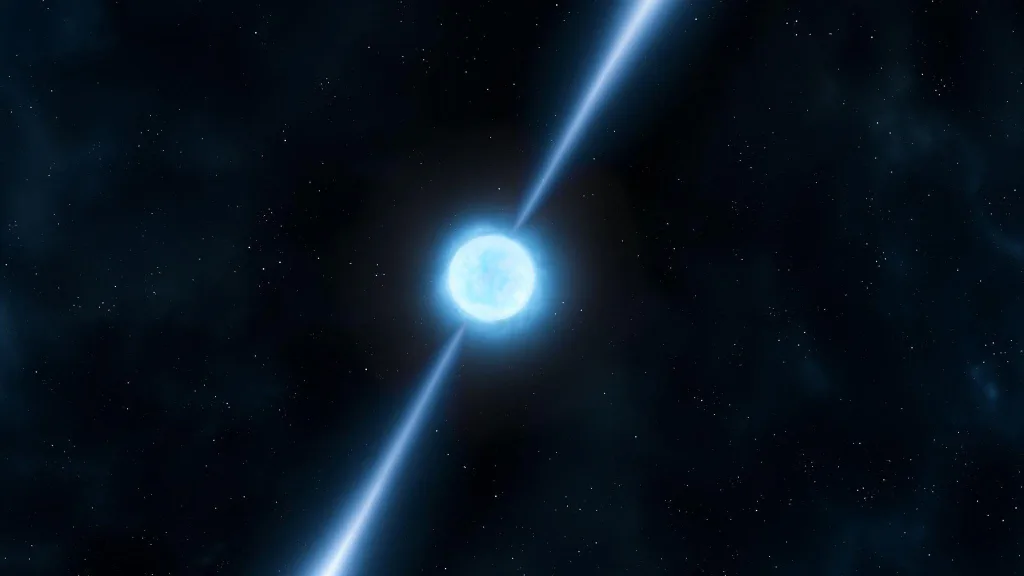
millisecond pulsars FAST telescope results: six ultra-fast neutron stars
Spin rates and properties
The study identified six millisecond pulsars:
- Four in NGC 6517
- Two in NGC 7078
Their rotation periods range from 3.68 to 6.02 milliseconds. One spins every 4.83 milliseconds.
These speeds translate into hundreds of rotations per second. That makes them some of the most stable natural clocks in the universe.
Population growth inside clusters
This discovery significantly expands known populations:
- NGC 6517 increased by about 27%
- NGC 7078 grew by nearly 20%
These changes highlight a clear gap. Even well-studied clusters still contain undetected objects.
millisecond pulsars FAST telescope anomaly: isolated systems
Why isolation stands out
Most millisecond pulsars form in binary systems. A companion star transfers matter and spins them up.
However, all six newly discovered pulsars are isolated. No companion stars appear nearby. This is unexpected.
Possible explanations
Several explanations may account for this pattern:
- Companion stars were lost through gravitational interactions
- Stellar encounters disrupted binary systems
- Alternative formation pathways may exist
Each option points to complex dynamics inside globular clusters.
Cluster dynamics reshape outcomes
Dense environments do more than host stars. They actively reshape them. Interactions can alter or destroy systems.
This means cluster dynamics may play a larger role in pulsar evolution than previously assumed.
millisecond pulsars FAST telescope impact on astronomy
Revising formation models
The millisecond pulsars FAST telescope discovery challenges existing models. It suggests that binary evolution is not the only path.
Cluster interactions may contribute more than expected.
A larger hidden population
If six pulsars remained hidden in well-studied clusters, many more likely exist elsewhere.
This implies that the galaxy may host a much larger population of faint neutron stars.
The role of large surveys
This discovery forms part of a broader effort. The GC-FANS survey using FAST has already identified more than 60 pulsars across 16 clusters.
Even with this progress, the data remains incomplete.
millisecond pulsars FAST telescope and invisible astronomy
Data reanalysis drives discovery
Modern astronomy is entering a new phase. Observations alone are not enough. Reanalyzing existing data reveals new results.
This approach is efficient and powerful.
Extending beyond pulsars
The same methods can apply to other phenomena:
- Weak fast radio bursts
- Faint black hole signals
- Subtle astrophysical patterns
The principle remains consistent. Better analysis leads to deeper discovery.
A new discovery framework
Astronomy is shifting toward a data-driven model. Researchers now extract more value from existing observations.
This transition increases discovery potential without requiring new instruments.
Conclusion — millisecond pulsars FAST telescope discovery reveals what we missed
The millisecond pulsars FAST telescope discovery highlights a simple reality. The universe still hides objects in plain sight.
These pulsars were always there. Detection limits kept them hidden. Now, improved methods reveal them clearly.
Looking ahead, many discoveries may already exist within archived data. The next breakthrough may not depend on new telescopes. It may depend on new ways of seeing.
Main Sources:
- https://universemagazine.com/en/seeing-the-invisible-fast-discovers-six-new-pulsars-in-globular-clusters/
- https://phys.org/news/2026-04-fast-discovers-millisecond-pulsars-globular.html
- https://arxiv.org/abs/2404.xxxxx (FAST pulsar survey preprint)