
BY:SpaceEyeNews.
Missing black holes could exist throughout the Milky Way, yet most remain beyond astronomers’ detection. Now, researchers want public help finding clues in observations from NASA’s Transiting Exoplanet Survey Satellite, or TESS.
The Black Hole Hunters project asks volunteers to examine graphs of changing starlight. A brief brightening could reveal an unseen companion through its gravitational influence.
Scientists at the University of Southampton highlighted the search in an October 1 announcement. Their goal is practical: identify promising targets for further observations. For volunteers, a few careful decisions could contribute to real astronomical research.
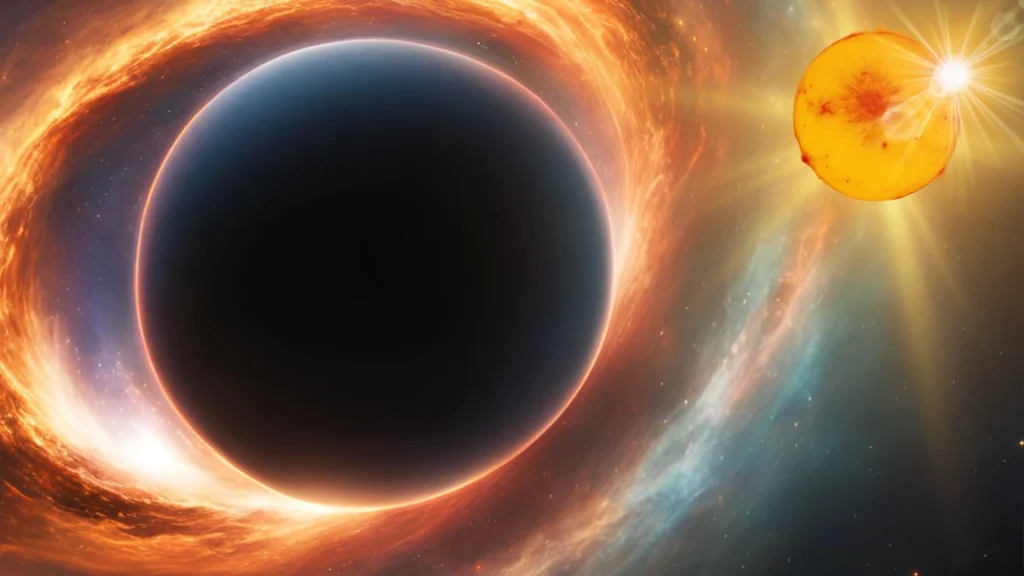
Missing Black Holes: A Hidden Companion in the Milky Way.
Why Missing Black Holes Remain Difficult to Find
Astronomers expect the Milky Way to contain millions of stellar-mass black holes. However, locating quiet examples remains challenging. Without bright material nearby, these objects offer fewer obvious clues.
Southampton’s announcement cites roughly 70 known black holes in this context. That approximate figure describes a limited Galactic population, rather than every black hole discovered throughout the universe.
The word “missing” also needs context. These objects have not disappeared. Researchers expect them to exist but have not identified their locations.
Black Hole Hunters focuses on systems containing a black hole and a visible companion star. Even then, the viewing angle must favor detection. Consequently, this search cannot reveal every hidden black hole. www.southampton.ac.uk
The Brief Brightening That Gives Away a Companion
The project seeks a specific effect called gravitational self-lensing. It occurs when a compact companion passes between its partner star and Earth.
During that alignment, the companion’s gravity bends the star’s light toward us. The star briefly appears brighter, creating a peak in its light curve. This graph tracks brightness over time.
For volunteers, the task involves spotting that distinctive pattern among many measurements. They examine changes in starlight rather than photographs of black holes.
However, a brightening event does not automatically establish a discovery. Stellar flares and pulsations can produce competing signals. Researchers must distinguish those variations from potential lensing events.
Why Alignment Matters
The method requires a favorable arrangement of the orbit and our viewing direction. Most systems will not line up appropriately.
That limitation explains why researchers need extensive datasets. Rare signals demand a broad search, even when the underlying population could be enormous. www.zooniverse.org
Why NASA’s TESS Data Fits the Search
TESS primarily searches for planets by measuring small dips in stellar brightness. Black Hole Hunters examines those observations for a different pattern: temporary increases.
This overlap makes existing telescope data valuable for another research question. NASA notes that TESS monitors many changing objects, including pulsating stars and distant galaxies.
The mission therefore provides more than a catalog of potential planets. Its repeated measurements create opportunities to investigate subtle behavior across the sky.
Black Hole Hunters is a university-led project using NASA observations. Volunteers support the researchers’ analysis rather than operate the spacecraft. science.nasa.gov
Why Human Eyes Still Matter Alongside AI
Southampton reports that automated screening has already narrowed millions of possible locations. This preparation helps direct volunteers toward data worth examining.
Yet real observations rarely match ideal examples perfectly. Noise, natural stellar variability, and imperfect models complicate automated searches.
The project’s FAQ explains another challenge. Machine-learning systems can focus on subtle features that differ between simulated signals and actual observations. As a result, they might overlook useful candidates.
People can help recognize broader patterns that resemble examples without matching them exactly. The approach combines automated screening with human judgment.
Learning What to Look For
Participants receive examples showing the shapes researchers want them to identify. Some light curves contain simulated signals.
These examples serve two purposes. They demonstrate possible lensing patterns and help measure which signal strengths volunteers can recognize.
Therefore, seeing an impressive peak does not necessarily mean spotting a previously unknown object. Some examples support training and evaluation. www.southampton.ac.uk
From a Promising Signal to Scientific Evidence
A volunteer’s classification starts a longer investigation. Researchers must assess the signal, examine alternative explanations, and determine whether additional observations would help.
Follow-up measurements can investigate the visible star’s motion. An unseen companion may produce measurable changes as the star travels around their shared center of mass.
Such evidence helps researchers test the system’s nature. It also prevents an unusual brightness fluctuation from becoming an unsupported black hole claim.
This process makes a useful shortlist especially valuable. Telescope observations require time and resources, so researchers need strong reasons to prioritize particular targets.
The project’s results page describes interesting candidates from its earlier SuperWASP search. Those candidates remain under investigation; the page does not announce confirmed black hole discoveries. www.zooniverse.org
What the Search Could Realistically Deliver
The potential is exciting, but expectations need careful wording. Southampton’s announcement discusses potentially thousands of discoveries. Meanwhile, the project FAQ estimates roughly 100 possible self-lensing examples in TESS, if conditions prove favorable.
These figures should not be treated as interchangeable forecasts. Neither represents a confirmed discovery total or a guaranteed outcome. www.southampton.ac.uk
Finding additional quiet systems could expand the sample available for studying stellar companions and black hole populations. Even a modest number of convincing detections could provide valuable research targets.
How to Follow the Missing Black Holes Search
Readers can visit Black Hole Hunters on Zooniverse to explore the project and check participation opportunities. No astronomy degree or personal telescope is necessary.
At the time of checking, the project page displayed an out-of-data notice. Readers should therefore check for new classifications and research updates rather than assume tasks are immediately available. www.zooniverse.org
The search for missing black holes connects public curiosity with a concrete scientific need. Careful inspection of ordinary-looking graphs could help astronomers choose where to point their telescopes next.
Main sources:
- University of Southampton — Scientists enlist armchair astronomers to find thousands of black holes hiding in our galaxy
- Zooniverse — Black Hole Hunters: Research
- Zooniverse — Black Hole Hunters: FAQ
- Zooniverse — Black Hole Hunters: Results
- NASA — TESS mission overview
You Might Also Like:
Wandering black holes: Clues to galaxy history
Little Red Dots May Hide Growing Black Holes