
BY:SpaceEyeNews.
The MMX mission could answer a question that has followed Mars exploration for decades: where did its two moons come from? Japan’s spacecraft will study Phobos and Deimos, then attempt to bring material from Phobos back to Earth. NASA is supplying instruments, sampling technology, and communications support for that ambitious journey.
Those small grains could carry evidence that distant observations cannot fully resolve. With launch approaching, researchers are preparing to connect detailed measurements around Mars with samples they can examine in laboratories.
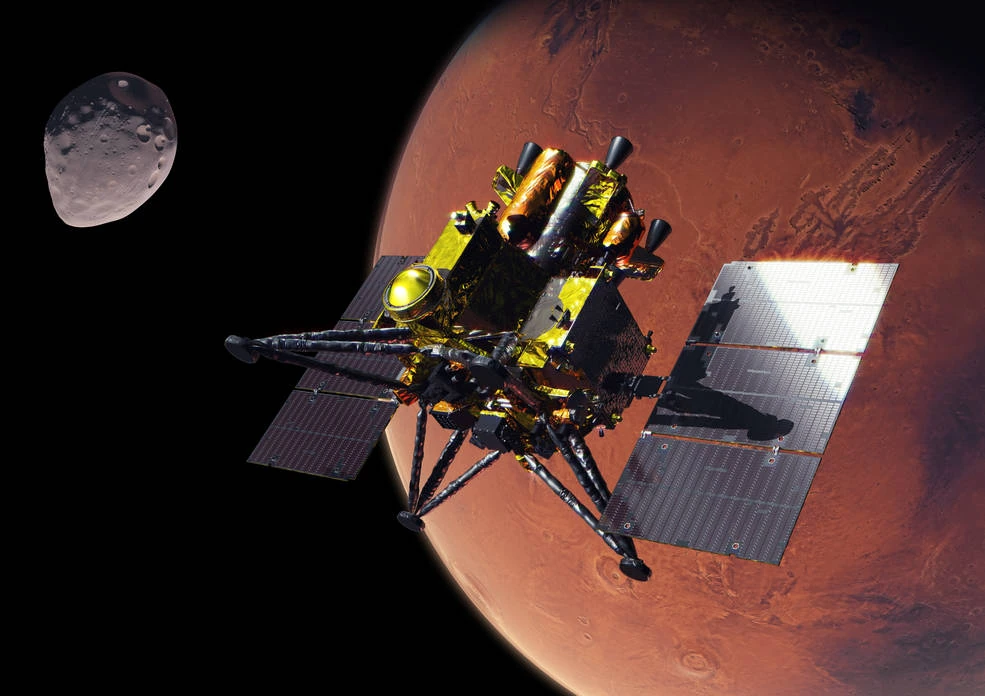
MMX Mission: Exploring Mars and Phobos.
MMX mission prepares for launch
JAXA, Japan’s space agency, leads Martian Moons eXploration, or MMX. The spacecraft is scheduled to launch from Tanegashima Space Center on October 20, 2026, Japan time. That corresponds to October 19 in the eastern United States.
NASA’s October 8 announcement confirms a planned arrival at Mars in August 2027. The spacecraft will then begin surveying both moons, with detailed work around Phobos guiding later sample collection.
The schedule allows scientists time to understand their destination before attempting the mission’s most demanding operations. NASA places surface sampling no earlier than December 2028. The team currently targets 2031 for delivery to Earth.
NASA will preview its contributions during an October 15 media teleconference. The briefing will bring together representatives from the agency, Johns Hopkins Applied Physics Laboratory, and Honeybee Robotics. It offers a timely look at the hardware supporting Japan’s mission.
These dates describe the mission plan. Each major step still depends on successful spacecraft operations. www.nasa.gov
What Phobos could reveal about Mars’ moons
Two leading explanations offer very different histories for Phobos and Deimos. Under the capture hypothesis, both moons began as asteroids before Mars’ gravity captured them.
The alternative suggests that debris surrounding ancient Mars gradually assembled into moons. In that scenario, an earlier collision supplied the material.
Chemistry could distinguish their origins
Samples give scientists a direct way to investigate those possibilities. Their minerals and chemical composition could preserve clues about the materials and conditions involved in formation.
A resemblance to primitive asteroid material could strengthen the capture explanation. Other characteristics could support formation from debris involving Mars.
However, interpreting those clues will require care. Researchers must compare laboratory findings with measurements across the moons’ surfaces. A small collection of grains represents a particular location, so understanding its surroundings matters.
The scientific goal therefore extends beyond identifying what Phobos contains. Scientists also want to understand how that material arrived there and changed over time. NASA Science
NASA’s MEGANE instrument will examine Phobos
One of NASA’s central contributions is MEGANE, a gamma-ray and neutron spectrometer. Johns Hopkins Applied Physics Laboratory developed the instrument to investigate Phobos’ elemental composition.
Its full name is Mars-moon Exploration with Gamma-rays and Neutrons. Despite that technical title, its purpose is straightforward: help determine which chemical elements make up the moon.
Connecting measurements with returned samples
MEGANE measures radiation emerging from Phobos. These signals carry information about the elements within its surface material.
That approach adds chemical evidence to the images collected by other instruments. Together, the observations will help scientists interpret the terrain and evaluate potential sampling locations.
MEGANE also provides context for the material that eventually reaches Earth. Laboratory researchers can compare their findings with the spacecraft’s broader measurements.
This connection matters because a sample alone cannot describe an entire moon. Combining local material with remote observations offers a stronger foundation for explaining Phobos’ history. science.nasa.gov
A gas-powered sampler for the MMX mission
Collecting loose material from Phobos demands equipment suited to its extremely weak gravity. NASA’s contribution includes a pneumatic sampler developed by Honeybee Robotics, a Blue Origin company.
The device uses pressurized gas to lift surface particles into a sample container. JAXA describes this collection process as taking a fraction of a second.
Two methods for gathering material
MMX also carries a separate coring sampler. Its robotic arm and cylindrical corer aim to collect material from beneath the immediate surface, reaching approximately two centimeters deep.
These systems give the spacecraft different ways to gather Phobos material. One collects loose surface particles, while the other accesses shallow subsurface material.
The sample return capsule will hold the collected material for the journey home. JAXA’s overall goal is to return more than 10 grams.
That modest quantity reflects the mission’s focus on careful scientific analysis. The value lies in the evidence within the grains and their documented origins. MMX – Martian Moons eXploration
Surface surveys come before sample collection
Before the spacecraft approaches its sampling site, the team must assess local conditions. Images, compositional measurements, and terrain observations will help guide that decision.
The mission also carries IDEFIX, a rover developed by France’s CNES and Germany’s DLR. It will explore Phobos before the main spacecraft lands.
By examining surface properties, the rover will help reduce uncertainty around landing and sampling. Its observations will complement measurements taken from above.
Meanwhile, NASA’s Deep Space Network will support communications and navigation. NASA also funds American scientists participating in the international research team. MMX – Martian Moons eXploration
Bringing Phobos material back to Earth
After completing its work around Mars, MMX must deliver its samples across interplanetary space. JAXA’s published schedule places departure from the Martian system in 2030, followed by Earth return in 2031.
The return capsule will enter Earth’s atmosphere, with recovery planned in Australia. Successful delivery would give scientists the first samples collected directly from a Martian moon.
Earth-based laboratories can then examine those grains with equipment beyond the spacecraft’s onboard capabilities. Researchers will connect the results with years of mission observations. www.mmx.jaxa.jp
Why the MMX mission matters
The MMX mission could turn competing explanations for Mars’ moons into questions scientists can test with actual samples. NASA’s technology supports that effort, while JAXA leads the broader journey from launch to return.
Success could deepen our understanding of the Martian system and its early evolution. The most revealing evidence may come from something remarkably small: grains of Phobos that finally reach Earth.
Main sources:
- NASA — Mission briefing and current schedule, October 8, 2026: https://www.nasa.gov/news-release/nasa-briefing-to-highlight-contributions-to-martian-moons-mission/
- JAXA — MMX mission overview: https://www.mmx.jaxa.jp/en/
- JAXA — Scientific instruments and sampling systems: https://www.mmx.jaxa.jp/en/science/
- NASA — MMX mission overview: https://science.nasa.gov/mission/mmx/