BY:SpaceEyeNews.
Introduction: Detection Is Not the Same as Proof
Scientists have identified more than 350 compounds through molecules in space detection. Yet some of the most exciting announcements do not hold up over time. The gap between detection and confirmation defines modern Astrochemistry.
Many of these compounds relate to the chemistry of life. That is why each new claim draws attention. Still, weak signals, overlapping data, and early publication pressure often complicate the picture. Understanding this process reveals how discoveries form—and why some disappear.
A Growing Chemical Map of the Universe
Since the first interstellar molecule was identified in 1937, researchers have steadily expanded the cosmic inventory. Today, scientists detect molecules across a wide range of environments.
Where These Molecules Are Found
Observations come from:
- Dense regions like the Taurus Molecular Cloud
- Planetary atmospheres within our Solar System
- Remote galaxies far beyond it
Each region offers different conditions. Molecular clouds often host complex organic chemistry. Planetary atmospheres reflect dynamic interactions with radiation and pressure.
Why This Chemical Inventory Matters
Many of these molecules act as precursors to biological systems. They do not prove life exists elsewhere. However, they show that the ingredients for life appear across the universe. This growing catalog forms a map of where complex chemistry can develop.
How Scientists Identify Molecules in Space
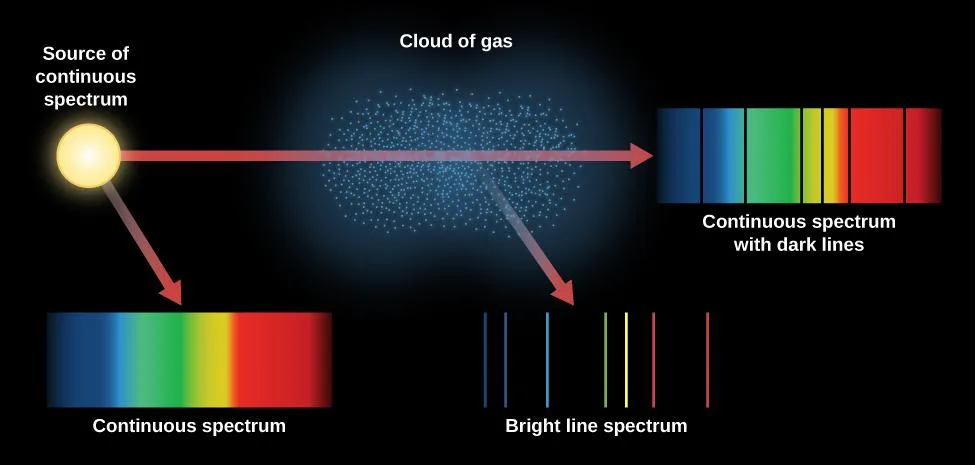
Researchers do not observe molecules directly. Instead, they rely on their interaction with light.
Spectral Fingerprints and Signal Matching
Every molecule emits radiation at specific frequencies. Scientists use Spectroscopy to study these patterns, known as spectral fingerprints.
The process follows a clear structure:
- Scientists measure a molecule’s signature in laboratory conditions
- Telescopes collect signals from space
- Researchers compare both datasets
A strong match suggests the presence of a molecule.
Why Laboratory Data Is Essential
Laboratory measurements provide the reference needed for identification. Without them, signals from space remain ambiguous. This step anchors the entire detection process.
When a Match Is Not Enough
Even a convincing match does not guarantee accuracy. Signals can overlap. Noise can distort measurements. For that reason, scientists look for multiple confirming signals before accepting a result.
When Signals Mislead: Limits of Detection
The main challenge in this field lies in interpreting weak or complex data.
Overlapping Signals in Crowded Environments
Space contains many molecules at once. Their signals often overlap. This overlap makes it difficult to isolate a single compound with certainty.
Competition and Early Announcements
Scientific timing also matters. Researchers often aim to publish results quickly. Data becomes publicly available soon after collection, which increases pressure to report findings early.
What Makes a Detection Reliable
Confidence depends on the number of signals detected:
- Few signals suggest a tentative result
- Multiple consistent signals strengthen the case
- A larger set of matching lines supports confirmation
This distinction separates early claims from established discoveries.
Glycine: A Discovery That Did Not Hold
One of the most well-known examples involves Glycine.
Why It Drew Global Attention
Glycine is the simplest amino acid and a key component of biological systems. Detecting it in space would have significant implications for the origin of life.
The Initial Announcement
Scientists reported glycine in interstellar space more than two decades ago. The claim quickly gained attention.
What Changed the Outcome
Further analysis revealed critical gaps:
- Essential spectral lines were missing
- Some signals overlapped with other molecules
- The evidence did not meet confirmation standards
Where It Stands Today
Most researchers now agree that the original claim was incorrect. This case shows how early excitement can fade when data undergoes deeper scrutiny.
Phosphine on Venus: A Debate Still Ongoing
Another high-profile case involves Phosphine in the atmosphere of Venus.
Why This Case Matters
On Earth, phosphine often associates with biological processes. Its possible detection on Venus raised questions about unknown chemistry or potential biological activity.
Conflicting Interpretations
Unlike the glycine case, this issue remains unresolved:
- Some studies support the presence of phosphine
- Others attribute the signal to noise or data processing effects
An Open Scientific Question
Researchers continue to analyze the data. No clear consensus has emerged. This ongoing debate reflects how scientific understanding evolves with new evidence.
Beyond Headlines: How Science Confirms Discoveries
Public attention often focuses on initial announcements. However, the scientific process extends far beyond that moment.
Verification Takes Time
Confirmation requires several steps:
- Independent analysis by other teams
- Additional observations
- Re-evaluation using different methods
This process can take months or longer.
Why Skepticism Matters
Scientific skepticism ensures accuracy. Researchers test claims repeatedly before accepting them. This approach prevents premature conclusions.
A Clear Perspective
In this field, confirmation carries more weight than announcement. A result becomes meaningful only after it withstands repeated testing.
What This Means for the Search for Life
The search for life drives much of the interest in space chemistry.
Ingredients Do Not Equal Life
Finding organic molecules does not prove life exists. It only shows that the necessary components are present. Life depends on additional conditions and processes.
Better Tools, New Challenges
Modern instruments detect weaker signals than ever before. This progress expands the number of known molecules. At the same time, it increases the risk of misinterpretation.
A Shift in the Challenge
The difficulty has changed. Scientists no longer struggle to find signals. Instead, they must interpret them correctly and verify them carefully.
Conclusion: A Process That Refines Itself
Molecules in space detection continues to reshape our understanding of the universe. The growing list of compounds highlights a chemically rich cosmos. Still, not every discovery stands the test of time.
Some claims, like glycine, fade after deeper analysis. Others, like phosphine on Venus, remain under debate. Each case shows that science evolves through testing and revision.
Reliable discoveries require strong evidence, repeated validation, and patience. As technology improves, more signals will emerge. Some will lead to confirmed findings. Others will not.
The next major breakthrough may already exist within current data. It simply awaits confirmation.