BY:SpaceEyeNews.
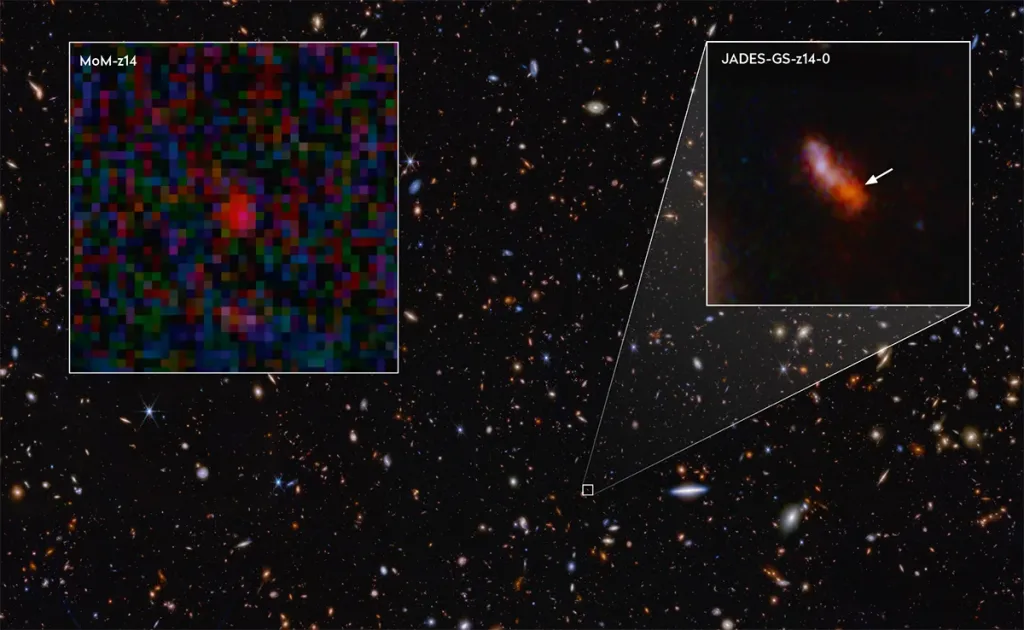
The James Webb Space Telescope continues to reshape our view of the early universe. Its latest record-breaking discovery, the MoM-z14 Galaxy, has become the most distant spectroscopically confirmed galaxy ever observed. The galaxy’s light began its journey roughly 280 million years after the Big Bang.
At first, this may sound like another distance record. Yet the real significance goes much deeper. The MoM-z14 Galaxy joins a growing collection of unexpectedly bright and mature galaxies found during the universe’s earliest period. These discoveries suggest that galaxies may have formed stars and assembled their structures much faster than astronomers predicted before the launch of the James Webb Space Telescope.
Importantly, this discovery does not challenge the Big Bang itself. Instead, it challenges some long-standing ideas about how quickly galaxies evolved during Cosmic Dawn. As researchers collect more data, the early universe appears increasingly active, efficient, and complex.
MoM-z14 Galaxy Sets a New Distance Record
A Galaxy From the Earliest Known Epoch
The MoM-z14 Galaxy was confirmed through spectroscopy at a redshift of 14.44. This places it slightly farther away than the previous record-holder, JADES-GS-z14-0.
Spectroscopic confirmation is important because it provides a highly reliable measurement of distance. Unlike photometric estimates, spectroscopy analyzes specific features in a galaxy’s light. This allows astronomers to determine its redshift with much greater confidence.
The discovery places the MoM-z14 Galaxy within one of the earliest periods ever observed. When its light was emitted, the universe was only about 2% of its current age.
Why This Discovery Matters
Distance alone is not the most surprising aspect of the discovery. Astronomers expected to find a few galaxies during this era. Instead, Webb continues to uncover many bright galaxies at extremely high redshifts.
That growing population is forcing scientists to reconsider how rapidly the first galaxies formed.
The MoM-z14 Galaxy therefore represents more than a new record. It serves as another piece of evidence that the young universe may have developed much faster than expected.
The Growing Population of Bright Early Galaxies
Webb Keeps Finding More Galaxies Than Predicted
Since its first observations in 2022, the James Webb Space Telescope has repeatedly identified galaxies from Cosmic Dawn that appear brighter and more numerous than many pre-launch models predicted.
Researchers expected galaxies at redshifts above 10 to be relatively rare. Instead, Webb has found them in significant numbers.
The surprise became even greater at redshifts approaching 14 and 15. Some studies suggest that these bright galaxies appear far more frequently than earlier models anticipated.
This trend has become one of the most important findings from Webb’s mission.
Brightness Is the Key Observation
One fact remains clear. Webb is directly observing these galaxies.
Their brightness is not an assumption. It is a measurement.
The challenge comes when scientists attempt to explain how galaxies became so bright so early in cosmic history.
That question remains one of the biggest mysteries in modern astronomy.
Why Abundance Matters More Than Records
Individual discoveries often attract headlines. However, astronomers are increasingly focused on the overall population.
Finding one unusual galaxy could simply be luck.
Finding many similar galaxies suggests that current models may underestimate how efficiently galaxies formed stars during Cosmic Dawn.
That broader pattern is why the MoM-z14 Galaxy has generated such interest within the scientific community.
Why the Big Bang Remains Secure
The Origin of the “Universe Breaker” Headlines
Several early reports suggested that Webb had discovered galaxies that should not exist.
Some media outlets described them as “universe breakers.”
Those headlines attracted attention. Yet many scientists argued that they overstated the situation.
The observations created an astrophysical puzzle. They did not create a cosmological crisis.
Cosmology Still Explains the Universe
Current observations continue to support the standard cosmological model.
The expansion of the universe remains well established.
The cosmic microwave background still provides strong evidence for the Big Bang.
The observed abundance of light elements continues to match theoretical predictions.
For these reasons, researchers are not rewriting cosmology.
Instead, they are refining models of galaxy formation.
What Scientists Are Actually Revising
The debate now centers on astrophysics.
Researchers want to understand how galaxies formed stars so efficiently during the first few hundred million years.
The focus has shifted from questioning the universe itself to questioning how galaxies assembled within it.
That distinction is important.
The Mass Problem That Became Smaller
Early Estimates Raised Questions
In 2023, several studies reported galaxies that appeared extremely massive for their age.
Those findings sparked intense discussion.
If correct, some galaxies would have accumulated enormous amounts of stellar mass in a remarkably short time.
Brightness Does Not Always Equal Mass
Astronomers estimate galaxy mass from observed light.
However, that process depends on assumptions about the sources producing that light.
Later studies revealed that some objects contained actively growing black holes.
These black holes can significantly increase a galaxy’s brightness.
As a result, some early mass estimates proved too high.
The Role of Little Red Dots
Webb has also discovered many compact objects known as Little Red Dots.
Evidence suggests that many host rapidly feeding black holes.
These black holes contribute additional light and can make galaxies appear more massive than they truly are.
Correcting for this effect reduced some of the original tension.
However, it did not eliminate the broader abundance problem.
New Ideas About Cosmic Dawn
Star Formation May Have Been More Efficient
One possibility involves unusually efficient star formation.
The early universe contained dense gas with very low levels of heavy elements.
Under those conditions, galaxies may have converted gas into stars more effectively than modern galaxies.
If true, galaxies could grow rapidly while remaining consistent with current cosmology.
Early Galaxies May Have Experienced Starbursts
Another explanation involves bursty star formation.
Galaxies may have gone through short periods of intense activity.
During those episodes, they would appear exceptionally bright.
Webb may be detecting many galaxies during these luminous phases.
The First Stars Could Have Been Different
Some researchers suggest that the earliest stars were larger than stars commonly found today.
Massive stars produce tremendous amounts of ultraviolet radiation.
As a result, a galaxy could appear brighter without requiring as much stellar mass.
This scenario remains under active investigation.
Black Holes May Have Contributed More Light
Rapidly growing black holes likely played a role as well.
Their contribution could help explain why some galaxies appear brighter than expected.
Many researchers now believe that several factors worked together rather than a single mechanism.
What the MoM-z14 Galaxy Means for Future Research
A New Focus for Webb
The MoM-z14 Galaxy highlights one of the most important scientific goals of the James Webb Space Telescope.
Researchers want to understand how the first galaxies emerged and evolved.
Each new observation provides another piece of that puzzle.
Future Discoveries May Push Even Further Back
Astronomers expect Webb to discover additional galaxies at extreme redshifts.
Some may be even older than the MoM-z14 Galaxy.
Future observations will help determine whether these objects are rare exceptions or common features of the early universe.
Cosmic Dawn Is Becoming More Complex
The picture of Cosmic Dawn is changing rapidly.
Scientists once imagined a relatively gradual process of galaxy formation.
Webb is revealing a universe that appears more dynamic than expected.
The coming years will likely bring additional surprises.
Conclusion
The MoM-z14 Galaxy is not rewriting the Big Bang. Instead, it is helping astronomers rewrite the story of Cosmic Dawn.
Its discovery adds to a growing body of evidence showing that early galaxies formed stars and assembled structures faster than many models predicted. While revised mass estimates have eased some concerns, the abundance of bright early galaxies remains a major scientific challenge.
As the James Webb Space Telescope continues to peer deeper into the universe, the MoM-z14 Galaxy may become remembered not only as a distance record holder but also as a turning point in our understanding of how the first galaxies emerged after the Big Bang.
Main Sources:
- Space Daily
https://www.spacedaily.com - NASA Webb Telescope News (JADES-GS-z14-0)
https://www.nasa.gov - The Open Journal of Astrophysics (MoM-z14 Paper)
https://astro.theoj.org - JADES Collaboration Research
https://ui.adsabs.harvard.edu - Scientific American Coverage of Early Galaxy Formation
https://www.scientificamerican.com - James Webb Space Telescope Official Site
https://webb.nasa.gov