BY:SpaceEyeNews.
At least six moons in our Solar System may contain large oceans beneath their frozen surfaces. That possibility has changed how scientists search for habitable environments beyond Earth.
Europa, Ganymede, Callisto, Enceladus and Titan form the best-known group. More recently, Mimas became a strong sixth candidate after researchers reexamined data from NASA’s Cassini mission.
Other worlds may eventually join them. Triton and several moons around Uranus also show signs of possible internal water layers.
However, scientists have not photographed these oceans directly. Instead, they infer them through magnetic signals, gravity measurements, orbital motion, surface geology and chemical evidence.
The expanding list of moons with hidden oceans suggests that liquid water can survive far from the Sun. It can even remain concealed inside worlds that appear inactive.
Mimas Changed the Hidden-Ocean Debate
Mimas may be the most surprising world on the list.
The small Saturnian moon has a heavily cratered surface. It lacks the active fractures and towering plumes seen on Enceladus. For decades, it appeared cold, solid and geologically quiet.
That picture changed in 2024.
A study published in Nature analyzed Cassini measurements of Mimas’s orbit and motion. The researchers concluded that the moon’s icy shell likely covers a global ocean.
Their models placed the ocean roughly 20 to 30 kilometers beneath the surface. They also suggested that it formed relatively recently, perhaps within the past 5 million to 15 million years.
This remains a model-based conclusion rather than a direct sample. Even so, the evidence makes Mimas a strong ocean-world candidate.
Its importance extends beyond one moon. Mimas shows that an ocean does not always leave obvious marks on the surface.
A frozen world may hide liquid water while preserving an ancient, cratered appearance.
Europa and Enceladus Lead the Search
Among all moons with hidden oceans, Europa and Enceladus remain the most compelling targets for astrobiology.
Europa May Hold More Water Than Earth
Europa’s fractured surface, magnetic response and tidal interaction with Jupiter support the existence of a global saltwater ocean.
NASA estimates that Europa may contain about twice as much water as Earth’s global ocean. That water lies beneath an outer shell of ice.
Scientists are especially interested in possible contact between the ocean and a rocky seafloor. Such contact could support chemical reactions that release energy.
Energy matters because life needs more than water. It also requires useful chemistry and a stable environment.
Europa may contain those ingredients. However, no mission has found evidence of life there.
Enceladus Offers Natural Ocean Samples
Enceladus provides something Europa does not: direct access to material from below its surface.
Cassini repeatedly flew through plumes erupting near the moon’s south pole. The spacecraft detected water-rich particles, salts, organic compounds, molecular hydrogen and phosphates.
Scientists believe those plumes connect to a global ocean beneath the ice.
Molecular hydrogen may indicate water-rock reactions on the seafloor. Phosphates and organic compounds also strengthen the moon’s scientific importance.
Still, these materials do not prove that life exists.
They show that Enceladus contains several ingredients linked to habitable environments.
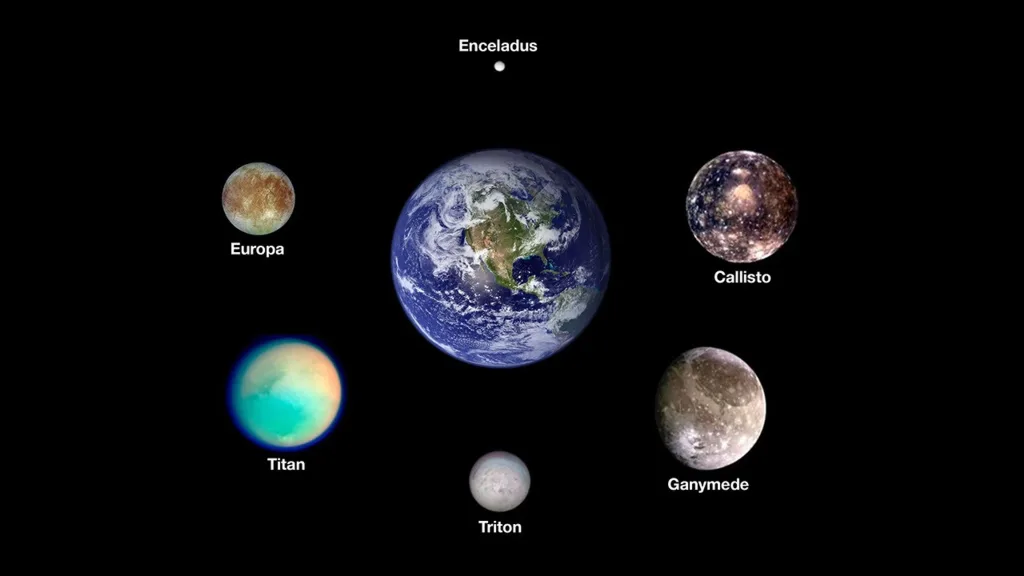
Icy Moons in Our Solar System That May Have Oceans Now – NASA Science
Other Moons With Hidden Oceans
Europa and Enceladus receive the most attention, but other moons may contain even larger internal water reservoirs.
Ganymede May Have Layered Oceans
Ganymede is the largest moon in the Solar System. It is also the only moon known to generate its own magnetic field.
Magnetic measurements and observations of shifting auroras support the presence of a salty ocean beneath its surface.
Models suggest that Ganymede may contain several layers of water and ice. High-pressure forms of ice could separate liquid layers from the rocky interior.
That structure may reduce direct water-rock interaction. It could therefore affect the moon’s habitability.
Callisto Remains a Quieter Candidate
Callisto shows fewer signs of geological activity.
Its ancient surface carries many impact craters. Yet measurements from the Galileo spacecraft detected a changing magnetic response.
A conductive salty layer could explain that signal.
The evidence for Callisto’s ocean remains less direct than the plume measurements at Enceladus. Even so, scientists still consider Callisto an important ocean-world target.
Titan Has Two Types of Liquid
Titan offers a unique case.
Methane and ethane form lakes, rivers and seas on its surface. Beneath the icy crust, scientists also infer a deep ocean of liquid water.
Cassini gravity measurements and radio data from the Huygens probe support this interpretation.
The internal ocean may contain salts and ammonia. Those materials can lower water’s freezing point and help it remain liquid.
Titan’s thick atmosphere and complex organic chemistry add another layer of interest. However, its surface liquids differ greatly from Earth’s water-based environments.
Triton and Uranian Moons Could Join the List
Neptune’s moon Triton remains a possible ocean world.
Voyager 2 observed nitrogen geysers and a relatively young, altered surface during its 1989 flyby. Triton also travels around Neptune in a backward orbit.
That unusual path suggests Neptune captured the moon long ago. The capture could have generated intense tidal heating.
A present-day ocean remains possible, but scientists lack enough measurements to confirm it.
Several moons of Uranus also look promising. NASA-supported models suggest that Ariel, Umbriel, Titania and Oberon may retain briny oceans below their surfaces.
Those conclusions rely mainly on Voyager 2 observations, composition estimates and thermal models.
No dedicated Uranus orbiter has measured their gravity or magnetic responses at close range. Therefore, these moons remain credible candidates rather than confirmed ocean worlds.
How Scientists Detect Invisible Oceans
Researchers use several techniques to study water they cannot see.
A salty ocean can conduct electricity. It may create an induced magnetic signal as a moon moves through its planet’s magnetic field.
Gravity measurements can reveal how mass sits inside a moon. Small changes in rotation may also show whether an outer ice shell moves separately from the deeper interior.
Surface fractures, ridges and resurfaced regions provide geological clues.
Plumes offer the strongest access because they carry subsurface material into space.
Each method provides a different level of confidence. A plume sample does not offer the same evidence as an interior model.
Europa Clipper and Juice Will Test the Evidence
Two major missions will soon examine the leading Jovian ocean worlds.
NASA launched Europa Clipper on October 14, 2024. The spacecraft should reach Jupiter in April 2030.
It will conduct 49 close flybys of Europa. Its instruments will study the ice shell, surface composition, geology and internal structure.
Europa Clipper will not search directly for organisms. Its main goal is to determine whether Europa contains conditions suitable for life.
ESA’s Juice spacecraft launched in April 2023 and should reach Jupiter in July 2031.
Juice will study Europa, Callisto and Ganymede. It will later enter orbit around Ganymede, becoming the first spacecraft to orbit a moon in the outer Solar System.
Together, the missions should improve estimates of ocean depth, ice thickness, salinity and internal structure.
Frozen Surfaces May Conceal Habitable Worlds
The growing number of moons with hidden oceans does not mean that every frozen moon contains life.
Liquid water alone cannot create a habitable environment. Useful chemistry, energy, stability and water-rock interaction may also matter.
The larger lesson concerns appearances.
Enceladus advertises its ocean through active plumes. Mimas may hide one beneath an old and battered surface.
Future missions could add more worlds to the list. They may also reveal which hidden oceans have the strongest ingredients for habitability.
The search for life has therefore moved beyond planets near the Sun. Some of its most promising locations may lie inside frozen moons, sealed beneath kilometers of ice.
Main Sources:
NASA — Ocean Worlds:
https://science.nasa.gov/solar-system/ocean-worlds/
NASA — Europa Facts:
https://science.nasa.gov/jupiter/jupiter-moons/europa/
NASA — Europa Clipper Mission:
https://science.nasa.gov/mission/europa-clipper/
ESA — Juice Mission:
https://www.esa.int/Science_Exploration/Space_Science/Juice
NASA JPL — Ocean Worlds Laboratory:
https://oceanworldslab.jpl.nasa.gov/research/
NASA — Four Uranian Moons May Hold Water:
https://www.nasa.gov/centers-and-facilities/jpl/new-study-of-uranus-large-moons-shows-4-may-hold-water/
Lainey et al. — A Recently Formed Ocean Inside Saturn’s Moon Mimas:
https://pubmed.ncbi.nlm.nih.gov/38326592/