BY:SpaceEyeNews.
For decades, scientists believed that space weather mainly came from the Sun. Solar flares, charged particles, and magnetic storms usually received most of the attention. Now, the NASA AWE mission has confirmed something remarkable. Earth’s own storms can also influence space weather around the planet.
The NASA AWE mission spent more than two years aboard the International Space Station studying invisible atmospheric waves created by hurricanes, tornadoes, and thunderstorms. The mission captured millions of observations and revealed how these waves travel upward into near-Earth space. Scientists now understand that severe weather on Earth can disturb satellite communications, navigation systems, and radio signals in orbit.
This discovery changes how researchers view the connection between Earth’s atmosphere and the space environment above it.
What Was the NASA AWE Mission?
The NASA AWE mission, short for Atmospheric Waves Experiment, launched to study atmospheric gravity waves. Scientists installed the instrument on the outside of the ISS in November 2023. From orbit, the instrument observed Earth’s upper atmosphere every night for nearly 30 months.
Unlike many space missions that focus on distant planets or galaxies, AWE looked back toward Earth. Its goal was simple but important. Researchers wanted to understand how weather near the surface affects the edge of space.
A Mission Focused on Atmospheric Gravity Waves
Atmospheric gravity waves form when air gets disturbed. Strong thunderstorms, hurricanes, tornadoes, and even winds flowing over mountains can create these waves.
Despite the name, these are not the same as gravitational waves from black holes or neutron stars. Atmospheric gravity waves behave more like ripples spreading across water after a stone drops into a lake.
Once created, these waves travel upward through the atmosphere. As they rise higher, they grow larger and stronger. Eventually, they reach the upper atmosphere near space.
That is where the NASA AWE mission focused its observations.
Observing Earth’s Airglow From Space
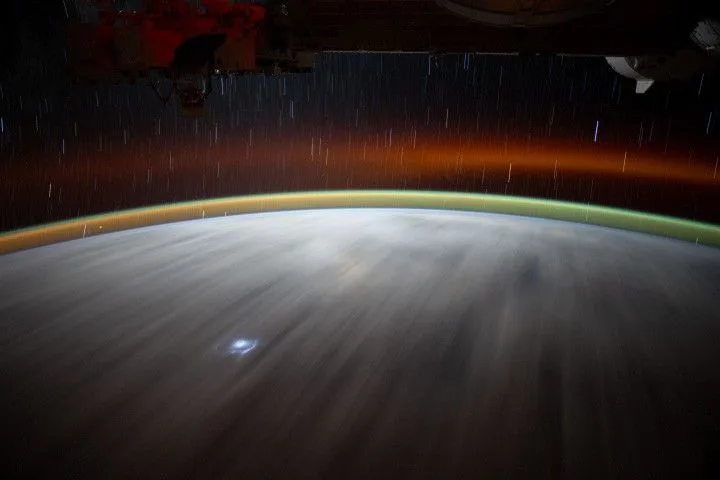
AWE studied a phenomenon called airglow. This faint glow surrounds Earth’s upper atmosphere constantly. Unlike auroras, airglow does not depend on solar storms.
From orbit, airglow appears as soft bands of colored light stretching across the atmosphere. The AWE instrument used infrared imaging to observe tiny changes in this glow.
Those changes allowed scientists to detect atmospheric gravity waves moving through the upper atmosphere.
During its mission, AWE captured four infrared images every second. By the end of the project, the instrument had collected more than 80 million nighttime images.
How Earth’s Storms Reach Space
One of the biggest discoveries from the NASA AWE mission involves how far weather effects can travel.
Scientists already suspected storms could send energy upward through the atmosphere. However, AWE finally provided detailed observations showing this process in action.
Hurricanes and Tornadoes Create Powerful Waves
The mission observed several major weather events during its operation. These included tornado outbreaks across the central United States and Hurricane Helene striking Florida in 2024.
Each storm produced different atmospheric wave patterns.
Researchers discovered that thunderstorms in Texas created smaller and more irregular waves than earlier storms in the same area. Hurricane systems generated larger and more organized patterns.
These observations proved that every storm leaves a unique atmospheric fingerprint.
Waves Travel Into Near-Earth Space
As atmospheric gravity waves rise higher, they interact with the ionosphere. This region contains charged particles and plasma that support radio communications and satellite signals.
The NASA AWE mission showed that these waves can disturb plasma density in the upper atmosphere. Even small changes in plasma density can affect modern technology.
This finding matters because many critical systems rely on stable signals passing through Earth’s upper atmosphere every day.
Why the NASA AWE Mission Matters for Satellites
The NASA AWE mission is important because modern civilization depends heavily on satellites. Communication systems, GPS navigation, weather forecasting, and aviation networks all rely on stable orbital infrastructure.
AWE revealed that Earth’s own weather can interfere with these systems more than scientists previously realized.
GPS and Communication Signals Can Be Disrupted
When atmospheric gravity waves disturb plasma in the upper atmosphere, radio signals can bend or scatter unexpectedly.
That creates problems for:
- GPS navigation
- Satellite communications
- Aircraft positioning systems
- Spacecraft data transmissions
- Military and civilian communication networks
Even small disruptions can reduce positioning accuracy or weaken signal quality.
Scientists involved in the NASA AWE mission found that short horizontal waves between 30 and 300 kilometers wide produced the strongest effects.
The mission was specifically designed to measure these smaller wave structures.
Space Weather Is Not Only About the Sun
Traditionally, researchers linked space weather mainly to solar activity. Solar flares and coronal mass ejections remain major factors.
However, AWE demonstrated that Earth itself also contributes to space weather conditions.
This changes the scientific picture significantly.
Instead of viewing Earth’s atmosphere and near-Earth space as separate systems, scientists now see them as deeply connected layers interacting constantly.
That connection may help researchers improve future space weather forecasts.
The Most Important Discoveries From AWE
The NASA AWE mission produced one of the largest atmospheric imaging datasets ever collected from orbit.
Beyond the raw numbers, the mission also delivered major scientific insights.
More Than 80 Million Images Captured
Over nearly 30 months, the instrument operated continuously during nighttime orbital passes.
Capturing four infrared images every second allowed AWE to monitor atmospheric activity on a massive scale.
Scientists can now analyze:
- Storm-generated wave structures
- Seasonal atmospheric changes
- Regional differences in wave behavior
- Interactions between weather systems and the ionosphere
This dataset will likely support scientific studies for years.
Every Storm Behaves Differently
Another important finding involves the diversity of atmospheric wave patterns.
Not all storms behave the same way. Some generate smooth wave structures. Others create irregular and asymmetric formations.
This complexity surprised researchers.
The NASA AWE mission revealed that local weather conditions, storm intensity, and atmospheric structure all influence how gravity waves travel upward.
As a result, predicting upper atmospheric disturbances may require more advanced forecasting models in the future.
A Better Understanding of Earth-Space Connections
Perhaps the mission’s biggest achievement is conceptual.
Scientists now have stronger evidence that Earth’s atmosphere behaves as one connected system extending into space.
Weather at ground level can influence orbital conditions hundreds of kilometers above Earth.
That idea may improve future satellite operations, communication planning, and atmospheric research missions.
The End of the NASA AWE Mission
NASA officially ended the NASA AWE mission on May 21, 2026.
The ISS robotic arm will soon remove the instrument from its mounting location. NASA plans to use the station’s external platform for a new science payload.
The Next Instrument on the ISS
The next experiment replacing AWE is called CLARREO Pathfinder.
This instrument will measure sunlight reflected from Earth and the Moon with much greater precision than current systems.
Scientists hope the mission will improve climate monitoring and Earth observation research.
While AWE has ended, its scientific impact will continue.
Public Access to AWE Data
NASA plans to make the mission’s data publicly available. Some visualizations already appear through the University of Utah’s online tools.
Researchers, students, and citizen scientists may continue exploring the observations for many years.
That open-access approach could lead to additional discoveries about atmospheric physics and space weather.
NASA AWE Mission Changes How Scientists View Space Weather
The NASA AWE mission revealed an important truth about our planet. Earth’s storms do not stop at the clouds.
Hurricanes, tornadoes, and thunderstorms can send invisible atmospheric waves all the way into near-Earth space. Those waves can disturb satellites, radio systems, and navigation signals that modern life depends on every day.
This discovery expands our understanding of space weather dramatically. Scientists now know that Earth itself plays an active role in shaping the environment around our planet.
Future missions will likely build on these findings. As researchers continue studying atmospheric gravity waves, they may improve satellite reliability, communication systems, and global navigation technology for the future.
Main Sources:
Universe Magazine
https://universemagazine.com/en/nasa-completes-awe-mission-earths-storms-shape-space-weather/
NASA AWE Mission Page
https://science.nasa.gov/mission/awe/
Phys.org
https://phys.org/news/2026-05-nasa-awe-instrument-mission-earth.html