BY:SpaceEyeNews.
🚀 NASA First Fire on the Moon: A New Era of Space Safety
For the first time, NASA is preparing to ignite a controlled flame on the lunar surface. This is not a symbolic milestone. It is a focused safety test. The NASA first fire on the Moon is designed to answer a critical question: do materials behave the same way in lunar gravity as they do on Earth?
As plans for long-term missions move forward, this question becomes urgent. A small ignition inside a closed habitat could quickly become a serious threat. That is why this experiment matters now.
🌕 NASA First Fire on the Moon: Why This Experiment Is Needed
🔍 Earth-Based Testing Has Limits
For years, engineers have relied on a standard flammability test conducted under Earth gravity. Materials pass or fail based on how they react to a controlled flame. The assumption has always been simple—if something is safe on Earth, it should be safe in space.
That assumption is now under pressure.
⚠️ A Critical Gap in Knowledge
The Moon’s gravity is only a fraction of Earth’s. That difference changes how heat moves and how gases behave. It also alters how flames form and spread.
The NASA first fire on the Moon directly addresses this gap. Instead of relying on simulations, scientists will observe real behavior in a real environment.
🛰️ What Previous Experiments Revealed
Earlier studies inside the
Cygnus spacecraft
offered valuable clues. Flames in microgravity appeared rounder and less dynamic. At the same time, they burned longer than expected.
Those findings raised new concerns. However, microgravity is not the same as lunar gravity. The missing piece has always been direct testing on the Moon itself.
🔥 NASA First Fire on the Moon: How Fire Could Change in Lunar Gravity
🌬️ A Different Flow of Oxygen
On Earth, rising heat drives airflow. This movement feeds flames and shapes their behavior. On the Moon, weaker gravity slows that process. Oxygen circulates differently, which changes how fire develops.
Instead of rising sharply, flames may spread in unusual patterns.
🔄 The Blowoff Effect Becomes Weaker
One of the most important differences involves the “blowoff” effect. On Earth, airflow can disrupt combustion and help extinguish flames. In lunar gravity, that effect slows down.
This allows flames to sustain themselves longer than expected.
⚡ Higher Flammability Risks
Research in reduced-gravity environments already suggests a shift. Some materials that barely resist ignition on Earth may become easier to burn in lower gravity.
That possibility is at the core of the NASA first fire on the Moon. It challenges assumptions that have guided material safety for decades.
🏠 Oxygen-Rich Environments Add Pressure
Future lunar habitats will likely contain higher oxygen levels than Earth’s atmosphere. This supports human life but also increases fire sensitivity.
Even a small spark could behave differently under these combined conditions.
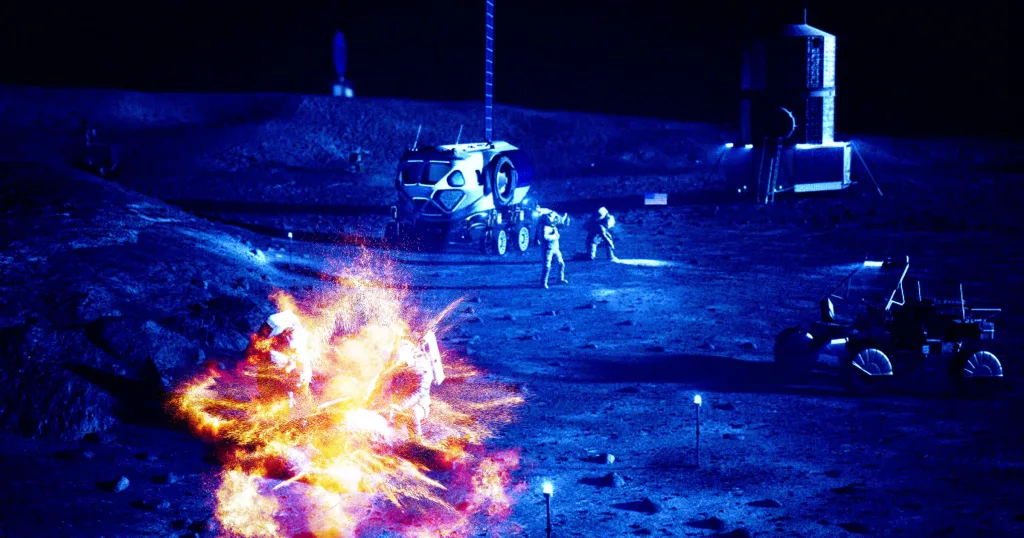
🧪 NASA First Fire on the Moon: Inside the FM2 Experiment
🚀 A Carefully Planned Mission
The experiment, known as FM2, is expected to launch in the coming years. Its goal is clear—observe how selected materials burn under lunar conditions.
🔬 Controlled and Contained Testing
Scientists will not ignite open flames on the surface. Instead, they will use sealed chambers designed to simulate habitable environments. This ensures control while allowing accurate measurement.
📊 Precision Instruments at Work
The setup will include cameras, thermal sensors, and oxygen monitors. Each tool will track a specific part of the combustion process.
Researchers will measure how flames grow, how heat spreads, and how oxygen is consumed.
📈 Building Real Data for the First Time
The NASA first fire on the Moon will produce direct comparisons between Earth and lunar conditions. This data will form the foundation for future safety standards.
⚠️ NASA First Fire on the Moon: What It Means for Future Missions
🌕 Supporting Long-Term Lunar Presence
Programs like the
Artemis program
aim to establish a continuous human presence on the Moon. Achieving that safely requires a deeper understanding of environmental risks.
Fire is one of the most critical.
🚫 Limited Options in Emergencies
On Earth, evacuation is often possible. On the Moon, that option does not exist. Every system must work as expected from the start.
This raises the stakes for accurate testing.
🧑🚀 Rethinking Materials and Design
Key components must be reassessed, including suits, wiring, and structural materials. Even minor differences in flammability could have major consequences.
The NASA first fire on the Moon may lead to new material standards and design strategies.
🌍 Beyond the Moon: A Broader Impact
🚀 Preparing for Deeper Exploration
The lessons from this experiment extend beyond lunar missions. Future journeys to Mars and beyond will face similar conditions.
Understanding fire in reduced gravity is essential for all long-duration missions.
🔬 Closing a Longstanding Knowledge Gap
Fire remains one of the least predictable factors in space environments. Despite decades of research, real-world data has been limited.
This experiment changes that.
🌐 Shaping Future Safety Standards
The results will likely influence how engineers test materials and design habitats. The impact will reach across agencies and future missions.
✅ Conclusion: A Necessary Step Forward
The NASA first fire on the Moon marks a shift in how we approach space safety. It highlights a simple truth—conditions beyond Earth require new understanding.
By studying fire directly on the lunar surface, scientists are reducing uncertainty before it becomes a risk. This is not about creating danger. It is about preventing it.
As humanity prepares to live beyond Earth, even the most familiar elements must be re-examined. Fire helped shape civilization here. Understanding it again may be key to surviving elsewhere.