
BY:SpaceEyeNews.
The dream of a permanent NASA Moon Base is no longer distant science fiction. NASA has now taken major steps toward building long-term infrastructure on the Moon. The agency recently announced new rover contracts, cargo delivery systems, and lunar drone projects designed to prepare the Moon’s south pole for future human activity.
This marks an important shift in space exploration. NASA is no longer planning short lunar visits. Instead, the agency is preparing for continuous operations on the Moon. The latest announcements also reveal something unexpected. NASA officials are now discussing a possible lunar “perimeter” system around the future base area.
That idea raises scientific, technical, and legal questions. It also highlights growing international competition near the Moon’s south pole.
NASA Moon Base Contracts Signal A Major Shift
NASA recently announced several contract awards connected to the future NASA Moon Base initiative. These contracts involve lunar mobility, cargo transportation, and surface mapping technologies.
The agency selected Astrolab and Lunar Outpost to build two advanced lunar rovers. Each rover will weigh about one ton and support future Artemis surface operations.
NASA awarded Astrolab approximately $219 million for its CLV-1 rover. Lunar Outpost received about $220 million for its Pegasus rover project.
Both vehicles are expected to travel up to 200 kilometers across the lunar surface. They will also operate autonomously while receiving guidance from controllers on Earth. Astronauts can drive them directly during future Moon missions as well.
These rovers will help crews transport equipment, explore difficult terrain, and carry scientific payloads.
Blue Origin Expands Its Lunar Role
Blue Origin also secured a major role in the NASA Moon Base program.
NASA selected the company’s Blue Moon Mark 1 lander to deliver both lunar rovers separately to the Moon’s surface. These transportation contracts are worth more than $280 million.
This decision increases Blue Origin’s importance within the Artemis architecture. The company is already involved in cargo missions and future lunar landing systems.
NASA officials believe commercial partnerships will reduce long-term costs and accelerate lunar development. The strategy also allows private companies to test technologies that could support future deep-space missions.
Why NASA Wants The Moon’s South Pole
The future NASA Moon Base will likely sit near the Moon’s south pole. Scientists consider this region one of the most valuable areas on the lunar surface.
Several permanently shadowed craters near the south pole may contain frozen water ice. That resource could become essential for long-term lunar operations.
Water ice offers several advantages:
- Drinking water for astronauts
- Oxygen production
- Rocket fuel manufacturing
- Support for future Mars missions
The south pole also receives long periods of sunlight. That makes solar power generation easier compared to other lunar regions.
Still, the environment remains extremely difficult. Temperatures can swing dramatically. Radiation levels remain high. The terrain is rough and heavily cratered.
NASA wants to understand these conditions in far greater detail before establishing permanent infrastructure.
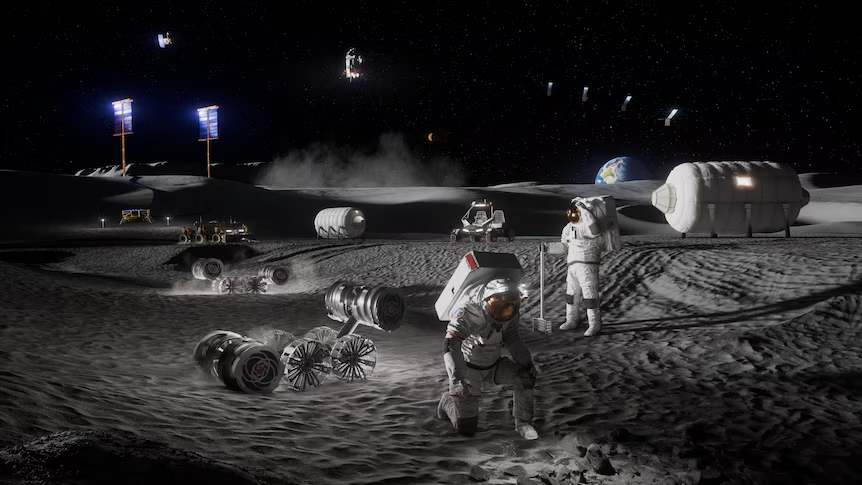
NASA Moon Base Drones Could Transform Lunar Exploration
One of the most ambitious parts of the NASA Moon Base program involves a new system called MoonFall.
NASA’s NASA Jet Propulsion Laboratory is leading development of these specialized lunar drones.
Unlike traditional lunar vehicles, these drones are designed to fly short distances across the Moon’s surface. Each vehicle stands about one meter tall and carries enough propellant for scouting operations.
NASA plans to deploy three or four MoonFall drones before the Artemis IV mission.
Why MoonFall Matters
Current lunar surface imagery still has major limitations. In many areas, surface resolution remains around one meter.
NASA wants MoonFall drones to improve that dramatically. The agency hopes to achieve imagery resolution as detailed as one centimeter.
That level of detail could help scientists identify:
- Safer landing areas
- Hidden hazards
- Scientific targets
- Surface stability
- Lighting conditions
- Ice-rich locations
The drones will also examine permanently shadowed craters where sunlight never reaches the surface.
These regions remain among the coldest places in the Solar System. Yet they may contain some of the Moon’s most valuable resources.
The Surprising NASA Moon Base “Perimeter” Concept
One detail from NASA’s announcement quickly attracted attention.
Officials revealed that retired MoonFall drones may eventually help establish a perimeter around the future NASA Moon Base.
According to lunar base manager Carlos Garcia-Galan, the drones could remain at fixed positions around important operational areas.
NASA may place these drones at the corners of future base zones. From there, they could function as:
- Navigation beacons
- Surface markers
- Retro-reflectors
- Communication nodes
- Early lunar cell towers
At first glance, this may sound simple. In reality, it represents something historically significant.
Humanity may soon create its first structured operational boundary system on another world.
NASA Moon Base Plans Raise Treaty Questions
The idea of a lunar perimeter immediately creates legal concerns.
The Outer Space Treaty clearly states that no nation can claim sovereignty over the Moon or other celestial bodies.
That treaty forms the foundation of modern space law.
Under the agreement:
- No country owns lunar territory
- No nation can claim parts of the Moon
- Space remains open to all humanity
However, modern lunar operations create new challenges that did not exist in 1967.
Future Moon missions may involve:
- Resource extraction
- Permanent infrastructure
- Surface traffic
- Energy systems
- Commercial activity
As more nations reach the Moon, operational conflicts could become possible.
Artemis Accords And Lunar Safety Zones
NASA and dozens of partner nations support the Artemis Accords.
The accords attempt to create guidelines for peaceful lunar activity.
One important concept involves “safety zones.” These areas are designed to prevent harmful interference between missions operating near one another.
NASA officials insist these zones do not represent territorial claims.
Still, critics argue that safety zones could eventually function like unofficial ownership areas.
China has expressed skepticism toward some Artemis Accords concepts. Meanwhile, China’s own lunar plans continue expanding rapidly.
Both the Artemis coalition and China aim to explore the Moon’s south pole during the coming decade.
That competition increases the strategic importance of NASA Moon Base planning.
The Moon Is Becoming An Economic Frontier
The new NASA Moon Base strategy also reveals how strongly commercial companies now shape space exploration.
Private firms are no longer supporting players. Many now build critical infrastructure for future Moon missions.
This could eventually create an entirely new lunar economy.
Possible future industries include:
- Lunar communications
- Surface transportation
- Resource extraction
- Construction systems
- Scientific services
- Power generation
Many experts believe the Moon could eventually become a staging area for deeper exploration across the Solar System.
NASA also sees the Moon as preparation for future Mars missions. Long-duration lunar operations will help engineers test life-support systems, habitats, robotics, and autonomous infrastructure.
NASA Moon Base Development Is Entering A New Era
The latest NASA announcements show that lunar exploration is entering a completely different phase.
The agency is moving beyond temporary missions and short surface visits. Instead, NASA is beginning to build the foundation for long-term lunar operations.
The combination of autonomous rovers, cargo landers, MoonFall drones, and possible lunar perimeter systems demonstrates how serious these plans have become.
At the same time, legal questions surrounding lunar boundaries and safety zones remain unresolved.
The next decade may determine not only how humans live on the Moon, but also who shapes the future rules of space exploration itself.
Main Sources:
- https://arstechnica.com/space/2026/05/nasa-takes-steps-toward-building-moon-base-including-discussing-a-perimeter/
- https://www.nasa.gov/artemis/
- https://www.nasa.gov/humans-in-space/artemis-accords/
- https://www.space.com/artemis-program
- https://www.blueorigin.com/