BY:SpaceEyeNews.
For years, the idea of a NASA Moon base sounded like a distant promise. Now it feels more concrete. NASA is not just talking about brief lunar visits anymore. The agency is shaping the systems that could support a long-term human presence on the Moon. That shift is what makes this story important now. Recent NASA planning, lunar resource research, and new U.S. policy on space nuclear power all point in the same direction: the Moon is becoming a place where infrastructure matters as much as exploration. NASA’s own Artemis planning has long focused on the lunar south pole because of light, terrain, and access to frozen water. More recent NASA and White House documents show that power systems, especially fission surface power, are also moving closer to mission reality.
The article that sparked this discussion uses bold wording. It says NASA plans to build the first permanent human base on the Moon with water. That captures the excitement, but the more accurate version is slightly different. NASA is building toward a sustainable lunar outpost, not announcing a finished permanent settlement tomorrow. That distinction matters. It makes the story stronger, not weaker, because it shows how real progress actually works in spaceflight. A true NASA Moon base will not appear all at once. It will emerge step by step through site selection, resource mapping, cargo delivery, power deployment, robotic preparation, and repeated crewed missions. NASA’s own documents describe this as Artemis Base Camp and a sustained lunar presence, especially at the south pole.
NASA Moon Base and the Race to the South Pole
The center of the NASA Moon base concept is the lunar south pole. That region stands out for practical reasons, not just symbolism. NASA has emphasized three core factors there: light, water, and elevation. Some high areas near the south pole receive long periods of sunlight. That helps with solar power and thermal stability. Nearby shadowed regions may hold water ice. That makes the area far more useful than many equatorial regions, where temperature swings are more extreme and known resources appear less favorable.
NASA has discussed several candidate regions for future missions. Shackleton-related terrain and Mons Mouton often come up in conversations about south-pole access and landing options. Yet NASA has not presented one final locked site for a full outpost. That is an important point for readers. The agency still needs better local data, more surface experience, and more engineering trade studies before it can commit to a final base layout. In other words, the NASA Moon base story is real, but it is still in the architecture phase.
Why this location matters more than any other
Location will decide whether a lunar outpost becomes efficient or fragile. A poorly chosen site would make every mission harder. A better site could reduce risk for years. That is why NASA keeps returning to the same south-pole logic. The right terrain could support landing operations, rover travel, power generation, and easier access to shadowed ice deposits. If NASA wants a lasting foothold instead of a series of isolated visits, the base must sit where nature offers at least some strategic help.
NASA Moon Base Depends on Water More Than Anything Else
If one resource could change the future of a NASA Moon base, it is water. NASA has made that clear in both its science and exploration work. Water matters because it is not just water. It supports drinking, hygiene, oxygen production, and potentially fuel production through electrolysis. That means water can reduce the amount of mass that must launch from Earth. In space exploration, that changes everything.
NASA’s science pages now state plainly that there is water on the Moon. Ancient ice appears to exist in permanently shadowed crater floors. Water molecules also exist on sunlit parts of the surface, though in lower concentrations and different forms. That is a major change from older assumptions. For decades, the Moon looked dry. New data changed that picture. In 2020, NASA announced the discovery of water on the sunlit lunar surface. In 2023, a wider-area map extended water clues toward the south pole, the same broad region tied to Artemis exploration.
Still, water presence does not automatically solve the problem. The harder question is access. How much ice exists in forms that astronauts or robotic systems can actually extract? How deep is it? How pure is it? How much energy will mining and processing require? Those are the questions that separate a promising region from a functioning NASA Moon base. This is why resource-hunting missions and mapping tools matter so much. NASA has spent years preparing for that phase. The agency selected instruments and rover concepts specifically to study water ice distribution near the south pole.
Water is not a bonus. It is infrastructure.
Many headlines frame lunar water as a scientific curiosity. That undersells the issue. For a future NASA Moon base, water is infrastructure. A base without local water would remain heavily dependent on Earth. A base with usable local water could slowly become more independent. That is the real divide. Once a mission starts using local resources, it stops behaving like a short expedition and starts behaving like a frontier outpost. That is one reason the Moon now looks strategically important again.
NASA Moon Base Will Need More Than Solar Power
Power is the second pillar of a real NASA Moon base. Solar power will play a major role. The south pole helps because some elevated areas receive extended sunlight. But sunlight alone is not enough for a lasting outpost. The Moon’s day-night cycle is harsh. A lunar night lasts about two Earth weeks. During that period, temperatures plunge and solar generation drops away. If crews, life-support systems, communications, and surface operations must continue through that darkness, the outpost needs another dependable source of energy.
That is where fission surface power enters the story. NASA says it is collaborating with the U.S. Department of Energy and industry to design, fabricate, and test a 40-kilowatt-class fission system for use on the Moon in the early 2030s. NASA has also stated in a January 2026 release that a lunar surface reactor would provide safe, efficient, plentiful electrical power for future sustained lunar missions, regardless of sunlight or temperature. This is one of the clearest signs that the NASA Moon base concept is evolving from broad vision into specific systems planning.
The White House has reinforced that direction. A December 2025 fact sheet says the administration directed deployment of nuclear reactors on the Moon and in orbit, including a lunar surface reactor ready for launch by 2030. It also refers to establishing initial elements of a permanent lunar outpost by 2030. That language is significant. It does not mean a complete base will exist by that date. It does mean the power question is now central at the national-policy level, not just in engineering workshops.
Why a reactor changes the lunar equation
Reliable power changes how a NASA Moon base can function. It supports survival during darkness. It enables steady communications. It powers scientific instruments and resource processing hardware. It can also reduce the need for oversized battery systems or risky operational gaps. In simple terms, a reactor turns the Moon from a place where crews must pause often into a place where systems can keep working continuously. That is a huge difference in exploration tempo.
Robots Will Build the NASA Moon Base Before People Live There
No serious NASA Moon base begins with astronauts landing and setting up a finished habitat in a few days. The Moon is too difficult for that approach. NASA’s own planning makes clear that robotic work comes first. Machines will scout terrain, study resources, map hazards, prepare landing zones, and test local conditions before long crew stays become practical.
That robotic phase matters for another reason. Lunar dust is a major problem. It is abrasive, clingy, and destructive to equipment. Repeated landings can also blast loose regolith across the surface. A base site cannot remain a raw patch of terrain forever. NASA has already discussed the need to harden or prepare landing areas and to use regolith testbeds on Earth to study how lunar materials behave. These steps may sound technical, but they are central to making a NASA Moon base safe and repeatable.
Habitats will likely start small and modular
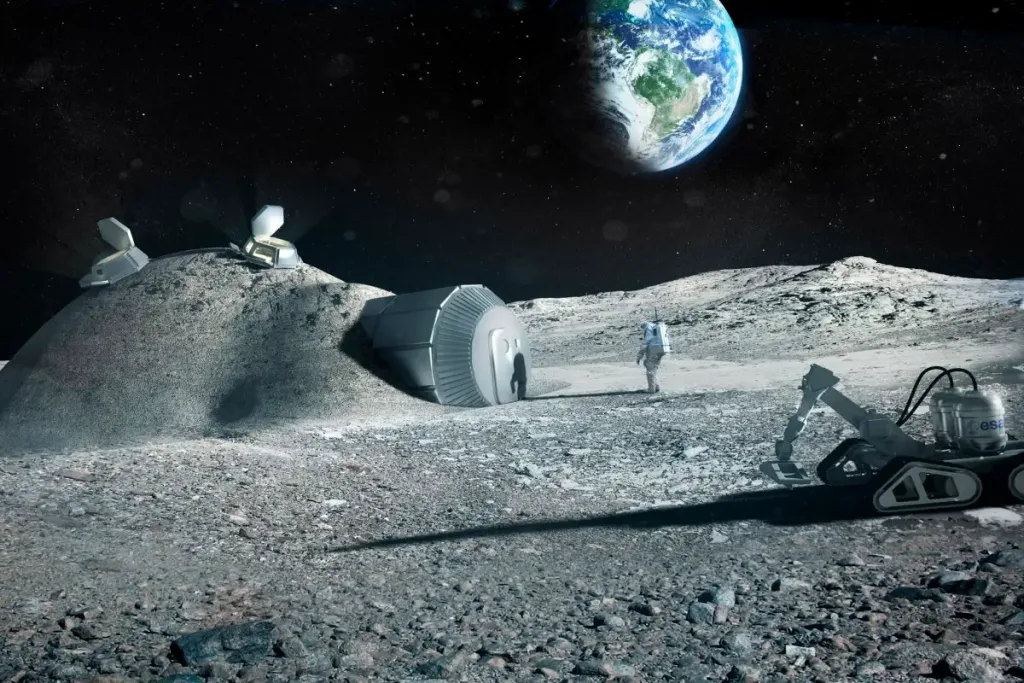
NASA’s long-term Moon planning points toward modular systems. That makes sense. Smaller units are easier to launch, land, deploy, and expand. A base can begin as a set of connected elements rather than a single giant structure. Over time, surface systems may use local regolith for shielding or construction support. NASA has described Artemis Base Camp as a framework for longer lunar stays, not as a giant science-fiction dome. That grounded approach is exactly why the plan deserves attention. It looks difficult, but it also looks technically plausible.
What “Permanent” Really Means for a NASA Moon Base
This is where many headlines oversimplify the story. A NASA Moon base can be called permanent in a political or strategic sense long before it is permanently occupied every day. There is a big difference between four stages: short missions, repeated missions, sustained infrastructure, and continuous habitation. NASA is clearly advancing toward the third stage. The fourth stage could come later, but it depends on budgets, launch reliability, landing systems, resource use, and surface power all working together over time.
That is why precise wording matters. NASA’s official language often refers to sustained lunar exploration, Artemis Base Camp, and a sustainable foothold. Those phrases are more careful than “permanent base,” but they point in the same overall direction. The strength of the current moment is not that every detail is settled. It is that the pieces are finally starting to align. NASA has a target region. NASA has evidence for useful local resources. NASA has active power planning. NASA also has a broader exploration framework built around repeated lunar operations. That combination makes the NASA Moon base concept more serious than it was even a few years ago.
The Real Meaning of the NASA Moon Base Story
The most interesting part of this story is not the headline itself. It is the shift underneath the headline. For decades, lunar return plans often centered on flags, footprints, and symbolic milestones. The modern NASA Moon base vision is different. It is about systems. It is about staying longer. It is about using local resources. It is about building enough power and enough infrastructure to make the Moon useful, not just reachable.
That is why the lunar south pole matters so much. It offers the best known overlap of light, terrain advantages, and possible water access. That is why fission power matters. It offers a path through the long lunar night. That is why robotic preparation matters. It lowers risk before larger crews arrive. When those threads come together, the phrase NASA Moon base stops sounding like fiction and starts sounding like a long engineering campaign.
NASA still faces real obstacles. Funding can change. Timelines can slip. Hardware can fail. Surface operations can reveal surprises. Even so, the direction is clearer now. The Moon is no longer just the destination. It is becoming the test site for sustained human operations beyond Earth. If that trend continues, the first true NASA Moon base may begin not with one dramatic landing, but with a series of quieter milestones that slowly turn the lunar south pole into humanity’s first durable foothold off our planet.
Main Sources:
- NASA’s Artemis Base Camp on the Moon Will Need Light, Water, Elevation
- Moon Water and Ices – NASA Science
- Fission Surface Power – NASA
- Fact Sheet: President Donald J. Trump Launches a New Age of American Space Achievement
- NASA’s Lunar Exploration Program Overview (Artemis Plan PDF)
- NASA, Department of Energy to Develop Lunar Surface Reactor by 2030
- NASA’s Plan for Sustained Lunar Exploration and Development (PDF)