
BY:SpaceEyeNews.
The NASA Moon race is entering a phase where completed tests matter more than confident promises. A commercial cargo lander has passed demanding ground checks. Meanwhile, NASA is preparing demonstrations that could shape its next crewed lunar landing.
Administrator Jared Isaacman has expressed confidence that the United States can prevail. Yet that confidence rests on several missions delivering results in sequence. Griffin-1 must prove its delivery capability, while commercial crewed landers face separate challenges.
These developments strengthen NASA’s preparations. They also reveal why no single launch can settle the wider competition to establish reliable lunar operations.
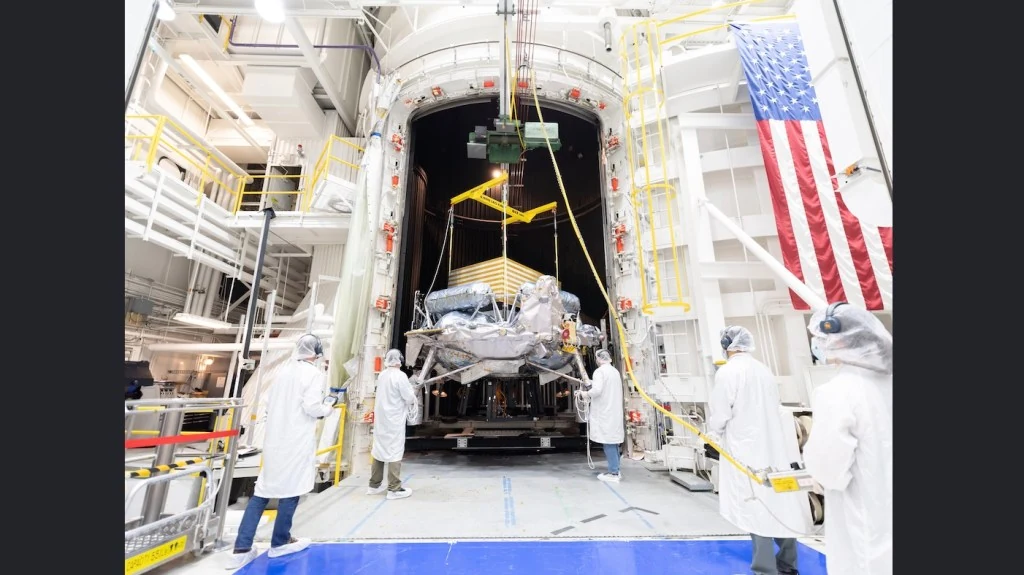
Griffin-1 lunar lander inside NASA JPL’s testing facility.Credit: NASA/JPL-Caltech — original photograph.
Griffin-1 Passes Demanding Ground Tests
Griffin-1 recently completed environmental testing at NASA’s Jet Propulsion Laboratory. Engineers examined how the spacecraft responds to conditions expected during launch and spaceflight.
Shaking, Sound and Temperature
Hundreds of sensors monitored the lander during vibration tests in three directions. Acoustic testing exposed the spacecraft to sound levels reaching 153 decibels.
The team also placed Griffin inside a thermal vacuum chamber. Over approximately two weeks, testing temperatures reached 75 degrees Celsius and dropped to minus 100.
These checks challenged the spacecraft’s ability to tolerate severe conditions. They gave engineers evidence about the assembled vehicle’s performance before flight.
Checking the Complete Spacecraft
Other tests examined how its systems interact. Engineers measured mass properties using a rotating table. Those measurements help teams understand spacecraft motion and support navigation planning.
Electromagnetic compatibility checks addressed another potential problem: interference between electronic components. A spacecraft must operate as a complete system, with its instruments and electronics working together.
NASA announced the testing milestone in October. However, passing environmental tests does not guarantee a successful journey or landing. Flight operations must still demonstrate capabilities that ground facilities cannot fully reproduce.
Why Griffin Matters to the NASA Moon Race
Griffin’s planned mission connects engineering progress with practical surface exploration. NASA lists its destination near Nobile Crater at the lunar South Pole.
The mission aims to deliver more than 1,100 pounds of cargo, approximately 500 kilograms. Astrolab’s FLIP rover forms part of that delivery. NASA expects its mobility work to inform future lunar terrain vehicle operations.
Voyager identifies ten payloads from six countries aboard Griffin-1. That gives several teams an opportunity to gather operating experience through one commercial mission.
Delivery Must Lead to Useful Operations
The important outcome extends beyond arrival. Surface equipment must function well enough to generate useful measurements and demonstrate its intended capabilities.
Successful cargo delivery could strengthen confidence in future missions carrying rovers, instruments, and infrastructure. Nevertheless, one success would establish an initial demonstration, rather than a dependable delivery service.
Timing also requires care. NASA currently lists Griffin-1 for late 2026, without confirming a November launch. Claims that the mission could secure victory this month therefore exceed the published schedule and its purpose.
NASA’s Route From Rehearsal to Landing
For astronauts, NASA’s next major preparation step involves operating spacecraft together. Artemis III is planned for Earth orbit in 2027.
During the proposed fourteen-day mission, four astronauts would test procedures involving Orion and commercial lander test vehicles. The objectives include rendezvous, docking, and crew operations.
Testing Connections Before Departure
NASA’s November update describes a sequence involving both commercial providers. Blue Origin would launch its test vehicle before Orion arrives with the crew.
Following operations with Blue Moon, Orion would separate and later dock with a SpaceX Starship test vehicle. This sequence would examine interfaces and procedures that must work during subsequent expeditions.
The value lies in discovering problems while teams can apply the lessons to later missions. Successful demonstrations would replace assumptions with operational evidence.
Two Commercial Landing Options
SpaceX’s proposed approach depends on refueling Starship in Earth orbit. Blue Origin’s architecture uses transfer stages to send Blue Moon toward the Moon.
Both companies target support for a crewed landing in 2028. Developing alternatives gives NASA flexibility if one provider encounters delays.
However, parallel development cannot remove every shared dependency. Orion, mission operations, surface equipment, and other supporting capabilities must also meet their requirements.
China’s Lunar Timeline Adds Urgency
China continues to target its first crewed lunar landing before 2030. Its program includes the Long March 10 rocket, Mengzhou spacecraft, and Lanyue lander.
The China Manned Space Agency has identified verification flights and initial spacecraft demonstrations among its upcoming tasks. Those milestones offer concrete ways to follow progress.
Comparing the programs requires more than placing target years beside each other. Each architecture has its own sequence of tests and operational requirements.
NASA’s published Artemis IV mission information targets 2028, with some pages specifying early that year. Isaacman discussed the end of 2028 in his interview.
That difference supports using the broader annual target when describing the NASA Moon race. Neither program’s stated deadline establishes an assured lead or guarantees when astronauts will reach the surface.
What Must Happen Next
Artemis IV would carry the campaign from rehearsals into a crewed surface expedition. NASA describes two astronauts spending approximately a week near the lunar South Pole.
Their planned work includes scientific observations and sample collection. They must then return to their colleagues in lunar orbit for the journey home.
Surface Readiness Also Matters
NASA identifies Axiom Space as its spacesuit provider. These systems must support astronauts outside their lander, adding another essential requirement to mission readiness.
A successful rocket flight cannot demonstrate every capability needed for that expedition. Progress must connect transportation, surface work, and safe return.
Meanwhile, NASA’s new astronaut recruitment campaign supports future missions. Applications close December 3, with selection expected in late 2027.
Recruitment expands the future talent pipeline. It does not resolve the immediate engineering challenges facing the first landing attempt.
Keeping Missions Moving
Isaacman also emphasizes flying major missions at least annually. Regular operations can help teams retain experience and improve procedures between flights.
That ambition brings its own test: maintaining a useful schedule while allowing time to investigate problems. Frequency matters most when each mission answers a necessary question. Repeating launches without resolving weaknesses would offer less value than steadily expanding demonstrated capability.
NASA Moon Race: Evidence Will Decide
NASA’s recent progress gives its lunar ambitions a firmer technical foundation. Griffin’s testing, planned spacecraft demonstrations, and commercial development all address specific requirements.
The next question is whether those preparations produce successful missions on a workable schedule. Readers should watch completed objectives, functioning hardware, and lessons applied between flights.
Ultimately, the NASA Moon race extends beyond a headline date. Reliable exploration requires useful deliveries, productive surface operations, and the ability to return. Those achievements will provide the clearest measure of progress.
Main Sources:
- NASA — Griffin-1 testing at JPL: https://www.nasa.gov/missions/moon-base/nasa-jpl-testing-readies-voyager-technologies-lander-for-moon-mission/
- NASA — Griffin-1 mission schedule: https://www.nasa.gov/event/clps-flight-astrobotics-griffin-mission-one/
- Voyager Technologies — Griffin-1 acceptance testing: https://voyagertechnologies.com/press-releases/voyagers-griffin-1-on-track-for-the-moon/
- NASA — Updated Artemis plans: https://www.nasa.gov/missions/artemis/nasa-shares-plans-to-accelerate-artemis-return-to-moon/
- NASA — Artemis IV: https://www.nasa.gov/mission/artemis-iv/
- China Manned Space Agency — Mission development update: https://www.cmse.gov.cn/xwzx/202605/t20260523_57542.html
- NASA — Astronaut recruitment: https://www.nasa.gov/news-release/nasa-seeks-next-generation-of-explorers-to-join-astronaut-corps/
- Space.com — Original Jared Isaacman interview: https://www.space.com/space-exploration/i-think-we-will-prevail-nasa-chief-jared-isaacman-on-artemis-china-and-the-new-moon-race-exclusive
You Might Also Like:
US China Moon Race Enters New Phase-Video
Chang’e-6 Lunar Samples Reveal Rare CI Chondrite Traces on the Moon’s Far Side-Video
Moon Reactor Race! China-Russia vs NASA Nuclear Race! (Video)
Two Asteroid Encounters Reveal a New Deep-Space Race