
BY:SpaceEyeNews.
NASA PUNCH solar storm forecasting has produced an unusually precise result in its first proof-of-concept test. Using continuous images of a coronal mass ejection, researchers tracked the solar cloud across most of its journey toward Earth. Their model settled on an arrival estimate about eight hours before the event reached our planet. The prediction proved accurate to within roughly 30 minutes.
That result could mark a major advance for space-weather forecasting. However, it needs careful context. Scientists produced the estimate retrospectively from one event. They did not issue it as a live public warning. Even so, the test shows how continuous observations could replace much of the uncertainty that forecasters face today.
NASA PUNCH solar storm forecasting closes an observation gap
Solar observatories already provide detailed images of coronal mass ejections, or CMEs, near the Sun. The challenge begins as these enormous clouds move farther away. Traditional coronagraphs usually lose sight of them after the early stage of their journey.
Before PUNCH, researchers could directly follow a CME through only about one-fifth of the distance between the Sun and Earth. They then had to estimate how it would behave across the remaining space. A CME may slow down, expand, change shape, or interact with the surrounding solar wind. Each change can shift its expected arrival time.
NASA launched PUNCH, short for Polarimeter to Unify the Corona and Heliosphere, on March 11, 2025. The mission consists of four small spacecraft in low Earth orbit. Together, they work like one virtual instrument about 8,000 miles across.
One spacecraft carries a Narrow Field Imager, which studies the region close to the Sun. The other three carry Wide Field Imagers. Their combined view covers a much larger part of the inner solar system.
PUNCH measures faint sunlight scattered by electrons in the solar wind. The mission then combines the observations into wide-field images. According to NASA, it can produce a new image every four minutes. This approach lets scientists watch solar material move from the outer corona toward Earth instead of relying mainly on early observations.
How PUNCH tracked the eruption toward Earth
Researchers tested the method with a CME that left the Sun on May 31, 2025. They fed a sequence of PUNCH images into a computer model. The model followed the eruption’s bright leading edge while the cloud crossed the inner solar system.
A simple model supported by continuous images
The team did not begin with an unusually elaborate forecasting system. Instead, it used a simple geometric model based on the cloud’s speed, direction, and expanding shape. Researchers compared that shape to an ice-cream cone. Its narrow end represented the CME’s origin, while the wider section represented the growing cloud.
This simplicity makes the result especially interesting. Better observational coverage supplied much of the improvement. Each new image showed how the front was actually moving. Therefore, the model needed less long-range extrapolation from data collected near the Sun.
NASA reported that the estimate eventually stabilized. That detail matters because forecasters need to know when a prediction has become reliable. A constantly shifting estimate offers limited operational value, even if its final number looks accurate afterward.
Eight hours ahead with 30-minute accuracy
Once the estimate stabilized, the model indicated that the CME would reach Earth about eight hours later. Its predicted arrival differed from the observed time by only around 30 minutes. NASA described that result as about ten times more precise than methods that provide an arrival window near five hours.
The wording requires one important clarification. PUNCH did not provide only 30 minutes of notice. Instead, the model produced an estimate roughly eight hours ahead, and that estimate had an error of about 30 minutes. Confusing those figures would significantly understate the available warning time.
Why more accurate CME timing matters
A narrower arrival window could help organizations make better-timed decisions. Satellite operators may place sensitive systems into safer configurations. Power-grid managers could monitor vulnerable equipment more closely. Communications providers may also prepare for possible changes in signal conditions.
More precise forecasts could support crewed spaceflight as well. Teams responsible for astronauts could adjust activities or direct crews toward better-protected areas when necessary.
Accurate arrival timing does not reveal the CME’s full effect, however. The cloud’s magnetic field plays a major role in determining how strongly it interacts with Earth’s magnetic environment. Two CMEs with similar speeds can produce very different outcomes. PUNCH improves tracking, but forecasters still need other measurements and models to estimate severity.
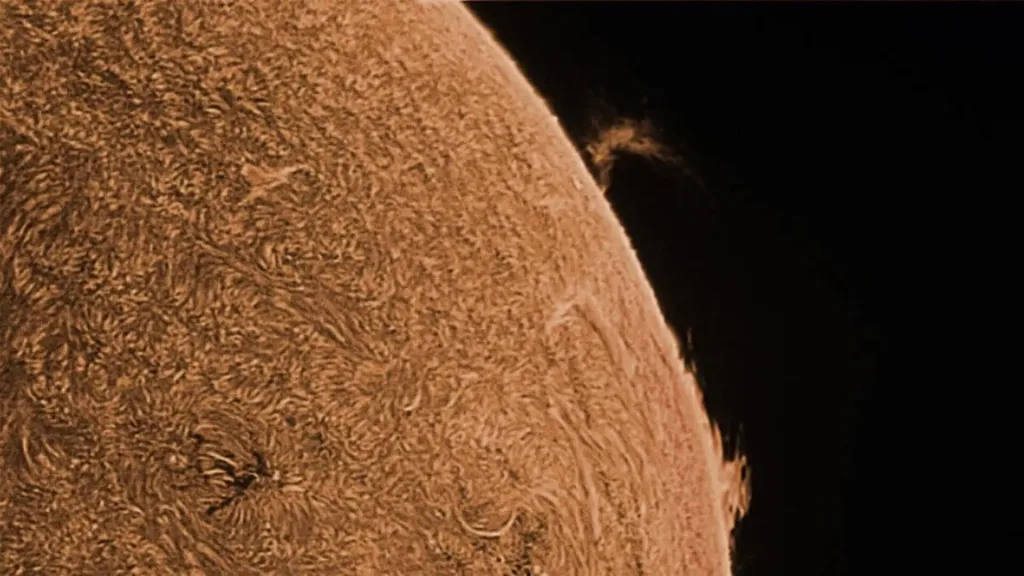
NASA PUNCH Tracks Solar Eruption to Earth, Predicts Arrival Within 30 Minutes.
PUNCH also reveals changing solar-cloud structures
The images offer scientific value beyond arrival predictions. NASA scientists found that CME clouds appeared clumpier than earlier observations suggested. The structures also continued evolving as they crossed the inner solar system.
Those details can improve researchers’ understanding of how plasma behaves in space. They may also help future models describe the changing shape and density of a CME more realistically. In time, those improvements could support forecasts that address both timing and possible effects.
NASA PUNCH solar storm forecasting still needs wider testing
The first result is impressive, but it does not prove that every future forecast will reach the same accuracy. The team analyzed one event retrospectively. The findings were presented at the Committee on Space Research Scientific Assembly. They remained under review by the journal Space Weather when NASA announced them.
Researchers must now test the technique across many eruptions. Slow, fast, wide, narrow, and interacting CMEs may present different challenges. Live forecasting will also test whether teams can process the imagery and deliver stable estimates quickly enough for real decisions.
Still, NASA PUNCH solar storm forecasting demonstrates what becomes possible when scientists can follow an eruption instead of losing sight of it. The mission predicted an arrival about eight hours in advance with roughly 30-minute accuracy. If future events confirm that performance, PUNCH could turn a major observational gap into a clearer and more useful view of space weather approaching Earth.
Main sources:
- NASA: PUNCH Sharpens Solar Storm Forecasting in First Test
- Southwest Research Institute: PUNCH’s Potential to Improve Space Weather Forecasts
- NOAA Space Weather Prediction Center: Coronal Mass Ejections