
BY:SpaceEyeNews.
For years, scientists believed planets beyond our solar system were rare and difficult to find. Today, that idea has completely changed. NASA has now revealed one of the most detailed exoplanet panoramas ever assembled, showing a sky crowded with distant worlds across our galaxy.
The new mosaic comes from the Transiting Exoplanet Survey Satellite, better known as TESS. After seven years of observations, the mission has combined massive amounts of sky data into a single panoramic map containing thousands of confirmed and candidate planets.
The result is more than a beautiful cosmic image. It is a growing planetary census of our galactic neighborhood. Some of these worlds may resemble Earth. Others orbit two stars, survive under extreme heat, or exist inside potentially habitable regions where liquid water could form.
Most importantly, many of these planets sit close enough for future atmospheric studies using advanced observatories like the James Webb Space Telescope.
How TESS Built Its Largest Planet Map Yet
Seven Years of Sky Scanning
Since launching in 2018, TESS has steadily surveyed the night sky using four wide-field cameras. The spacecraft searches for tiny brightness dips caused when planets pass in front of their stars. Scientists call this the transit method.
Unlike earlier planet-hunting missions, TESS focuses heavily on stars relatively close to Earth. That strategy gives astronomers better opportunities for future follow-up observations.
The newly released mosaic combines 96 sectors observed between April 2018 and September 2025. Each sector represents about one month of continuous monitoring. Repeated observations allow scientists to separate real planetary signals from random stellar activity.
The completed map contains:
- 679 confirmed exoplanets
- More than 5,000 planet candidates
- Dense star regions across the Milky Way
- Neighboring dwarf galaxies visible in the background
The glowing galactic arc running through the center represents the Milky Way plane. Bright patches near the lower region include the Large Magellanic Cloud, one of the Milky Way’s nearby galactic companions.
Why This Mosaic Matters
This release marks the most complete panoramic TESS image ever produced. More importantly, it demonstrates how dramatically exoplanet science has evolved during the past two decades.
Only a generation ago, scientists had not confirmed a single exoplanet around a Sun-like star. Today, astronomers track thousands of worlds across the galaxy.
Many of the orange markers inside the map still await confirmation. As analysis continues, researchers expect the catalog to grow significantly larger.
The mission has already uncovered systems unlike anything inside our own solar system. Some planets appear larger than Jupiter. Others orbit their stars in just a few days. Several may exist in regions where temperatures could allow liquid water to survive.
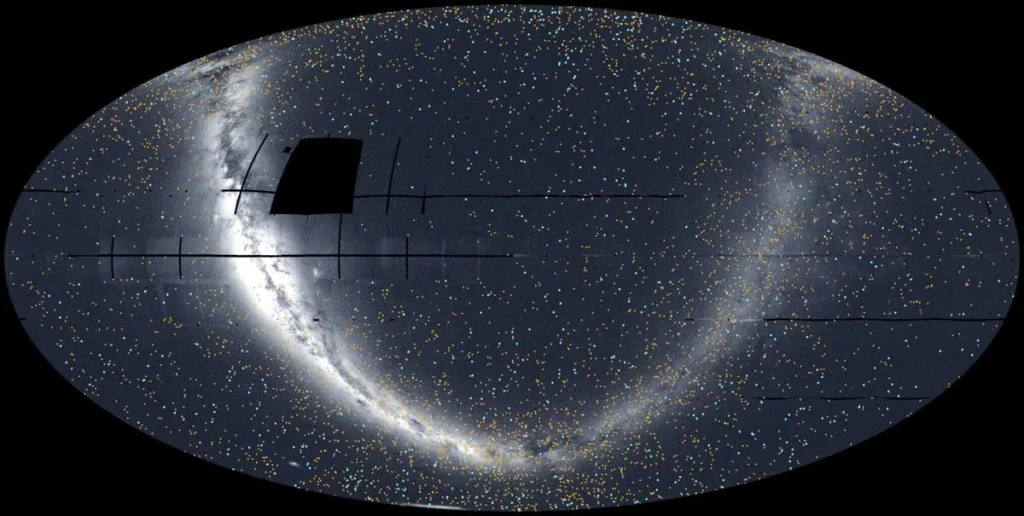
NASA planet hunter reveals thousands of potential alien worlds.
Alien Worlds Hidden Inside the TESS Database
Strange Planetary Systems Across the Galaxy
One reason TESS continues attracting global attention is the incredible variety of worlds it detects.
Some planets orbit extremely close to their stars and likely experience surface temperatures hot enough to melt rock. Others slowly break apart under intense stellar gravity and radiation.
Researchers have also identified planets orbiting binary stars. In those systems, two suns may rise and set across the same sky.
The growing catalog includes:
- Giant gas worlds
- Rocky super-Earths
- Volcanic planets
- Fast-orbiting planets
- Multi-star systems
Several discoveries challenge current ideas about planetary formation and stability.
The Search for Habitable Planets
Some of the mission’s most valuable discoveries lie inside habitable zones. These are orbital regions where temperatures may allow liquid water to exist on a planet’s surface.
Water remains one of the key ingredients associated with life. That possibility makes habitable-zone planets especially important for future studies.
Because TESS focuses on nearby stars, many of its discoveries become ideal targets for atmospheric analysis. The James Webb Space Telescope already studies several planets first detected by TESS.
Scientists search planetary atmospheres for gases such as:
- Water vapor
- Oxygen
- Methane
- Carbon dioxide
Those chemical signatures could eventually help researchers identify worlds with Earth-like environmental conditions.
Still, astronomers remain careful. Detecting life from light-years away remains extremely difficult. Many natural processes can mimic biological signals.
Even so, the growing TESS catalog continues narrowing the search.
Why Nearby Stars Matter
Distance plays a major role in exoplanet science.
Earlier missions often detected planets located extremely far away. Those discoveries proved planets are common, but detailed atmospheric observations remained difficult.
TESS changed that strategy by prioritizing nearby bright stars. That decision now gives future telescopes a much stronger chance of studying alien atmospheres in detail.
Scientists believe this nearby-target approach could eventually lead to the first strong evidence of potentially life-supporting environments beyond Earth.
Why TESS Is Changing Modern Astronomy
More Than an Exoplanet Mission
Although TESS was designed primarily to discover planets, the spacecraft now contributes to several areas of astronomy.
Researchers also use TESS data to study:
- Stellar eruptions
- Young star streams
- Variable stars
- Galactic structure
- Near-Earth asteroids
The mission continuously records brightness information from millions of stars. That enormous archive allows scientists to monitor changes across the sky over long periods.
As the dataset grows, researchers continue uncovering new patterns and unexpected signals.
Artificial Intelligence Is Accelerating Discoveries
Modern exoplanet science increasingly depends on artificial intelligence and automated analysis systems.
Machine-learning tools now scan huge datasets searching for subtle brightness patterns linked to orbiting planets. Some signals appear too weak or irregular for traditional methods to detect easily.
AI-assisted systems help researchers identify:
- Possible planetary transits
- Multi-planet systems
- Unusual orbital behavior
- Stellar activity variations
Scientists believe many undiscovered planets still remain hidden inside the TESS archive.
The Future of Planet Exploration
TESS also prepares the foundation for future astronomy missions.
Upcoming observatories may eventually study many of these planets in remarkable detail. Researchers hope future instruments will analyze:
- Atmospheric chemistry
- Surface temperatures
- Cloud layers
- Planetary weather systems
- Possible biosignatures
The mission’s importance will likely grow throughout the next decade as more powerful telescopes enter service.
Every new discovery improves humanity’s understanding of how planets form and evolve across the galaxy.
Could One of These Worlds Support Life?
The biggest question surrounding modern exoplanet research remains impossible to ignore: could one of these worlds actually support life?
Scientists still do not know. However, the number of potentially interesting planets continues rising rapidly.
Each discovery improves the chances of finding a world with conditions similar to Earth.
Future telescopes may eventually identify strong atmospheric biosignatures around a nearby exoplanet. Such a breakthrough would become one of the most important discoveries in scientific history.
For now, TESS continues expanding humanity’s cosmic map one planet at a time.
The mission reveals a galaxy filled with worlds of every imaginable kind. Some may remain barren forever. Others could contain oceans, thick atmospheres, or environments unlike anything found in our solar system.
For the first time in human history, scientists are not simply imagining alien worlds. They are systematically cataloging them.
Main Sources:
NASA TESS Mission
https://science.nasa.gov/mission/tess/
NASA Sky Mosaic Release
https://science.nasa.gov/missions/tess/nasas-planet-hunting-tess-reveals-dazzling-night-sky/
Daily Galaxy Report
https://dailygalaxy.com/2026/05/nasa-tess-sky-thousands-alien-worlds/