
BY:SpaceEyeNews.
NASA Venus missions could soon move a longstanding planetary mystery into sharper focus. DAVINCI and VERITAS will investigate how a world resembling Earth in size developed such different conditions. Fresh mission updates suggest renewed momentum after years of delays and budget uncertainty. Together, these spacecraft aim to connect Venus’s atmospheric history with the geological clues hidden beneath its clouds.
The opportunity goes beyond returning to a neglected destination. Scientists need measurements that can test competing explanations for Venus’s evolution. These missions approach that challenge from two different directions.
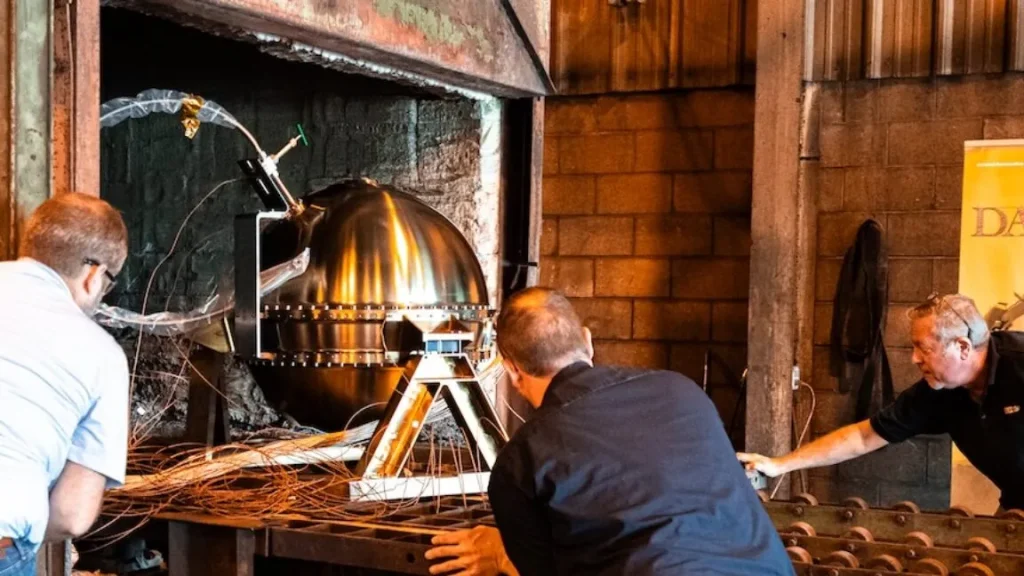
NASA Venus Missions: DAVINCI Probe Undergoes Thermal Testing.
NASA Venus Missions Regain Momentum
NASA selected DAVINCI and VERITAS in 2021. However, selection did not guarantee a smooth path toward launch. Staffing pressures and wider program difficulties subsequently slowed progress.
In 2022, NASA announced a delay of at least three years for VERITAS. That decision followed an independent review into problems affecting the Psyche mission. NASA linked the postponement to staffing needs at its Jet Propulsion Laboratory. www.nasa.gov
New Targets, With Important Qualifications
An October 2026 update from Ars Technica describes renewed staffing and development activity. It gives DAVINCI a December 2030 launch target and VERITAS a November 2032 target, citing mission scientists.
Those dates remain planning targets. NASA’s accessible VERITAS overview still lists launch as no earlier than 2031. Public agency pages do not yet consistently reflect the detailed timetable described in the update. science.nasa.gov
For readers, the distinction matters: renewed progress strengthens the outlook, but development milestones must still follow.
DAVINCI Will Read Venus’s Atmospheric History
DAVINCI will carry a descent probe through the atmosphere, collecting measurements as conditions change around it. Its instruments will examine gases that preserve clues about the planet’s origins and evolution.
Noble gases offer one route into that history. Other measurements will investigate atmospheric chemistry and the processes operating near the surface. Together, these observations could help researchers reconstruct changes that occurred over billions of years.
Searching for Clues About Ancient Water
One particularly valuable measurement concerns hydrogen isotopes, which are different forms of the same element. Their relative abundance can help scientists investigate how Venus gained, retained, or lost water. www.nasa.gov
That does not mean DAVINCI will simply confirm an ancient ocean. Researchers must interpret its results alongside models and other observations. A wetter past remains a scientific possibility to investigate, rather than an established starting point.
The mission’s strength lies in collecting evidence that current explanations must accommodate.
Atmospheric measurements also gain meaning from their surroundings. Temperature and pressure observations will help researchers interpret the chemistry along the descent route. This combination matters because individual gas measurements cannot, on their own, explain the planet’s entire environmental history.
A Closer View of Alpha Regio
During descent, DAVINCI will also photograph the rugged Alpha Regio region. Its folded and fractured terrain could preserve important clues about the development of Venus’s crust.
Close observations will reveal details that distant measurements cannot easily resolve. Scientists can then compare these local features with broader geological patterns across the planet. svs.gsfc.nasa.gov
One Hour to Capture Crucial Measurements
DAVINCI’s atmospheric journey will last roughly an hour. Throughout that descent, the probe must operate as temperatures and pressure increase dramatically.
Near the surface, temperatures approach 467 degrees Celsius. Atmospheric pressure reaches roughly 90 times Earth’s sea-level pressure. These conditions make insulation, instrument protection, and reliable communications central to the mission.
The probe will send its observations to the carrier spacecraft for relay toward Earth. Consequently, collecting data and transmitting it successfully form parts of the same engineering challenge.
NASA does not require prolonged operation after landing for the probe’s primary science. The descent itself provides the essential opportunity. Its final observations could deliver an especially valuable combination of atmospheric measurements and landscape images. www.nasa.gov
VERITAS Will Map the Geological Evidence
While DAVINCI samples one atmospheric path, VERITAS will investigate Venus from orbit. Its radar will map the surface through the thick clouds that obstruct ordinary visible views.
NASA’s Magellan mission provided the foundation for modern understanding of Venus’s landscape during the 1990s. VERITAS aims to improve that picture substantially, revealing geological relationships with greater detail.
Looking Beyond Better Maps
Sharper mapping serves a larger purpose than producing impressive images. Surface elevations, landforms, and composition help scientists investigate how a planet transports heat and reshapes its crust.
VERITAS will examine evidence relevant to volcanism and geological activity. Its observations could help researchers understand connections between the interior and surface.
Meanwhile, measurements of surface composition could clarify differences between geological regions. Combining these findings will help scientists assess how Venus developed its present landscape. science.nasa.gov
Giving DAVINCI a Wider Context
A descent probe offers detailed information from a limited location. An orbiter supplies the broader setting needed to interpret those findings.
That makes the two missions complementary. DAVINCI can examine local terrain and atmospheric chemistry, while VERITAS explores patterns across the planet. Neither dataset alone provides the same perspective as their combined results.
Why the Wider Venus Effort Matters
Europe’s EnVision mission adds another dimension through investigations of Venus’s atmosphere, surface, subsurface, and interior. Its planned observations could further connect processes that scientists often study separately.
ESA’s accessible mission page currently lists November 2031 as its launch target. That differs from the 2032 date in the recent coverage, so the precise schedule needs continued confirmation. www.esa.int
Beyond launch calendars, the scientific opportunity remains compelling. Comparing several kinds of evidence could help researchers narrow explanations for Venus’s development. It could also improve how they interpret other rocky planets whose environments remain difficult to observe directly.
NASA Venus Missions Could Change the Questions We Ask
NASA Venus missions promise a closer examination of a planet that still resists simple explanations. DAVINCI will investigate atmospheric history and local terrain. VERITAS will place geological evidence within a global framework.
Their greatest contribution may come from linking those perspectives. With successful development and delivery, scientists could better explain why Venus followed its own path—and what that history reveals about planetary habitability.
Main sources:
- Ars Technica — Things are finally looking up for NASA’s first missions to Venus in a generation.
- NASA — DAVINCI mission science and descent
- NASA — VERITAS mission overview
- NASA — Psyche review and VERITAS delay
- ESA — EnVision mission overview