
BY:SpaceEyeNews.
The NASA X-59 is getting closer to transforming the future of air travel. During a recent test flight over the Mojave Desert, the aircraft reached Mach 0.98, just below the speed of sound.
That achievement marks more than another test milestone. It signals real progress toward solving one of aviation’s biggest challenges: the sonic boom.
For decades, commercial supersonic travel faced severe restrictions because shockwaves created disruptive noise over populated areas. The Concorde proved that faster passenger flights were possible, but its loud sonic boom limited where it could operate.
NASA now believes the X-59 could offer a different future. Instead of producing an explosive boom, the aircraft is designed to create a far softer sound profile often described as a “sonic thump.”
If successful, that technology could eventually reshape aviation regulations and reopen the door to overland supersonic passenger travel.
NASA Pushes the X-59 Closer to Supersonic Speed
NASA carried out the latest flight as part of the aircraft’s envelope expansion campaign. This testing phase helps engineers understand how the aircraft behaves as speed and stress levels increase.
The mission took place near NASA Armstrong Flight Research Center in California.
During the flight, pilots pushed the aircraft to Mach 0.98, placing it extremely close to breaking the sound barrier.
Why Envelope Expansion Matters
Experimental aircraft never jump directly to maximum performance levels. Engineers gradually increase speed, altitude, and maneuver complexity over multiple flights.
That process allows teams to evaluate safety, stability, and aerodynamic behavior step by step.
The recent mission included several demanding maneuvers designed to stress different parts of the aircraft’s flight envelope.
High-Speed Maneuvers Tested Stability
Pilots performed rollercoaster-style pitch maneuvers that moved the aircraft up and down at high speed. Engineers used those movements to study aerodynamic forces and handling characteristics.
The team also carried out bank-to-bank roll maneuvers to evaluate lateral stability.
Another major test involved flutter excitation. During this procedure, pilots deliberately introduced vibrations into the aircraft structure.
Flutter testing remains critical for high-speed aviation because unstable vibrations can become dangerous near supersonic speeds.
NASA also tested landing gear deployment and wings-level push maneuvers during the mission.
Together, these exercises provided engineers with valuable data on structural performance and aircraft control.
The Aircraft’s Shape Is the Real Innovation
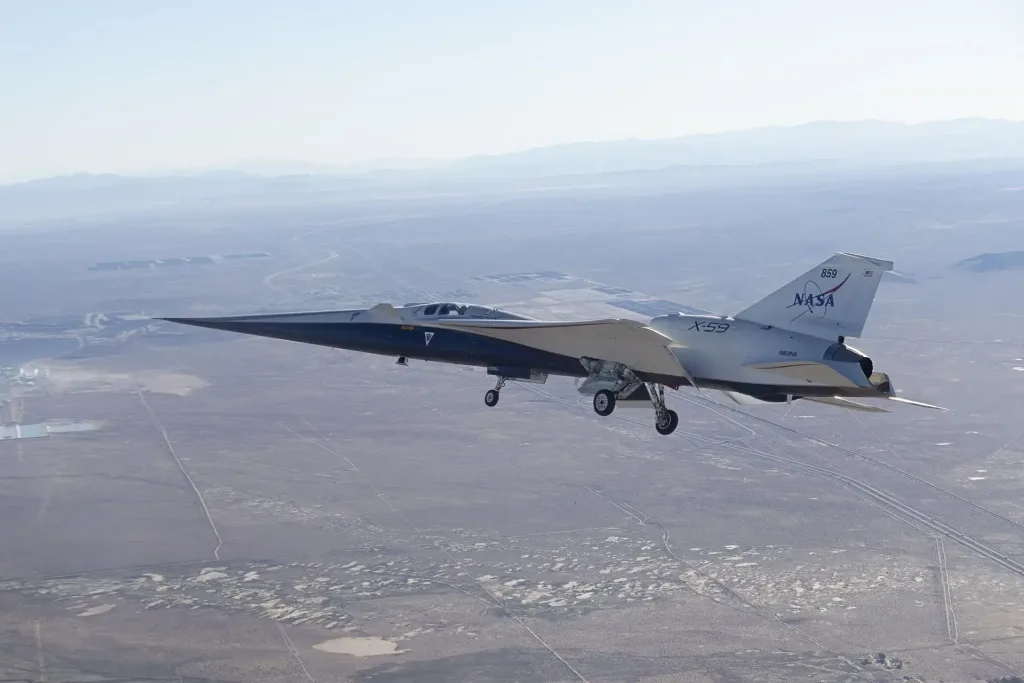
The X-59 does not look like a traditional passenger aircraft. Its unusual appearance exists for one reason: noise reduction.
NASA developed the aircraft with Lockheed Martin under a long-term research partnership focused on quiet supersonic technology.
A Needle-Like Nose Changes the Shockwave Pattern
The aircraft stretches nearly 100 feet long while maintaining a relatively narrow wingspan.
Its most distinctive feature is the extremely long nose section, which makes up nearly one-third of the aircraft’s total length.
That shape helps distribute pressure waves more smoothly during supersonic flight.
Traditional supersonic aircraft compress shockwaves into a concentrated sonic boom. The X-59 spreads those waves across a greater distance, reducing the intensity of the sound reaching the ground.
NASA believes this approach could dramatically reduce public disturbance during high-speed flight.
From Sonic Boom to Sonic Thump
The agency says communities below the aircraft may hear something closer to a distant car door slam rather than the thunderous crack associated with older supersonic aircraft.
That difference may sound small, but it represents the entire purpose of the program.
The retirement of the Concorde left a major gap in commercial aviation. Supersonic passenger travel became difficult to justify because of operational restrictions tied to noise concerns.
NASA hopes the X-59 can finally overcome that barrier.
The X-59 Program Has Progressed Rapidly Since 2025
The aircraft completed its first flight on October 28, 2025.
That early mission stayed relatively conservative. The aircraft reached about 230 mph and climbed to approximately 12,000 feet.
Since then, NASA has steadily expanded both altitude and speed during each test campaign.
The recent Mach 0.98 flight represents the most aggressive profile completed so far.
Engineers continue analyzing data from every maneuver before moving to the next testing phase.
That careful pace reflects the complexity of experimental supersonic flight development.
Future Community Flights Could Influence Aviation Rules
NASA’s next testing stage may become the most important part of the program.
The agency plans to fly the aircraft over selected communities across the United States to measure public reaction to the quieter sound signature.
Public Acceptance Could Reshape Supersonic Travel
Current aviation regulations heavily restrict civilian supersonic flight over land.
Those rules were created because traditional sonic booms generated strong public complaints.
NASA hopes the X-59 can provide scientific evidence showing that quieter supersonic aircraft can operate without causing major disruption.
If regulators accept that data, future commercial aircraft may gain approval for routine overland supersonic travel.
That shift could transform long-distance aviation.
A Faster Future for Passenger Aviation
Quieter supersonic technology could eventually reduce travel times on many domestic and international routes.
Several aerospace companies are already developing next-generation high-speed aircraft concepts.
Still, major challenges remain. Fuel efficiency, operating costs, sustainability goals, and certification standards will continue shaping the industry’s future.
Even so, the X-59 represents one of the strongest efforts in decades to revive practical supersonic passenger flight.
NASA’s Quiet Jet Could Open a New Aviation Era
The recent Mach 0.98 milestone highlights how far the X-59 program has advanced.
NASA is no longer testing ideas only on paper. The agency is now demonstrating real-world progress toward quieter supersonic travel.
The aircraft still faces important evaluation phases ahead, especially during future community overflight testing.
However, the momentum behind the program continues to grow.
For the first time since the end of the Concorde era, supersonic passenger aviation may be moving back toward reality — this time with far less noise.
Main Sources:
NASA Official X-59 Mission Updates
https://www.nasa.gov/mission/quesst/
NASA Armstrong Flight Research Center
https://www.nasa.gov/armstrong/
Lockheed Martin X-59 Program
https://www.lockheedmartin.com/
Interesting Engineering Report
https://interestingengineering.com/innovation/nasa-x59-mach-098-nears-767-mph-test-flight