BY:SpaceEyeNews.
Neutrino flavor conversion could change how astronomers predict the final moments of massive stars. New simulations suggest that this subtle particle behavior can prevent some stars from producing a supernova. Instead, their collapsing cores may form black holes.
The findings could connect several puzzles: missing supernovas, disappearing red supergiants, and unexpectedly light neutron stars. Researchers have not confirmed this explanation through direct observations. However, their results suggest that neutrino behavior deserves a larger role in models of stellar collapse.
For stars near the boundary between different outcomes, these microscopic changes could make a substantial difference.
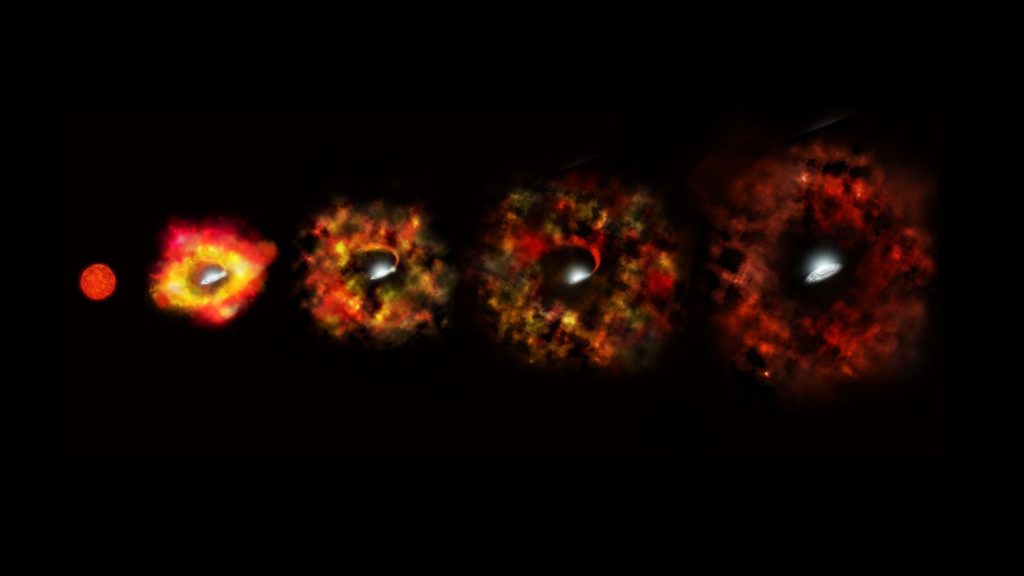
An illustration showing a star that fails to explode as a supernova and rather turns into a black hole. (Image credit: NASA/ESA/P. Jeffries (STScI))
How Neutrino Flavor Conversion Changes a Star’s Fate
During core collapse, neutrinos carry away roughly 99% of the released energy. Most escape, but some transfer energy to surrounding material. That heating can help the star produce a successful supernova.
Consequently, even a small change in energy transfer can matter. A collapsing star needs sufficient heating in the right region. Otherwise, its core can continue toward black hole formation.
Why changing flavors matters
Neutrinos come in three flavors: electron, muon, and tau. They can switch between these types, a process physicists call flavor conversion or oscillation.
Electron neutrinos and their antimatter counterparts play a particularly important role in heating stellar material. Changing the balance between flavors therefore changes how energy moves through the collapsing star.
The location of that change also matters. Related work by the same researchers shows that conversion can help or hinder a supernova. Its effect depends partly on where it occurs within the star. Read the companion study.
What the 195 Stellar Simulations Tested
Mariam Gogilashvili and Irene Tamborra investigated this problem at the University of Copenhagen’s Niels Bohr Institute. Their study followed the collapse of 195 stellar models.
The sample covered stars with initial masses between nine and 120 times the Sun’s mass. This broad range let the team compare outcomes across different stellar structures.
Researchers then introduced a simplified treatment of neutrino flavor conversion. They tested different assumptions about the regions where conversion operates.
The purpose was straightforward: determine whether adding this particle behavior changes which stars produce successful supernovas. They also examined how it affects the compact objects that remain afterward.
These were computer simulations, rather than observations of 195 stars undergoing collapse. The official journal record identifies the paper as accepted in Physical Review D. See the study record.
Why Stars Between 16 and 30 Solar Masses Stand Out
One group proved especially sensitive: stars with initial masses between 16 and 30 times the Sun’s mass.
Many models in this range produced successful supernovas without flavor conversion. After the researchers included it, a large number no longer did so.
That shift challenges the assumption that neutrino flavor changes contribute only a minor correction. In these simulations, they could change the predicted outcome entirely.
However, the mass range does not create a universal dividing line. The findings do not mean every star within it becomes a black hole.
Instead, they show that predictions depend on both stellar properties and neutrino physics. A star’s mass alone cannot capture that full interaction.
This distinction matters when describing the discovery. The study identifies a sensitive group of models, rather than a definitive rule for individual stars.
Could Flavor Changes Explain Missing Supernovas?
The results become especially interesting when researchers compare them with astronomical observations. Several unresolved questions concern what massive stars leave behind.
The gap in supernova numbers
Astronomers have detected fewer supernovas than theoretical expectations suggest. If more massive stars collapse without producing a normal bright supernova, that gap becomes easier to understand.
Neutrino flavor conversion offers a possible mechanism for increasing those unsuccessful outcomes. However, the simulations do not establish how much of the observed shortfall it explains.
The red-supergiant puzzle
Some large red supergiants also appear to disappear without a typical supernova display. Collapse into a black hole offers one possible explanation.
The new findings suggest a way neutrino behavior might favor that outcome. Yet a disappearing star does not directly reveal which particle processes operated inside it.
Researchers must therefore separate the observation from the proposed explanation. The connection is promising, but it remains a hypothesis to test.
A Further Clue: Lighter Neutron Stars
The study also found consequences for stars that still produce successful supernovas. Their remaining neutron stars could have lower masses when models include flavor conversion.
That result may help explain the lighter neutron stars astronomers have observed. Previous theoretical expectations have struggled to account for the low-mass end of this population.
The finding concerns the distribution of remnant masses. It does not imply that every neutron star must become lighter.
Together, these results suggest that neutrino behavior can affect both a star’s final outcome and the properties of its remnant.
What Researchers Still Need to Test
The central limitation lies in the simplified treatment of flavor conversion. Real collapsing stars contain complex flows, changing conditions, and feedback between matter and neutrinos.
The researchers want to incorporate more realistic neutrino behavior into three-dimensional simulations. Those models would follow how conversion begins and evolves as collapse proceeds.
This step matters because flavor changes can alter heating differently in different regions. A broad trend in simplified models may change when researchers include additional physics.
The challenge now is to establish how strongly the proposed effect operates in real stars. Researchers must also check whether the same assumptions explain several observations together. Matching one feature alone would not establish a complete account of stellar outcomes.
Neutrino Flavor Conversion and the Future of Stellar Models
Neutrino flavor conversion could help connect missing supernovas, black hole formation, and lighter neutron stars. Its importance lies in how strongly particle behavior can influence an entire star’s final stages.
The current findings offer a promising explanation, with clear limits. More realistic simulations must now test whether this connection survives a fuller treatment of stellar collapse.
Main sources:
Physical Review D — Neutrino flavor conversion shapes the rate of failed core-collapse supernovae.
Research manuscript — Neutrino Flavor Conversion Shapes the Rate of Failed Core-collapse Supernovae.
Companion study — Flavor Conversion Enhances or Suppresses Supernova Explodability Independent of the Progenitor Mass.
Space.com — Original reporting and researcher interviews.