
BY:SpaceEyeNews.
🚀 New Glenn Booster Reuse Marks a Critical Turning Point
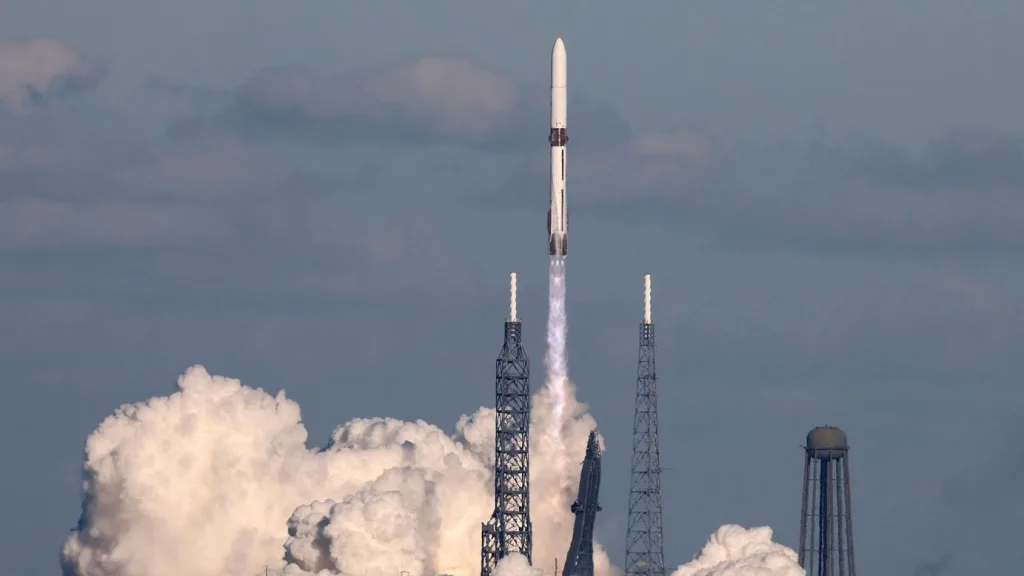
The New Glenn booster reuse milestone is about to be tested in real flight conditions. Blue Origin is preparing its NG-3 mission using a previously flown first-stage booster for the first time. This is not just another launch. It is a defining step toward reusable orbital systems.
Unlike earlier missions, this flight introduces a reused booster core from NG-2. That shift moves New Glenn beyond early demonstrations and into operational testing. The payload, BlueBird 7, adds commercial value. Yet the real focus remains on proving reuse reliability.
As competition intensifies, reusability determines long-term success. The New Glenn booster reuse effort now sits at the center of Blue Origin’s strategy.
🔁 New Glenn Booster Reuse Moves from Concept to Execution
First Reflight Attempt for New Glenn Booster Reuse
NG-3 introduces a simple but critical upgrade. Blue Origin will fly a booster that already completed a previous mission. That marks the program’s first step toward repeated use of orbital hardware.
The company did not reuse the system unchanged. Engineers replaced all seven BE-4 engines and tested upgrades, including thermal protection improvements. These changes aim to improve durability while maintaining performance.
Design targets already suggest that each booster could eventually support up to 25 flights. That goal aligns with the broader industry shift toward reusable systems. Even so, this mission represents an intermediate step rather than full reuse capability.
Why Structural Reuse Matters
Reusing the booster structure remains the real milestone. Structural components endure extreme stress during ascent, reentry, and landing. Proving their resilience unlocks long-term efficiency.
A successful reflight confirms that the core design can withstand multiple missions. It also reduces manufacturing demand and shortens turnaround time between launches. These advantages directly affect cost and scalability.
In practical terms, New Glenn booster reuse is not just about technology. It is about building a sustainable launch model.
🛰️ New Glenn Booster Reuse Supports a Growing Satellite Economy
BlueBird 7 and Direct-to-Phone Connectivity
The NG-3 mission carries BlueBird 7, a next-generation communication satellite built for direct-to-device connectivity. Unlike traditional systems, this approach allows standard mobile phones to connect directly to orbit.
The satellite features a massive antenna spanning approximately 2,400 square feet. This scale enables stronger signals and wider coverage, especially in regions lacking infrastructure.
BlueBird 7 follows earlier versions with similar design goals. Together, they form part of a larger effort to expand global connectivity from space.
Commercial Impact of New Glenn Booster Reuse
The New Glenn booster reuse mission also reflects broader market demand. Satellite networks continue to expand across communications, data services, and global coverage.
Reusable rockets play a central role in that expansion. Lower launch costs allow companies to deploy constellations faster and more efficiently. As demand rises, reusability becomes essential rather than optional.
For Blue Origin, supporting missions like BlueBird 7 strengthens its position within this growing ecosystem.
⚙️ New Glenn Booster Reuse: Launch Profile and Flight Flow
Flight Timeline and Booster Separation
The NG-3 mission follows a standard orbital profile. Liftoff occurs from Launch Complex-36 in Florida during a two-hour window. After ascent, the rocket reaches stage separation roughly 3.5 minutes into flight.
At that point, the first-stage booster shuts down and detaches from the upper stage. The upper stage continues carrying the payload toward orbit.
Landing Attempt and Recovery
Following separation, the booster begins its return sequence. It performs controlled maneuvers before targeting a droneship named “Jacklyn” in the Atlantic Ocean.
Landing is expected about six minutes after liftoff. This phase remains critical. A successful recovery confirms that the reused booster can complete both ascent and landing without performance loss.
Previous Mission Context
Earlier missions provide important context. The first New Glenn launch reached orbit but did not recover the booster. The second mission achieved a successful landing, marking a major step forward.
Now, NG-3 combines both achievements. It uses a recovered booster and attempts another landing. This progression moves the system closer to routine reuse.
🌍 New Glenn Booster Reuse and Industry Competition
Closing the Gap with SpaceX
The New Glenn booster reuse milestone directly impacts competition in the launch market. SpaceX currently leads in reusable rocket operations with proven systems.
Blue Origin aims to reach similar reliability. However, it enters the reusable era later. That position requires faster iteration and consistent performance improvements.
Why Reusability Defines Market Leadership
Reusable rockets reduce cost per launch and increase operational flexibility. Manufacturing a new booster for each mission limits scalability and raises expenses.
By contrast, reuse spreads costs across multiple flights. It also allows for higher launch frequency. These factors create a strong competitive advantage.
For Blue Origin, achieving reliable New Glenn booster reuse is essential to competing at scale.
Next-Generation Systems Still Evolving
Despite current differences, the industry remains in a testing phase. New Glenn still requires multiple successful reflights to prove consistency. Other next-generation systems also continue development.
This dynamic keeps competition open. Progress depends on sustained performance rather than single milestones.
🌙 New Glenn Booster Reuse and Future Lunar Missions
Connection to NASA Programs
The New Glenn booster reuse effort extends beyond Earth orbit. Blue Origin plans to use the rocket to support its Blue Moon lunar lander program, selected as part of NASA’s Artemis architecture.
These missions aim to enable future crewed lunar operations and expand human presence beyond Earth.
Why Reusability Matters for Deep Space
Lunar missions require frequent launches and complex logistics. Reusable systems simplify both. They reduce cost and improve mission cadence.
Without reuse, each mission demands new hardware. That approach increases cost and slows progress. Reusability changes that equation entirely.
New Glenn therefore serves as a critical infrastructure component for future exploration.
Path Toward Operational Readiness
Before supporting crewed missions, systems must complete extensive testing. These include orbital operations, fuel transfer, and landing validation.
NG-3 contributes to that path. While focused on Earth orbit, it strengthens the reliability of the launch system itself.
📊 What New Glenn Booster Reuse Success Would Mean
If the Mission Succeeds
A successful New Glenn booster reuse mission would validate the rocket’s design and long-term strategy. It would confirm that boosters can operate across multiple flights without major degradation.
Such a result would strengthen Blue Origin’s position in the commercial launch market and increase confidence among customers.
If Challenges Emerge
If issues appear, progress may slow. Reusability depends on consistency. Single successes are not enough. Delays would extend development timelines and widen the gap with competitors.
However, early challenges remain part of complex aerospace development. The key factor is how quickly improvements follow.
🔚 Conclusion: The Real Test Ahead
The New Glenn booster reuse mission represents more than a technical upgrade. It defines whether Blue Origin can transition into a reliable reusable launch provider.
This launch alone will not decide the outcome. Yet it will reveal how close the system is to operational maturity. Reusability now stands at the core of modern spaceflight.
The real question is no longer theoretical. Can New Glenn deliver consistent reuse and compete at scale, or will the gap remain difficult to close?
🔗 Main Sources:
https://www.space.com/space-exploration/launches-spacecraft/watch-live-blue-origin-reusing-new-glenn-rocket-stage-for-1st-time-on-april-19-launch
https://www.blueorigin.com/news