
BY:SpaceEyeNews.
An older universe theory has cleared an important consistency check, raising fresh questions about how we reconstruct cosmic history. The proposed framework places the universe’s age at 26.7 billion years. It also seeks to explain observations without dark matter or dark energy.
Researchers report that the model can preserve predictions for the first light elements. Their broader programme examines galaxy rotation, expansion measurements, and other observations.
However, passing this test does not establish the proposed age. Nor does it demonstrate that dark matter and dark energy do not exist. The result addresses a narrower question: can this alternative retain one of cosmology’s major successes?
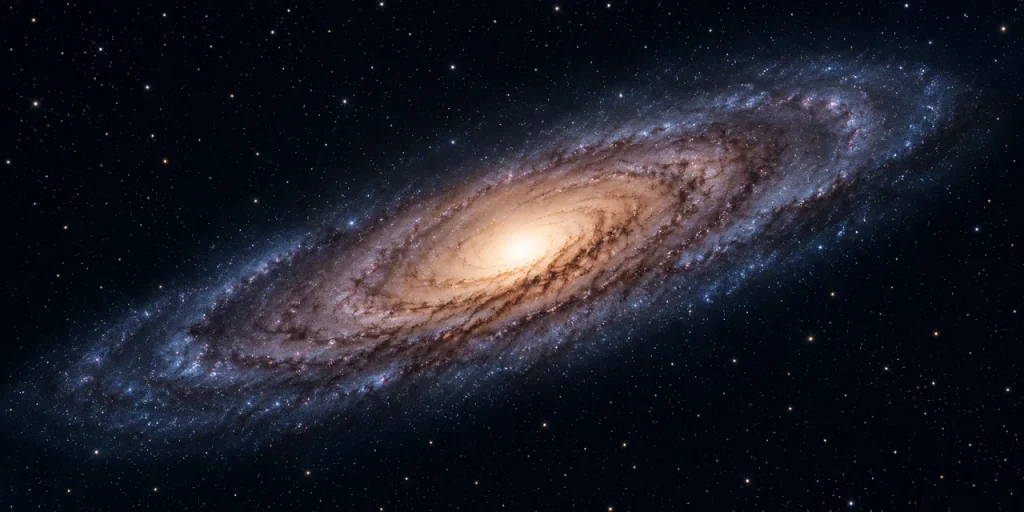
Andromeda-inspired spiral galaxy illustration accompanying an article about the older universe theory.Credit: AI-generated illustration; not the original source photograph.
What the Older Universe Theory Changes
The framework carries the name CCC+TL, meaning “covarying coupling constants plus tired light.” It combines coordinated changes in certain physical quantities with a different interpretation of cosmic redshift.
In standard cosmology, cosmic expansion stretches travelling light. CCC+TL adds another contribution: light loses energy during its journey, producing additional reddening.
That distinction matters because astronomers use redshift to reconstruct cosmic history. Changing its interpretation changes the relationship between observations, distances, expansion, and time.
A Different Clock for Cosmic History
The model retains cosmic expansion. It also includes an early period when the first light nuclei formed.
Its proposed age differs sharply from the approximately 13.8 billion years in standard cosmology. Yet the framework does not simply double every astronomical date.
Instead, it changes how elapsed time relates to redshift. Different stages of cosmic history therefore acquire different ages.
The nucleosynthesis study also makes an important distinction about changing constants. Its prescription preserves dimensionless constants and ratios. It does not allow every physical quantity to vary independently.
Testing the Universe’s First Elements
The central paper, published in Universe, examines Big Bang nucleosynthesis. Rajendra Gupta and Nikolaos Samaras investigate whether CCC+TL can preserve standard predictions for early light elements.
These abundances provide a demanding consistency check. A model might offer more time for galaxies to grow yet fail to reproduce the universe’s early chemical composition.
The researchers implemented their scaling prescription in an established nuclear reaction calculation. Under the conditions they examined, the resulting abundances closely matched standard predictions.
Why the Reaction Rates Matter
The crucial point concerns the balance between expansion and microscopic processes.
A slower expansion rate gives reactions more time. However, changing the relevant reaction and decay rates together can preserve the combinations that determine final abundances.
The paper finds this preservation under its specified scaling assumptions. Numerical differences between the compared calculations were extremely small.
That result demonstrates compatibility within the calculation. It does not independently verify the underlying physical prescription or establish the universe’s present age.
Another limitation concerns the abundance of lithium. Using a lower inferred ordinary-matter density can reduce the lithium discrepancy, but it also raises predicted deuterium abundance.
Consequently, the study does not provide a universal solution to every light-element problem. Its central achievement remains a conditional consistency result.
Other Cosmological Tests Show Uneven Progress
The announcement places this paper within a broader research programme. Several related studies examine whether the framework can reproduce observations normally associated with dark components.
The team reports agreement with cosmic chronometer measurements, which estimate expansion through differences in galaxy ages.
Researchers also report fitting rotation curves for 175 galaxies in the SPARC database without dark matter. These curves describe how orbital speeds change across galaxies.
Such results deserve attention. Nevertheless, a successful fit alone does not establish that one physical explanation uniquely describes the data.
Some Findings Remain Preliminary
The announcement also references supernova time dilation and the Bullet Cluster.
At the time of the announcement, the supernova study remained under review. The researchers described their Bullet Cluster analysis as an early proof of concept requiring further investigation.
They also referred to cosmic microwave background work that had not yet reached publication.
These differences matter. Published calculations, preliminary demonstrations, and forthcoming analyses do not carry identical evidential weight.
Could an Older Universe Explain Early Galaxies?
The older universe theory offers a possible explanation for unexpectedly developed galaxies at high redshift: additional formation time.
The announcement illustrates this with a striking comparison. One early epoch corresponds to roughly 300 million years in standard cosmology, versus approximately 4.6 billion years in CCC+TL.
Those numbers represent different interpretations of the same observed redshift. They are not two direct measurements of a galaxy’s age.
Additional time could allow more growth before the light we observe began its journey. However, that possibility depends on whether the revised framework survives other tests.
Calling early galaxies “impossible” would go too far. Their interpretation also depends on estimates of stellar populations, dust, brightness, and growth histories.
The useful question concerns which framework explains the observations most consistently.
What Would Strengthen the Case?
Replacing standard cosmology requires more than passing individual checks. An alternative must explain many observations using a coherent set of assumptions.
Independent teams need to examine the equations, reproduce calculations, and assess how results depend on parameter choices.
Comparisons should include uncertainties and model flexibility. A framework with greater freedom can sometimes match data without offering a stronger physical explanation.
Researchers also need to distinguish assumptions from outcomes. If a calculation preserves familiar results through coordinated changes, those changes require their own justification. The next step involves checking whether the same prescription remains consistent in other settings. That would make the agreement more informative than an isolated numerical match.
Predictions Must Work Together
The most persuasive evidence would connect early element formation, expansion history, galaxy dynamics, gravitational lensing, and the cosmic microwave background.
Success in one area cannot automatically compensate for failure elsewhere.
Clear predictions also matter. Researchers should identify observations that could distinguish CCC+TL from competing explanations, including results that would challenge their own framework.
This makes independent testing especially valuable. It can reveal whether apparent agreement persists beyond the original researchers’ methods and assumptions.
The absence of an identified dark matter particle does not, by itself, establish an alternative. Any replacement must still explain the observations that motivate the dark matter hypothesis.
Older Universe Theory: A Result Worth Testing
The older universe theory has reached a useful milestone. Under its stated assumptions, it can preserve standard predictions for early light-element abundances.
That achievement supports further investigation. It does not confirm a 26.7-billion-year-old cosmos or remove the need for dark components across cosmology.
The next challenge is broader consistency. Independent scrutiny and discriminating observations must determine whether this alternative can explain cosmic history beyond the tests it already addresses.
Main Sources:
University of Ottawa — Official research announcement:
https://www.uottawa.ca/faculty-science/news-all/theory-predicting-older-universe-without-dark-matter-dark-energy-passes-key-cosmological
Universe — A Big Bang Nucleosynthesis Consistency Test of the CCC+TL Cosmology:
https://doi.org/10.3390/universe12070193
Universe — On Dark Matter and Dark Energy in CCC+TL Cosmology:
https://www.mdpi.com/2218-1997/10/6/266
NASA Jet Propulsion Laboratory — Cosmology overview:
https://www.jpl.nasa.gov/go/astronomy-and-physics/science/
Phys.org — Original coverage supplied for this article:
https://phys.org/news/2026-11-theory-older-universe-dark-energy.html
You Might Also Like:
Time After the Big Bang: Did Time Behave Differently in the Early Universe?
JWST images reveal the Universe like never before-Video
Black Hole Entropy Gets a New Horizon