
BY:SpaceEyeNews.
Astronomers have confirmed the first stellar-mass black hole detected inside Omega Centauri. The discovery ends a long search for the hidden objects that computer models predicted should exist across this enormous star cluster.
The Omega Centauri black hole, named oMEGACat BH-2, does not produce strong X-rays or radio signals. Instead, astronomers found it by tracking a visible star moving around an unseen source of gravity.
Researchers combined more than two decades of observations from the Hubble Space Telescope with newer measurements from the James Webb Space Telescope. Their results reveal an unusual system with a low-mass black hole and an estimated 94-year orbit.
Omega Centauri’s Missing Black Holes
Omega Centauri lies about 18,000 light-years from Earth. It contains roughly 10 million gravitationally bound stars, making it the largest and brightest globular cluster visible in our sky.
Computer simulations suggest that around 10,000 stellar-mass black holes could remain hidden within the cluster. These objects formed after massive stars reached the end of their lives.
However, astronomers struggled to confirm even one of them.
Traditional searches often look for radio waves or X-rays. Those signals appear when a black hole draws gas from a nearby companion star. The material heats up as it approaches the black hole and produces detectable radiation.
Most black holes in Omega Centauri may lack close companions. Others may orbit their partners at distances too large for significant material transfer. As a result, they remain quiet and nearly impossible to detect with radiation-based methods.
The new study took a different approach. Rather than searching for light from a black hole, the team searched for the motion caused by its gravity.
A Star Revealed the Invisible Object
Researchers used astrometry to track tiny changes in stellar positions over time. The measurements came from Hubble observations collected between 2002 and 2023.
Recent Webb data added greater infrared precision. Together, the observations covered a period of about 23 years.
During the analysis, astronomers identified a main-sequence star following a curved path around an invisible companion. The star appeared to orbit empty space, but its changing position revealed the presence of a compact object.
The measurements reached fractions of a pixel on the telescope detectors. This precision allowed the team to reconstruct part of the star’s path.
Astronomers observed the system near periastron, which is the point where the star passes closest to its companion. At that stage, the star moves more quickly and shows stronger orbital acceleration.
This timing helped researchers calculate the companion’s mass despite observing only part of the full orbit.
Why the Omega Centauri Black Hole Is Confirmed
The visible star has an estimated mass of 0.78 times the Sun’s mass. Its unseen companion weighs about 4.46 solar masses.
The study gives the dark object a mass range of approximately 3.45 to 5.68 Suns. Earlier research had suggested that the companion could be an unusually dense neutron star.
However, the expanded Hubble dataset and Webb measurements produced a much stronger mass estimate. The object exceeds the expected upper mass limit for neutron stars. It also emits no detectable light.
A stellar-mass black hole offers the strongest explanation.
The discovery marks the first astrometric identification of a stellar-mass black hole in a globular cluster. It also provides direct support for models that predict large hidden black hole populations inside dense clusters.
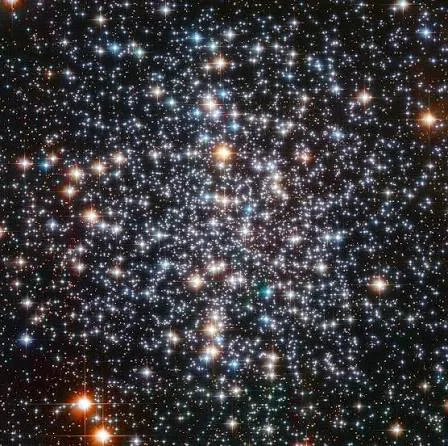
Omega Centauri’s first stellar-mass black hole has been found!
A Record-Breaking 94-Year Orbit
The visible star may take around 94 years to complete one orbit. However, that number remains an estimate because astronomers have not observed a full cycle.
The study places the likely orbital period between about 52 and 157 years. The orbit has a semi-major axis of roughly 31 astronomical units. One astronomical unit equals the average distance between Earth and the Sun.
For comparison, Neptune orbits the Sun at an average distance of about 30 astronomical units. Therefore, the separation in this system is enormous for a black hole binary.
Its orbit is also highly elongated, with an estimated eccentricity of 0.72. The distance between the two objects changes greatly during each cycle.
According to the research team, oMEGACat BH-2 has the longest known orbital period of any confirmed black hole binary.
That wide separation also explains why the system remained hidden. The black hole cannot easily pull material from the distant star. Without a bright accretion structure, it produces little detectable radiation.
Its Low Mass Challenges Existing Models
The newly discovered Omega Centauri black hole is lighter than many models expected.
Omega Centauri has a very low abundance of elements heavier than hydrogen and helium. Astronomers describe such environments as metal-poor.
Massive stars in metal-poor environments often lose less material through stellar winds. They can therefore retain more mass before forming black holes. For that reason, scientists often expect these environments to produce relatively heavy black holes.
Yet oMEGACat BH-2 weighs only about 4.5 Suns.
The result shows that low-mass black holes can also form in environments with metallicities below Z = 10⁻³. Researchers must now explain how such a lightweight object formed under those conditions.
One discovery will not overturn current stellar-evolution models. Still, it adds an important constraint that future simulations must reproduce.
The Pair Probably Formed Later
The black hole and its companion star probably did not begin as a pair.
Instead, the crowded environment of Omega Centauri likely brought them together through a series of gravitational interactions. The black hole may have captured the star during a close encounter or an exchange involving another binary system.
Their wide separation makes the system fragile. Passing stars can gradually alter its orbit or separate the pair entirely.
The researchers estimate that oMEGACat BH-2 may survive for only another 800 million years. That sounds long, but Omega Centauri is around 12 billion years old.
This short survival time supports the idea that the system formed relatively recently rather than existing since the cluster’s early history.
A Different Black Hole Mystery
The new object should not be confused with the proposed intermediate-mass black hole near Omega Centauri’s center.
In 2024, astronomers reported seven fast-moving central stars. Their speeds suggested that an unseen object with at least several thousand solar masses could sit near the cluster’s core.
That candidate remains a separate scientific question.
oMEGACat BH-2 is much smaller, at about 4.5 solar masses. It also orbits with one visible companion away from the cluster’s exact center.
Omega Centauri could contain both a central intermediate-mass candidate and thousands of smaller stellar-mass black holes. However, astronomers still need more observations to map that hidden population.
The First of Many Hidden Discoveries
The Omega Centauri black hole shows how long-term astrometry can uncover objects that produce almost no detectable radiation.
Its gravity exposed its location by changing the motion of a visible star. Hubble supplied the long observational baseline, while Webb improved the final measurements.
The object’s low mass challenges expectations for black holes in metal-poor environments. Its estimated 94-year orbit also explains why earlier searches missed it.
Astronomers have now confirmed one member of Omega Centauri’s predicted black hole population. Thousands more may still move silently among the cluster’s stars.
Main Sources:
European Space Agency:
https://www.esa.int/ESA_Multimedia/Images/2026/07/Hubble_discovers_first_of_star_cluster_s_missing_black_holes
University of Utah:
https://attheu.utah.edu/facultystaff/nasas-hubble-discovers-first-of-star-clusters-missing-black-holes/
Research Paper:
https://arxiv.org/abs/2606.18350
NASA’s 2024 Omega Centauri Study:
https://science.nasa.gov/missions/hubble/nasas-hubble-finds-strong-evidence-for-intermediate-mass-black-hole-in-omega-centauri/