BY:SpaceEyeNews.
🚀 Introduction: A Safe Return… With a Hidden Engineering Signal
The Orion helium leak Artemis II story begins with a contradiction. A crewed spacecraft traveled to deep space, circled the Moon, and returned safely—yet revealed a propulsion system flaw along the way.
NASA confirmed a critical point early: there was no threat to Artemis II reentry or crew safety. The mission stayed stable, precise, and fully under control.
So why does this issue matter? Because Artemis II is not the destination. It is a stepping stone. And what looks like a minor leak today could become a limiting factor for future lunar missions.
This is not a failure. It is a signal. One that NASA must act on before pushing deeper into space.
🔧 Orion Helium Leak Artemis II: What Happened Inside the System
A Leak Within the Propulsion Architecture
The Orion helium leak Artemis II originated inside the spacecraft’s propulsion system. Helium maintains pressure inside fuel tanks, ensuring propellant flows correctly into engines and thrusters.
During the mission, engineers detected a small internal leak across valves in the service module. The leak rate increased compared to ground observations. Still, the gas remained contained within the system. It did not escape into space.
NASA responded with precision. Mission control adjusted the timeline and prioritized propulsion diagnostics. A planned piloting demonstration was replaced with targeted testing to better understand the leak under real conditions.
A Known Risk, Not a Sudden Surprise
This issue did not emerge without warning. Engineers had already identified a lower leak rate before launch. A similar behavior also appeared during the earlier Artemis I mission.
The mission design accounted for this. Artemis II followed a free-return trajectory, using the Moon’s gravity to guide the spacecraft back to Earth. This approach minimized reliance on continuous propulsion.
Performance data confirmed that decision. Orion used only about 40% of its available fuel. That margin ensured the spacecraft could operate safely despite the leak.
📊 Orion Helium Leak Artemis II: Why Reentry Was Never at Risk
Independent Systems, Clear Separation
The most important fact about the Orion helium leak Artemis II is straightforward. The leak had no connection to reentry systems.
Orion operates with two distinct modules. The service module handles propulsion. The crew module manages reentry and landing. These systems remain independent.
The crew module carries its own thrusters, tanks, and control mechanisms. That separation ensures reentry remains fully functional, even if the propulsion system encounters issues.
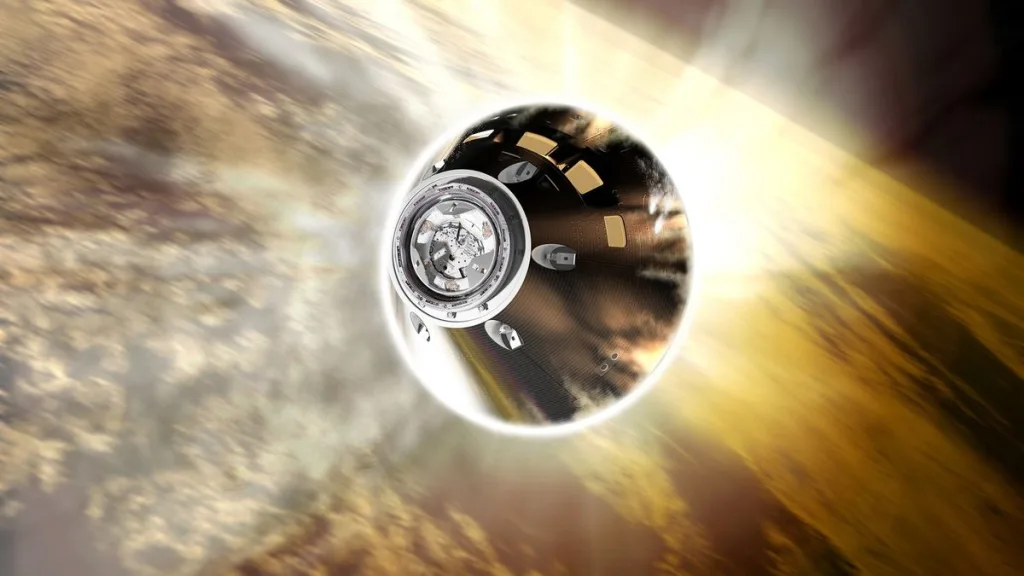
The Critical Step Before Reentry
Timing also plays a decisive role. The service module—the location of the leak—is jettisoned before reentry begins. This occurs roughly 20 minutes prior to atmospheric entry.
Once separated, the module burns up in the atmosphere. It never contributes to the reentry phase.
That single design choice removes the faulty component from the equation at the exact moment when precision matters most.
Performance That Stayed on Track
Flight data reinforces the conclusion. All propulsion burns performed as expected. The spacecraft remained extremely close to its predicted trajectory.
In fact, some correction maneuvers became unnecessary due to the mission’s accuracy.
The result is clear. The Orion helium leak Artemis II posed no threat to reentry, mission success, or crew safety.
⚠️ Orion Helium Leak Artemis II: A Challenge for What Comes Next
From Acceptable Margin to Design Limitation
While Artemis II remained safe, the Orion helium leak Artemis II introduces a deeper concern. The leak rate observed in space exceeded ground-based measurements.
NASA still considers it acceptable under current conditions. However, future missions will demand more from the propulsion system. Under those conditions, even a small leak can become a constraint.
This shifts the issue from a manageable anomaly to a design-level challenge.
Future Missions Demand More
Upcoming Artemis missions will operate under different requirements.
- Artemis III will focus on operations closer to Earth
- Artemis IV will move toward sustained lunar activity
These missions will require:
- Longer propulsion usage
- Stable pressure over extended durations
- Higher precision during orbital maneuvers
The conditions that made the leak acceptable on Artemis II will not apply in the same way moving forward.
Engineering Pressure Builds
Another factor increases urgency. Hardware for future missions is already in production. Any redesign must integrate into existing systems without causing major delays.
This creates a narrow window for engineers. They must identify the root cause, develop a solution, and validate it under real conditions—all within a tight schedule.
🛠️ Orion Helium Leak Artemis II: Inside NASA’s Redesign Effort
Fixing the Valve System
NASA is now preparing to address the Orion helium leak Artemis II through targeted design changes. The focus centers on the valve system responsible for maintaining pressure.
Possible solutions include:
- Refining valve geometry
- Improving sealing performance
- Enhancing resistance to thermal stress
The final approach will depend on ongoing analysis. However, early indicators suggest that adjustments alone may not be enough. A more substantial redesign could be required.
A Unique Investigation Challenge
One limitation stands out. Engineers cannot inspect the physical hardware after the mission. The service module burns up during reentry, removing direct access to the affected components.
Instead, teams rely on:
- Telemetry data collected during flight
- Controlled system tests performed mid-mission
- Analysis of thermal and orientation effects
This data-driven approach allows engineers to reconstruct the issue without direct inspection.
A Familiar Industry Pattern
Valve-related challenges are not unique to Orion. Similar issues have appeared across multiple aerospace systems.
This pattern highlights a broader reality. Managing pressure, temperature, and material behavior in space remains one of the most complex engineering tasks.
What makes the Orion helium leak Artemis II different is its timing. It appears at a critical stage in a program aiming to return humans to the Moon.
🌕 Orion Helium Leak Artemis II and the Artemis Timeline
Short-Term Outlook
The near-term impact on Artemis III appears limited. Its mission profile does not rely heavily on extended propulsion performance.
This provides NASA with a short buffer to implement solutions.
Long-Term Requirements
The situation changes with Artemis IV. Sustained operations near the Moon will require consistent propulsion performance over longer periods.
That makes resolving the leak essential before moving forward with deeper exploration phases.
Balancing Confidence and Complexity
NASA leadership has expressed confidence in resolving the issue. Still, the path forward involves multiple steps.
Redesigning components is only the beginning. Engineers must also:
- Test the updated system
- Validate performance under realistic conditions
- Integrate changes into existing spacecraft
Each step introduces complexity. Each step requires time.
🔍 Orion Helium Leak Artemis II: What This Mission Really Proved
A True Test of Deep Space Readiness
The Orion helium leak Artemis II highlights the real purpose of this mission. It was never just about sending humans around the Moon again. It was about testing systems under real conditions.
This leak provides insight that cannot be replicated on the ground. It reveals how components behave under thermal shifts, radiation, and long-duration exposure.
A Pattern of Iteration
The Artemis program continues to evolve through each mission.
- Artemis I revealed heat shield behavior
- Artemis II exposed propulsion system limitations
Each step reduces uncertainty. Each step prepares the program for more complex missions ahead.
🎯 Conclusion: A Safe Mission, A Critical Signal
The Orion helium leak Artemis II does not change the outcome of the mission. Orion returned safely. The crew remained secure. Reentry was never at risk.
But the story does not end there. The leak points to a system that must evolve before supporting sustained lunar operations.
This is how exploration progresses. Small issues surface early, when the stakes remain manageable. They are addressed before they grow into mission-critical risks.
The real question now is not about Artemis II. It is about the future.
Will this redesign remain a routine adjustment—or will it shape the next phase of human exploration beyond Earth?
🔗 Sources:
- https://arstechnica.com/space/2026/04/nasa-homes-in-on-likely-redesign-to-fix-orion-spacecrafts-leaky-valves/
- https://www.nasa.gov/