
BY:SpaceEyeNews.
The Oyashio stellar stream is a faint ribbon of stars with an unusually important role. Astronomers found it in the ultra-diffuse galaxy UGC 9050-Dw1, about 115 million light-years from Earth. Its shape allowed researchers to trace the galaxy’s gravity and estimate its hidden mass. The feature could also become the first known globular-cluster stellar stream beyond the Milky Way. More importantly, it shows that a method developed inside our galaxy may work across far greater distances.
Oyashio Stellar Stream Emerges From Archival Hubble Data
Researchers did not find Oyashio during a newly commissioned observation. Instead, the feature appeared in archival images from the Hubble Space Telescope. Hubble captured the data in September 2022 while studying the globular clusters around UGC 9050-Dw1.
The galaxy lies about 35.2 megaparsecs away. That equals roughly 115 million light-years. Yet its sparse population of stars creates a very faint background. This unusual setting helped the delicate arc stand out.
The visible stream arm extends for about 2 kiloparsecs, or nearly 6,500 light-years. Researchers measured a width of around 72 parsecs, equal to about 235 light-years. The feature also appears in separate Canada-France-Hawaii Telescope observations. That independent detection makes an image-processing artifact much less likely.
Evidence Points to a Disrupting Globular Cluster
A compact source sits close to one end of the stream. Astronomers identify it as the likely surviving parent cluster. Its color closely matches the surrounding ribbon, which suggests that both contain related stellar populations.
Oyashio’s narrow profile provides another clue. Streams created by dwarf galaxies are generally wider. By contrast, this structure falls within the width range expected from globular clusters. Computer models also support that explanation. They place the cluster’s initial mass below 2.5 million solar masses with 95% confidence.
The evidence suggests that the host galaxy’s tidal forces gradually removed stars from the cluster. Those stars continued along related orbital paths and formed the thin arc. Therefore, “destroyed cluster” is not the most precise description. The cluster appears to be disrupting, and part of it may survive.
Only one arm appears clearly in the images. Models indicate that a second, fainter arm may curve behind the brighter central region of UGC 9050-Dw1.
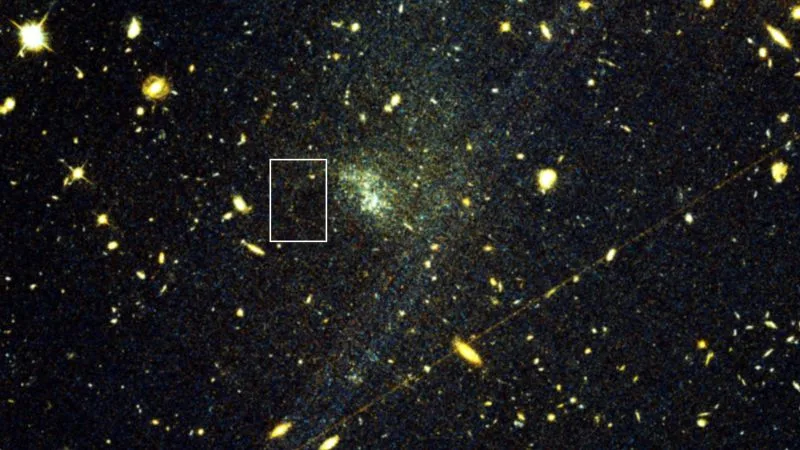
Stellar stream discovery beyond Milky Way helps map dark matter.
How the Oyashio Stellar Stream Traces Dark Matter
Stars within a stream follow paths shaped by the host galaxy’s gravitational field. As a result, the stream preserves information about mass that telescopes cannot see directly.
The team used a modeling system called X-Stream to test different possible conditions. Thousands of simulations varied the cluster’s mass, orbit and position. They also changed the mass and density profile of the galaxy’s surrounding halo. Researchers then compared each simulated stream with Oyashio’s observed width, curvature and location.
The best matches indicated that UGC 9050-Dw1 occupies a massive, dark matter-dominated halo. This method does not photograph dark matter. Instead, it measures how unseen mass influences the stellar stream through gravity.
What the Mass Estimates Show
One representative model placed about 13.6 billion solar masses inside a radius of 2.52 kiloparsecs. It estimated the galaxy’s total halo mass at roughly 156 billion solar masses. However, the full model allows a broad range of values. The figures should not be treated as a final, exact weighing.
Earlier estimates used the galaxy’s unusually rich globular-cluster population. Those calculations suggested a halo mass of approximately 150 billion to 180 billion solar masses. The new stream-based result agrees with that range within the uncertainties.
This agreement matters because ultra-diffuse galaxies are difficult to measure through conventional methods. Their faint stars make rotation and velocity studies challenging. Oyashio offers an independent gravitational test. It also provides the first stream-based constraint on the mass and inner density slope of an ultra-diffuse galaxy’s halo.
Why the Oyashio Interpretation Remains Cautious
The Nature study describes “evidence for” the first extragalactic globular-cluster stream. That wording leaves room for further testing.
The researchers considered several alternative explanations. These included a tidal shell, gravitational lensing, dust, random stellar alignment and a broader stream from a dwarf galaxy. None matches all the observed features as well as the globular-cluster model. Oyashio’s width, curvature, color and alignment with the compact source all support that interpretation.
Still, the current images do not resolve individual stars within the stream. Deeper Hubble or James Webb Space Telescope observations could separate it more clearly from the background. Spectroscopy could also compare the stream’s stellar population with the proposed parent cluster.
Future Telescopes Could Find More Stellar Streams
Oyashio may be the first example of a much larger population. ESA’s Euclid observatory and NASA’s Nancy Grace Roman Space Telescope can survey wider areas than Hubble. Roman’s Wide Field Instrument offers a field of view about 100 times larger than Hubble’s wide-field cameras.
Larger surveys could uncover streams around many types of galaxies. A bigger sample would let astronomers compare dark matter halos across different environments. Thin streams may also contain gaps or clumps created by small concentrations of unseen mass. Confirming such effects could test how dark matter behaves on scales that remain difficult to explore.
Conclusion: Oyashio Opens a New Route to Hidden Mass
The Oyashio stellar stream turns a disrupting star cluster into a sensitive measure of galactic gravity. Its discovery extends stream-based dark matter research far beyond the Milky Way. The result remains a candidate that needs deeper confirmation. Even so, it demonstrates how faint stellar structures can expose the mass and shape of distant galactic halos. Future surveys may transform this single example into a powerful new field of dark matter research.
Main Sources:
Nature — Evidence for the first globular cluster stellar stream beyond the Milky Way
Northwestern University — Cosmic breadcrumb trail reveals hidden dark matter
NASA — Nancy Grace Roman Space Telescope science information