BY:SpaceEyeNews.
The Planet Nine Mystery has fascinated astronomers for nearly a decade. A massive unseen world may exist far beyond Neptune, shaping the orbits of distant objects through its gravity. Many researchers consider it one of the most compelling unsolved puzzles in planetary science.
Now, a newly discovered object called 2023 KQ14 has added a surprising twist. Instead of strengthening the case for Planet Nine, the object appears to challenge some of the theory’s key predictions. Its orbit is unusual, but it is also remarkably stable. That stability raises new questions about whether a giant hidden planet is influencing the outer Solar System.
As a result, the Planet Nine Mystery has become even more intriguing. Scientists now face a difficult challenge. They must explain both the strange orbital patterns that inspired the theory and the growing number of discoveries that seem harder to reconcile with it.
Planet Nine Mystery: Why Scientists Proposed a Hidden World
The modern Planet Nine hypothesis emerged in 2016. Astronomers Konstantin Batygin and Mike Brown proposed that an undiscovered planet could explain unusual orbital behavior among several distant Solar System objects.
Researchers had noticed that some extreme trans-Neptunian objects followed highly elongated orbits. Even more interesting, several of these objects appeared to cluster in similar orientations. Such alignment seemed unlikely to occur by chance.
Strange Orbital Patterns Beyond Neptune
The outer Solar System contains thousands of icy bodies. Many orbit far beyond Neptune. Most follow predictable paths, but a small group behaves differently.
Several objects possess highly eccentric orbits. Their trajectories stretch hundreds of astronomical units from the Sun. Scientists struggled to identify a clear explanation for these patterns.
Batygin and Brown suggested that a planet several times more massive than Earth could provide the missing gravitational influence. According to their calculations, such a world could gradually shape distant orbits over millions of years.
Why the Theory Gained Support
The idea initially faced skepticism. However, additional discoveries kept the discussion alive.
Researchers identified more distant objects with unusual orbital characteristics. Some computer simulations also showed that a hidden planet could reproduce several observed features of the outer Solar System.
Mike Brown stated in 2024 that he considered it very unlikely that Planet Nine did not exist. His confidence reflected years of observations and modeling efforts.
Even so, no telescope has directly detected the proposed planet. That absence remains one of the theory’s biggest challenges.
Planet Nine Mystery Faces a New Test with 2023 KQ14
The latest chapter began with the discovery of 2023 KQ14. Astronomers identified the object using the Subaru Telescope in Hawaii.
At first glance, the discovery seemed exciting for supporters of Planet Nine. The object belongs to a rare category known as a sednoid. These bodies spend most of their time far from the Sun.
What Makes 2023 KQ14 Special?
2023 KQ14 follows a highly elongated orbit. Its closest approach to the Sun occurs at roughly 71 astronomical units. Its most distant point lies around 433 astronomical units away.
For comparison, Neptune orbits at approximately 30 astronomical units.
This extreme orbit places 2023 KQ14 among the most distant known objects in the Solar System. Because Neptune exerts little influence at these distances, scientists view sednoids as valuable clues to conditions in the outer Solar System.
The Stability Problem
Researchers expected a sednoid to provide additional evidence for Planet Nine. Instead, 2023 KQ14 delivered a surprise.
Its orbit appears unusually stable.
That detail matters because a nearby giant planet should create measurable gravitational disturbances. Over long periods, those disturbances would alter orbital behavior in detectable ways.
However, observations suggest that 2023 KQ14 maintains a relatively stable path. That finding creates tension with some versions of the Planet Nine hypothesis.
Not the First Stable Sednoid
The challenge extends beyond a single object.
2023 KQ14 is now the fourth known sednoid. The other three also display stable orbital characteristics.
As scientists add more examples to the catalog, the pattern becomes harder to ignore. A hidden giant planet should leave stronger fingerprints on these objects if it occupies the region originally proposed.
This does not eliminate Planet Nine. Yet it forces researchers to reconsider where the planet might be located and how strongly it interacts with surrounding objects.
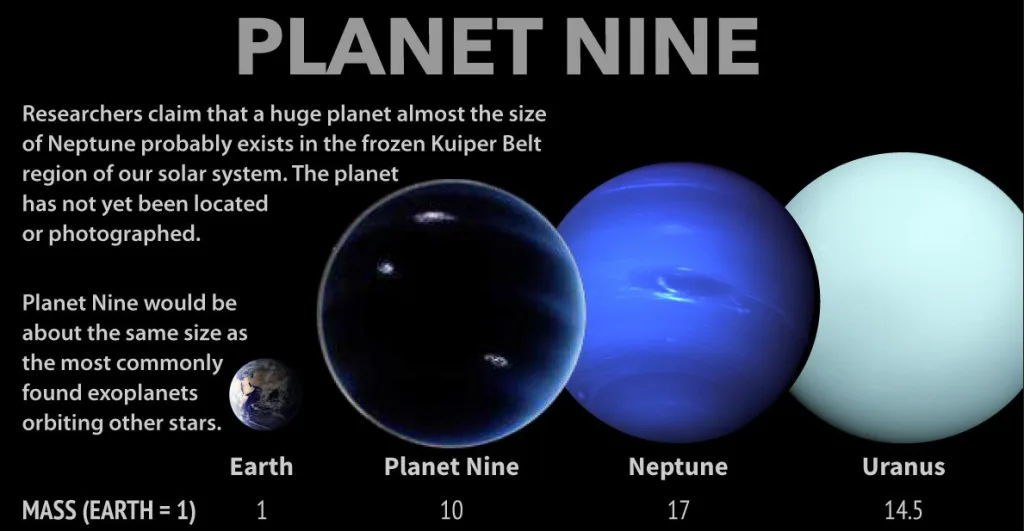
Could Planet Nine Be Farther Away Than Expected?
One possible solution is simple. Planet Nine may exist much farther from the Sun than astronomers initially estimated.
A greater distance would reduce its gravitational influence on nearby sednoids. That could explain why several objects maintain stable orbits despite the presence of a giant planet.
A More Distant Planet
Some researchers now suggest that Planet Nine could orbit beyond 500 astronomical units.
At such distances, detection becomes extremely difficult.
The planet would reflect very little sunlight. It would also move slowly across the sky from Earth’s perspective. Those factors would make identification challenging even for powerful observatories.
Why Finding Planet Nine Remains Difficult
The search area is enormous.
Astronomers must examine vast regions of the sky while looking for an object that may be faint and slow-moving. Even modern surveys require significant time to cover such territory.
Ground-based telescopes continue to play a crucial role. Space observatories also contribute valuable observations. Together, they help researchers identify new distant objects and refine existing orbital measurements.
Each discovery adds another piece to the puzzle.
Alternative Explanations Gain Attention
As the Planet Nine Mystery evolves, alternative ideas continue to receive attention.
Some scientists argue that observational bias may influence the apparent clustering of distant objects. Others suggest that the combined gravity of many smaller bodies could produce some observed effects.
A few researchers have even explored more exotic possibilities. These include unusual distributions of matter in the outer Solar System.
However, none of these alternatives has achieved broad scientific consensus.
Planet Nine remains one of the leading explanations because it can account for multiple observed features simultaneously. Yet the theory now faces stronger tests than ever before.
Future Discoveries May Finally Resolve the Planet Nine Mystery
Astronomers expect the coming years to bring major advances.
New surveys continue to discover distant objects beyond Neptune. Each additional sednoid provides valuable information about the structure of the outer Solar System.
More Sednoids Could Change Everything
The current sample size remains small.
Only a handful of known sednoids exist. That limitation makes it difficult to draw firm conclusions. Future discoveries could reveal patterns that support Planet Nine or undermine it.
Either outcome would represent a major scientific breakthrough.
Next-Generation Observatories
Upcoming observatories will dramatically improve search capabilities.
More sensitive instruments can detect fainter objects. Better tracking systems can also measure orbital motion with greater precision.
As datasets expand, researchers will gain a clearer picture of the Solar System’s most distant regions.
A Mystery Worth Following
The Planet Nine Mystery extends beyond the search for a single planet. It touches on fundamental questions about how planetary systems form and evolve.
Every new object discovered in the outer Solar System helps scientists understand that environment more clearly. Sometimes discoveries support existing theories. Other times they reveal unexpected complications.
2023 KQ14 belongs firmly in the second category.
Conclusion: The Planet Nine Mystery Is Far from Solved
The discovery of 2023 KQ14 has not disproven Planet Nine. Instead, it has made the Planet Nine Mystery more complex.
Scientists originally expected distant sednoids to strengthen the hidden planet hypothesis. Instead, the latest object displays a stable orbit that raises new questions about the theory’s predictions.
Researchers may ultimately find that Planet Nine exists much farther away than expected. Alternatively, future observations may reveal a completely different explanation for the unusual behavior of distant Solar System objects.
For now, the Planet Nine Mystery remains one of astronomy’s most compelling puzzles. Every new discovery adds another clue. Yet each clue also seems to deepen the mystery itself. That makes the search for answers one of the most exciting scientific investigations of our time.
Main Sources:
- ScienceDaily (June 8, 2026)
https://www.sciencedaily.com/releases/2026/06/260608040009.htm - The Conversation (original article referenced by ScienceDaily)
https://theconversation.com - California Institute of Technology Planet Nine Research by Konstantin Batygin and Mike Brown
https://www.caltech.edu - Subaru Telescope Official Research Updates
https://subarutelescope.org - NASA Solar System Exploration Resources
https://solarsystem.nasa.gov