
BY:SpaceEyeNews.
Relativistic Heavy Ion Collider(RHIC) experiments have revealed an unexpected dip in particle behavior, opening a fresh question about matter under extreme conditions. Scientists studying gold nuclei found that momentum fluctuations changed unusually as collision energy increased. The pattern could help identify a long-sought critical point in nuclear matter.
That possibility connects a laboratory measurement with the universe’s early history. However, the result does not establish a new model for matter formation. Researchers have measured something intriguing, while its underlying cause remains open. The challenge now is to understand why the dip appears.
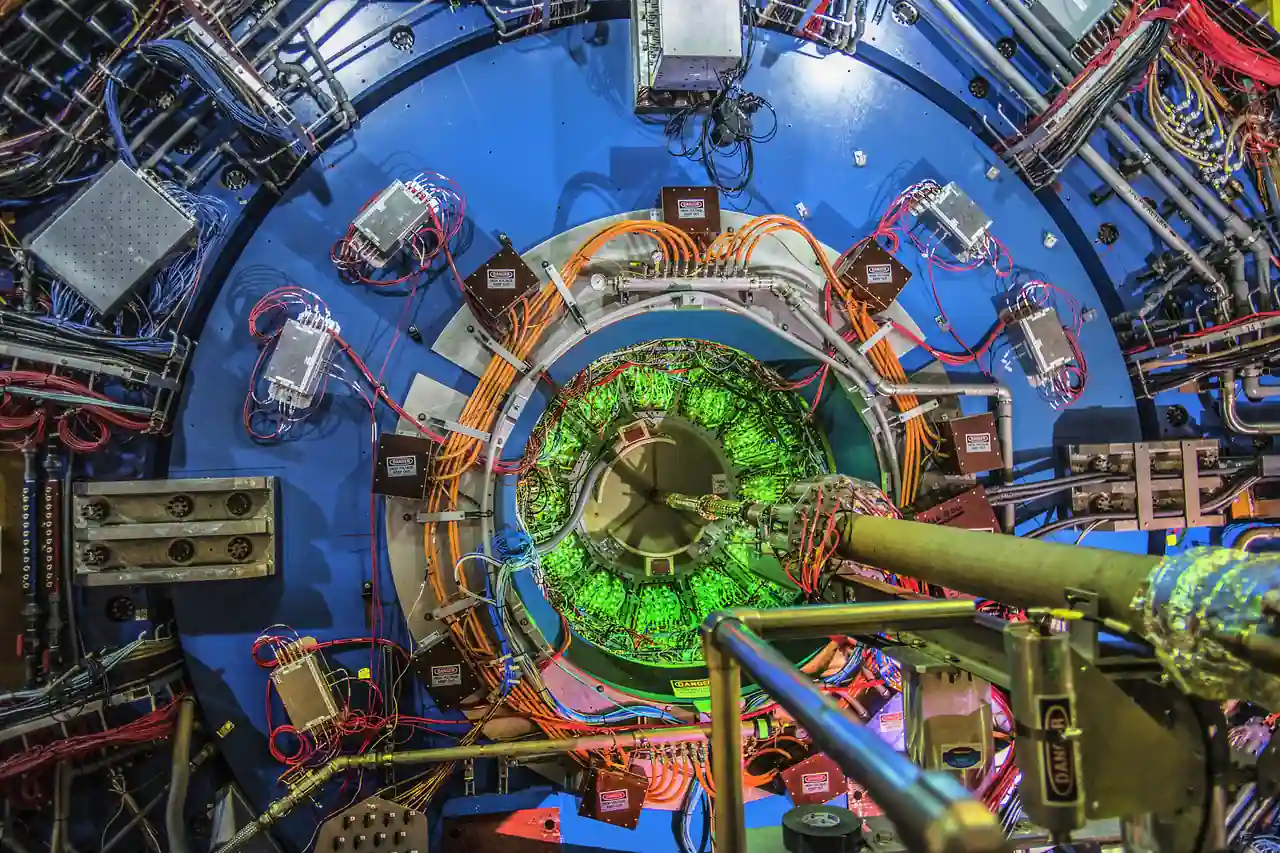
RHIC Experiments: Inside the STAR Detector.
What the RHIC Experiments Measured
The STAR collaboration studied gold-nucleus collisions at Brookhaven National Laboratory’s Relativistic Heavy Ion Collider, known as RHIC. Its analysis examined how particles moved away from these encounters.
Specifically, researchers measured correlations in transverse momentum: particle motion perpendicular to the beam direction. Comparing those measurements across collisions helped reveal how the matter’s behavior changed with energy.
The new dataset covered energies from 3 to 7.7 billion electron volts, or GeV, per colliding nucleon pair. Researchers also compared these results with earlier STAR measurements extending to 200 GeV. Phys. Rev. Lett.
Why Lower Energies Matter
Higher energy does not automatically answer every question about extreme matter. Lower-energy collisions allow researchers to explore particularly dense conditions.
For the lowest energies, the experiment used a fixed gold target. A beam of gold nuclei encountered that target, producing tiny, short-lived samples of dense nuclear matter. Changing the beam energy helped scientists examine different conditions within this largely unexplored territory.
A Dip That Broke the Smooth Trend
The striking feature appeared when researchers compared momentum fluctuations across the energy range. Those fluctuations fell sharply as energy increased from 3 GeV. They reached a minimum around 5.2–7.7 GeV, then rose at higher energies.
This downward-and-upward pattern departed from a smooth trend with a statistical significance of about five sigma. That makes the deviation scientifically compelling. It does not establish which physical mechanism produced it. www.bnl.gov
An Indirect Window Into Temperature
Particles emerging from hotter matter generally carry more momentum. Consequently, momentum correlations can offer clues about temperature fluctuations between collisions.
Researchers therefore interpret the dip as a possible sign of suppressed temperature fluctuations. The distinction matters: STAR tracks particles, rather than placing a thermometer inside the fleeting sample. Scientists must connect those observations to temperature through physical reasoning and models.
Could RHIC Experiments Reveal a Critical Point?
A critical point would mark a special location on the nuclear phase diagram. This diagram maps how matter behaves under different temperatures and densities.
At some conditions, matter can change smoothly between forms. Physicists call this a crossover. Under other conditions, they expect a sharper, first-order phase transition.
The proposed critical point marks where the first-order transition ends. Finding it would help establish how the transition changes character across the diagram. Researchers have searched for this landmark by varying collision energies and studying the resulting particles. BNL Newsroom
Why Temperature Fluctuations Could Shrink
Near a critical point, theory predicts a dramatic increase in heat capacity. Matter could then absorb substantial energy while its temperature changes relatively little.
For comparison, heating ice water initially supplies energy to melt the ice rather than raise the mixture’s temperature. That illustrates how energy can drive a phase change without immediate warming. The critical-point explanation involves different details, but similarly emphasizes matter’s response to added energy.
This makes the observed dip interesting. Still, a pattern compatible with a critical point does not uniquely identify one. www.bnl.gov
What This Means for the Early Universe
The broader question concerns how quarks and gluons became the protons and neutrons that form ordinary atomic nuclei. Understanding that transformation helps scientists reconstruct an important chapter after the Big Bang.
RHIC experiments explore the physics behind such changes by creating extreme conditions on a microscopic scale. However, each collision energy probes a different environment. The densest low-energy samples do not reproduce the early universe exactly.
A Connection to Neutron Stars
The same investigation also informs questions about neutron-star interiors. These objects contain matter at extraordinary densities, beyond anything familiar in everyday experience.
Researchers need reliable relationships between pressure, temperature, and density to describe these environments. New measurements help test those relationships and expose gaps in existing calculations. The value of the result therefore extends beyond any single explanation for the dip.
Why the Critical Point Remains Unconfirmed
One comparison model, called A Multi-Phase Transport, or AMPT, failed to reproduce the observed dip. That mismatch shows a limitation in that model’s description. It does not prove that critical-point physics supplies the missing ingredient.
Brookhaven also identifies theoretical work that offers an explanation without a critical point. This alternative makes the next stage especially important: researchers must compare competing descriptions against the measurements. Phys. Rev. Lett.
What Scientists Need Next
Independent observations can test different aspects of the same dense matter. Agreement between several measurements would strengthen the case for a shared physical explanation.
Further analysis must also examine whether alternative mechanisms can account for the pattern. The goal is a consistent description that explains more than one unusual feature.
Collision debris carries several kinds of information. A successful explanation should connect them without requiring a different story for every measurement. This is why researchers combine experimental precision with theoretical comparisons. More precise data narrow the possibilities, while better models clarify which features distinguish a critical point from other processes. Both steps matter before any broader discovery claim.
Until then, claiming a confirmed critical point would go beyond the evidence.
RHIC Experiments Open a New Question
RHIC experiments have supplied a precise clue about matter under extreme conditions. Their unexpected dip gives scientists a demanding test for competing theories.
Its eventual explanation could improve our understanding of nuclear phase changes, early cosmic history, and neutron-star matter. For now, the compelling story is the measurement itself: a clear pattern that researchers must explain before they can establish what it reveals about nature.
Main sources:
Brookhaven National Laboratory: RHIC Reports New Data from High-density Nuclear Matter, September 22, 2026.
STAR Collaboration, Physical Review Letters: Nonmonotonicity of Transverse Momentum Correlations in Au + Au Collisions at RHIC.
Brookhaven National Laboratory: How Low Can RHIC Go?.