
BY:SpaceEyeNews.
NASA’s Roman Space Telescope could reshape exoplanet research on an extraordinary scale. The observatory may reveal around 100,000 worlds during its five-year primary mission. That projected total far exceeds the number of confirmed exoplanets known today.
However, the headline needs context. Roman does not carry a list of undiscovered Earth-like planets waiting for confirmation. Instead, it will monitor immense stellar fields and search for patterns hidden in their changing light. Its greatest contribution may come from showing which types of planets are common across the Milky Way.
Roman Space Telescope Nears Its Launch Date
NASA and SpaceX are targeting launch no earlier than August 30, 2026, at 7:26 a.m. EDT. A Falcon Heavy rocket will carry the observatory from Launch Complex 39A at Kennedy Space Center in Florida.
NASA completed the mission’s flight-readiness review on August 21, clearing the way for final preparations. However, weather or technical concerns could still move the target.
Roman will then travel toward the second Sun–Earth Lagrange point, about 1.5 million kilometres from Earth. Commissioning must finish before science operations begin. Launch day will start the mission, not produce an immediate planet catalogue.
A Wider View Than Hubble
Roman has a 2.4-metre primary mirror, roughly the same diameter as Hubble’s. Its major advantage comes from the Wide Field Instrument behind that mirror.
The instrument combines 18 detectors into a 288-megapixel near-infrared camera. Its field of view covers 0.28 square degrees. That area is larger than the apparent full Moon and at least 100 times wider than Hubble’s comparable infrared view.
This comparison refers to sky coverage. It does not mean Roman will magnify objects 100 times more or produce images 100 times sharper. Instead, the telescope will capture Hubble-like detail across much broader regions.
Roman will map large populations and identify targets that Hubble, Webb, and other observatories can examine more closely.
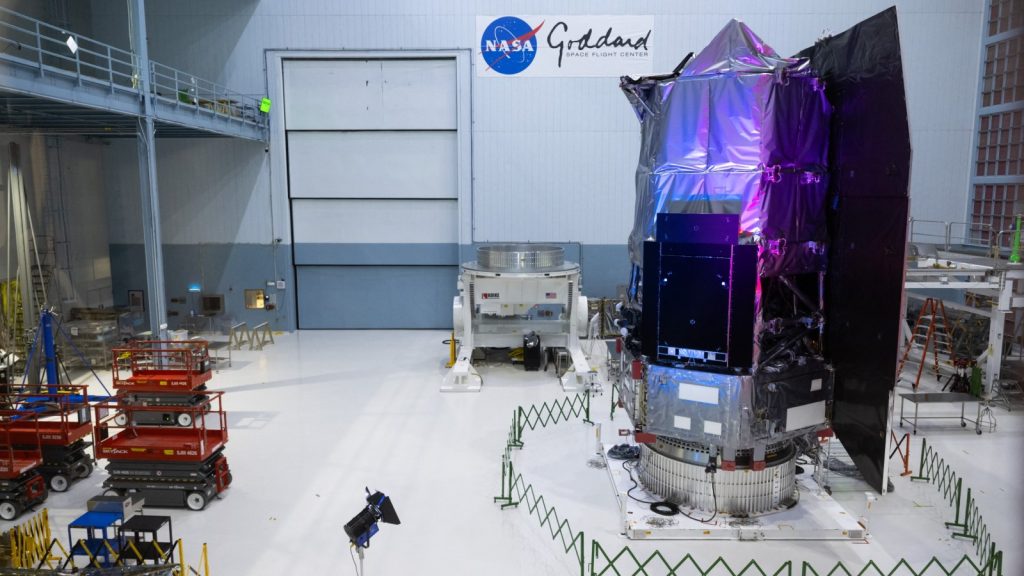
The Nancy Grace Roman Space Telescope is unveiled to the public at NASA’s Goddard Space Flight Center in Greenbelt.
How Roman Could Find 100,000 Worlds
The Roman Space Telescope will repeatedly observe dense star fields toward the Milky Way’s centre. Its Galactic Bulge Time-Domain Survey will revisit them rapidly, revealing changes that a single exposure would miss.
NASA expects transits to account for around 100,000 potential worlds. Recurring brightness dips can reveal a planet’s orbital period. Their depth also helps researchers estimate its relative size.
The projected collection will not contain 100,000 Earth twins. Large planets in short orbits produce stronger and more frequent signals. As a result, hot Jupiters and other close-orbiting giants should form a significant part of the sample.
Roman may still detect smaller worlds. The final total will depend on their frequency in the galactic bulge, survey cadence, detector performance, and data analysis.
Microlensing Reaches Planets That Transits Miss
Roman will also search for gravitational microlensing. A foreground object’s gravity briefly magnifies a distant star’s light. An orbiting planet can add a smaller feature to that temporary brightening.
This method explores a different planetary population. Transits favor worlds that orbit close to their stars and align with our viewing angle. Microlensing can reveal cooler planets in wider orbits. It can also detect worlds with masses similar to Earth or Mars.
NASA forecasts more than 1,000 microlensing planets. Some could travel through the galaxy without a detectable host star, making them difficult to find through other techniques.
Microlensing events usually do not repeat. Astronomers must extract information from each event’s brightness pattern, duration, and colour behavior. Roman’s stable space-based observations should make those measurements more precise.
Candidates Are Not Automatically Confirmed Planets
The NASA Exoplanet Archive listed 6,354 confirmed planets on August 20, 2026. If Roman approaches its projected transit yield, it could identify far more signals than the entire current confirmed catalogue.
However, that comparison places a future estimate beside a verified count. Roman will first produce candidates that scientists must validate.
Eclipsing binary stars can imitate planetary transits. Stellar variability, blended objects, and detector effects can also create misleading patterns. Automated searches will screen the dataset, while some candidates may require follow-up observations.
The distinction does not weaken Roman’s value. A large, consistent sample will improve comparisons between planetary populations. Even a lower yield could transform models of planetary formation and evolution.
Direct Imaging and a Universe Beyond Planets
Roman also carries a Coronagraph Instrument. It will block most of a star’s glare so researchers can examine faint nearby giant planets and dusty disks. This instrument is a technology demonstration, not the source of the 100,000-world estimate.
Roman will also study hundreds of millions of stars and billions of galaxies. Its surveys will track supernovae, galaxy clustering, weak gravitational lensing, and cosmic expansion. These measurements will test ideas about dark energy and cosmic structure.
NASA expects Roman to generate about 20 petabytes of processed data during its five-year primary mission. The agency plans to release survey data publicly after processing, with no exclusive-access period.
Roman Space Telescope Could Redraw the Galactic Map
The Roman Space Telescope promises more than a dramatic rise in exoplanet numbers. Its real strength lies in measuring diverse planetary populations through the same wide, repeated survey.
Transits should uncover many close-orbiting worlds. Microlensing will extend the search toward cooler, wider, and possibly free-floating planets. The coronagraph will test direct-imaging technology for future observatories.
If Roman performs as expected, it will move exoplanet science beyond individual discoveries. It could map how planet size, orbit, and frequency change across the Milky Way.
Main Sources:
NASA Roman launch readiness update:
https://science.nasa.gov/blogs/roman/2026/08/21/teams-complete-flight-readiness-review-for-nasas-roman-telescope/
NASA Roman exoplanet forecast:
https://www.nasa.gov/missions/roman-space-telescope/nasas-roman-mission-preps-to-unveil-new-populations-of-faraway-worlds/
NASA Roman frequently asked questions:
https://science.nasa.gov/mission/roman-space-telescope/frequently-asked-questions/
NASA Galactic Bulge Time-Domain Survey:
https://science.nasa.gov/mission/roman-space-telescope/galactic-bulge-time-domain-survey-technical/
NASA Exoplanet Archive:
https://exoplanetarchive.ipac.caltech.edu/
NASA Roman Coronagraph Instrument:
https://science.nasa.gov/mission/roman-space-telescope/coronagraph/
NASA Roman press kit:
https://assets.science.nasa.gov/content/dam/science/missions/rst/education/aug%20Roman%20Press%20Kit-508compliant.pdf