BY:SpaceEyeNews.
NASA’s Roman Space Telescope has started a mission that could reshape our view of the universe. The observatory lifted off aboard a SpaceX Falcon Heavy on August 30, 2026. It then began traveling toward its operational region near Sun–Earth L2. Roman will map vast areas of the infrared sky. It will track cosmic expansion and build a broad census of planetary systems. Its greatest strength is the ability to study enormous populations quickly and precisely.
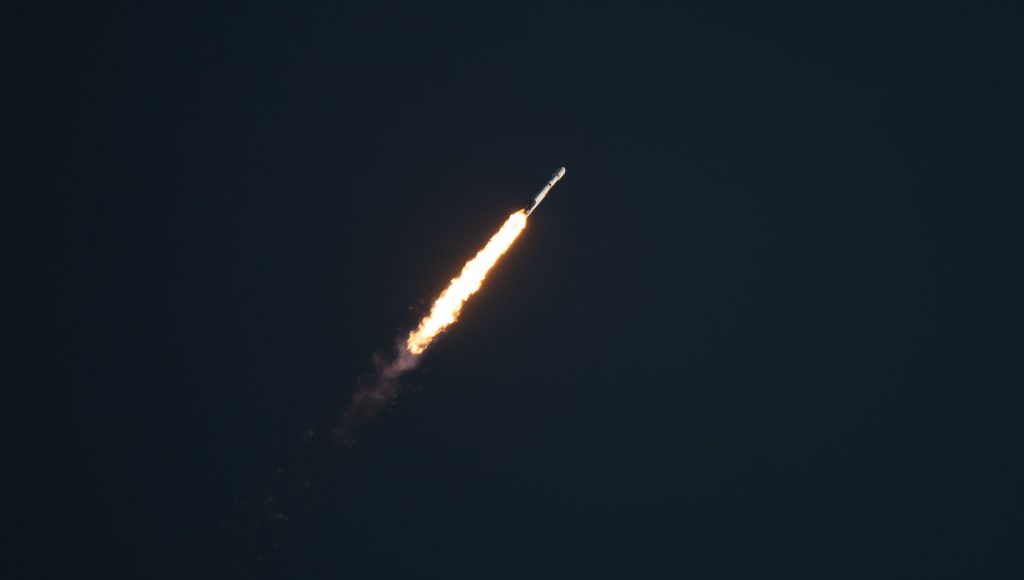
A SpaceX Falcon Heavy rocket launches with NASA’S Nancy Grace Roman Space Telescope onboard from Launch Complex 39A at Kennedy Space Center in Florida on Sunday. NASA/Joel Kowsky
Roman Space Telescope Starts Its Journey to L2
Roman launched at 7:26 a.m. EDT from Launch Complex 39A at NASA’s Kennedy Space Center. Ground controllers received telemetry seven minutes later. The spacecraft separated from Falcon Heavy about 31 minutes after liftoff. NASA also confirmed the deployment of its solar panels and lower instrument sunshade.
The observatory now faces a journey of roughly one million miles. It will operate in an orbit around the second Sun–Earth Lagrange point, known as L2.
Commissioning Comes Before Science
The launch did not begin full science operations. Teams must activate, test, and calibrate Roman’s systems during a three-month commissioning phase.
NASA expects to release the first images in early 2027. That schedule corrects earlier reports that suggested images might arrive in December 2026. Roman’s primary mission will run for five years, while NASA has set a ten-year operational goal.
A Wide Infrared View With Hubble-Like Detail
Roman’s main scientific tool is the Wide Field Instrument. This 300-megapixel infrared camera uses 18 detectors to create sharp sky panoramas. Its resolution and sensitivity resemble Hubble’s infrared capabilities. Yet its field of view is at least 100 times larger.
That difference changes the scale of possible research. Roman can examine huge celestial populations in a fraction of the time. NASA designed it to survey the universe up to 1,000 times faster than Hubble.
A Survey Telescope, Not a Hubble Replacement
Roman will not replace Hubble or Webb. Webb can study selected objects with exceptional depth and detailed spectroscopy. Hubble continues to provide ultraviolet, visible, and near-infrared observations.
Roman will locate patterns across wide fields and identify promising targets. Other telescopes can then provide the closer view.
Roman Space Telescope Will Test Cosmic Expansion
Roman’s cosmology program will examine two connected questions. How has the universe expanded, and how did matter assemble into today’s large-scale structures?
The High-Latitude Wide-Area Survey will combine imaging and spectroscopy. Weak gravitational lensing will measure how matter bends light from distant galaxies. Galaxy clustering, baryon acoustic oscillations, and redshift-space distortions will provide additional evidence. Together, these methods trace expansion and cosmic structure across time.
Supernovas Add an Independent Measurement
Another program, the High-Latitude Time-Domain Survey, will repeatedly observe selected regions. It will track Type Ia supernovas and other changing objects. Type Ia supernovas provide a separate way to reconstruct the universe’s expansion history.
Each method carries different uncertainties. Agreement could strengthen the current cosmological model. Conflicting results would demand closer examination.
Roman will test current cosmology rather than automatically overturn it. Its data could show whether recent tensions remain after more precise measurements.
Building a New Census of Exoplanets
Roman will also observe dense star fields near the Milky Way’s central bulge. Its Galactic Bulge Time-Domain Survey will revisit these fields at high cadence. Small changes in stellar brightness can reveal planets through gravitational microlensing and transits.
Microlensing gives Roman access to planetary systems that many previous surveys could miss. These include worlds on wider orbits, low-mass planets, and objects that may travel without a host star. Transit observations should add many more discoveries.
More Than a List of New Worlds
The main goal extends beyond increasing the known exoplanet count. Roman will measure how frequently different types of planets and systems occur. That statistical picture may show whether our solar system is common, unusual, or one example within a broad range of architectures.
The same observations could reveal variable stars, compact objects, and isolated black holes. Roman’s archive may support research far beyond the planet survey.
A Coronagraph That Prepares for Future Missions
Roman carries a second instrument called the Coronagraph Instrument. It will block the glare from nearby stars and capture reflected light from Jupiter-like exoplanets. NASA designed it to detect planets around 100 million times fainter than their host stars.
The coronagraph is a technology demonstration. It should perform 100 to 1,000 times better than existing space-based coronagraphs. Its results could guide NASA’s proposed Habitable Worlds Observatory.
Roman itself will not conduct a full search for Earth twins or signs of life. Instead, it will test hardware and control systems that could make such searches possible in the future.
An Open Archive With 1.4 Terabytes Every Day
Roman will send around 1.4 terabytes of information to Earth each day. NASA describes this as the highest data rate yet for one of its astrophysics missions. Scientists will use automated systems, machine learning, and public participation to identify noteworthy objects and events.
Roman’s observations will become public without a proprietary waiting period. Worldwide access should support discoveries that the original teams did not anticipate.
Conclusion: Roman Space Telescope Enters a New Discovery Era
The Roman Space Telescope has completed its launch, but its scientific test is only beginning. It will combine wide infrared coverage with sharp imaging and rapid surveys. Roman could refine measurements of cosmic expansion and transform the census of planetary systems. It may challenge existing theories or strengthen them with better evidence. Either result will matter. With its first images expected in early 2027, the observatory now stands ready to build a new map of the universe.
Main Sources:
NASA launch release:
https://www.nasa.gov/news-release/nasas-dark-universe-seeking-nancy-grace-roman-space-telescope-launches/
NASA Roman mission overview:
https://science.nasa.gov/mission/roman-space-telescope/
NASA Core Community Surveys:
https://science.nasa.gov/mission/roman-space-telescope/core-community-surveys/
NASA Wide Field Instrument:
https://science.nasa.gov/mission/roman-space-telescope/wfi-technical/
NASA JPL Roman Coronagraph:
https://www.jpl.nasa.gov/missions/the-roman-coronagraph-instrument/