
BY:SpaceEyeNews.
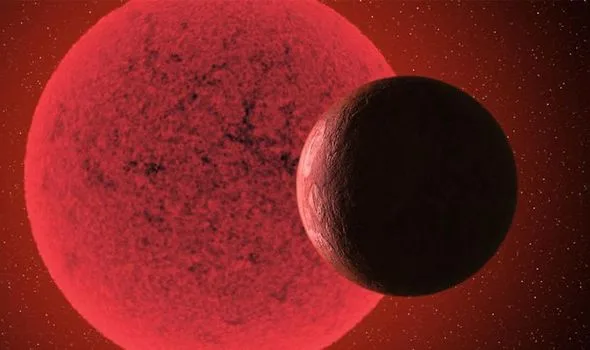
Astronomers have discovered an intriguing new world known as the Ross 318 b super-Earth, orbiting a nearby red dwarf star only 28 light-years from Earth. The rocky planet sits inside the star’s habitable zone and may possess a dense atmosphere capable of distributing heat across its surface.
That possibility immediately drew scientific attention. Rocky planets inside habitable zones remain some of the most valuable targets in astronomy. While scientists have not confirmed water or life on Ross 318 b, the nearby system offers an exciting opportunity to study how potentially life-friendly worlds evolve around red dwarf stars.
The discovery also highlights the growing importance of long-term ground observations in the search for hidden planets close to Earth.
Ross 318 b and Its Nearby Red Dwarf Star
The Ross 318 b super-Earth orbits the red dwarf star Ross 318, also known as Gliese 48. The star belongs to the M3.5V spectral class and has a surface temperature of roughly 3,450 Kelvin.
Compared with our Sun, Ross 318 is much cooler and dimmer. That shifts the habitable zone much closer to the star itself. As a result, planets can orbit at shorter distances while still receiving moderate temperatures.
Ross 318 b appears significantly larger than Earth. Researchers estimate the planet has:
- Around 6.2 times Earth’s mass
- Roughly 1.74 times Earth’s radius
- An orbital period of about 39 days
- An orbital distance near 0.16 AU
Despite orbiting close to its host star, the planet’s estimated equilibrium temperature remains around 237 Kelvin, or minus 36 degrees Celsius.
Those conditions place the planet inside the system’s conservative habitable zone.
Why Super-Earths Continue to Fascinate Scientists
Super-Earths occupy one of the most important categories in exoplanet research. These planets are larger than Earth but smaller than Neptune. Many scientists believe some may contain rocky surfaces beneath thick atmospheres.
Unlike gas giants, rocky super-Earths could potentially support long-term climate stability under the right conditions.
Nearby examples matter even more. Their relative closeness allows astronomers to collect better observational data and refine planetary models over time.
Ross 318 b now joins a growing list of nearby rocky worlds that may help researchers better understand planetary habitability beyond the Solar System.
Could Ross 318 b Maintain Habitable Conditions?
The most interesting aspect of the Ross 318 b super-Earth involves its possible climate behavior.
Because the planet orbits very close to its star, scientists think it is probably tidally locked. One hemisphere likely faces the star permanently while the opposite side remains in constant darkness.
At first glance, that setup may appear hostile. One side could become extremely warm while the other freezes.
However, researchers believe the planet’s large size may allow it to hold a dense atmosphere capable of moving heat around the globe.
A Thick Atmosphere May Stabilize Temperatures
Strong atmospheric circulation could transfer heat between the permanent day side and night side. If that process works efficiently, temperatures across the planet may become more balanced than expected.
Some climate simulations suggest tidally locked planets around red dwarfs could still support stable regions with moderate temperatures. Clouds and atmospheric dynamics may also help regulate surface conditions.
Even so, major uncertainties remain.
Scientists have not confirmed:
- Liquid water
- Atmospheric composition
- Surface pressure
- Magnetic field strength
- Actual surface conditions
For now, researchers simply know the planet occupies an intriguing location inside the habitable zone.
Red Dwarf Stars Create Difficult Environments
Red dwarf systems remain challenging environments for potentially habitable worlds.
These stars often produce intense stellar flares and radiation bursts. Over time, that activity may strip atmospheres from nearby planets.
Ross 318 itself appears magnetically active. Because of that, scientists remain cautious about describing the planet as truly habitable.
Instead, researchers view Ross 318 b as a promising target for future atmospheric studies.
How Astronomers Detected Ross 318 b
The discovery method makes this planet especially interesting.
Many modern exoplanets are found using transit observations from space telescopes. In those cases, astronomers detect tiny brightness dips as planets cross in front of stars.
Ross 318 b emerged through a different approach.
Researchers discovered the planet using long-term radial velocity observations collected over roughly 15 years.
Precision Instruments Revealed the Planet
Scientists relied heavily on two powerful spectrographs:
- CARMENES
- HIRES
These instruments measure tiny stellar movements caused by orbiting planets. As a planet pulls gravitationally on its star, the star shifts slightly back and forth.
Astronomers analyze those subtle changes in starlight to estimate:
- Planetary mass
- Orbital distance
- Orbital period
The Ross 318 observations required years of careful analysis before researchers confirmed the planetary signal.
Stellar Activity Complicated the Search
Ross 318 presents an additional challenge because the star itself remains magnetically active.
Magnetic activity can create signals that resemble planetary motion. Researchers therefore had to separate real orbital effects from stellar noise.
To strengthen the detection, scientists combined infrared and visible-light observations gathered over many years.
That multi-instrument approach improved confidence in the final result and demonstrated the continuing value of long-duration ground-based surveys.
Why Ross 318 b Could Become an Important Future Target
The Ross 318 b super-Earth now stands out as an important nearby candidate for future study.
Its relatively short distance from Earth makes the system scientifically valuable. Nearby planets offer stronger opportunities for detailed atmospheric analysis as telescope technology improves.
Future observatories may eventually investigate:
- Atmospheric chemistry
- Heat circulation
- Cloud structures
- Greenhouse gases
- Possible water vapor
Researchers also hope to better understand whether rocky planets around red dwarfs can maintain stable atmospheres over long timescales.
Could Future Space Telescopes Study Its Atmosphere?
The James Webb Space Telescope may eventually contribute observations of the Ross 318 system. However, one major limitation exists.
Ross 318 b does not appear to transit directly across its star from Earth’s perspective. That makes atmospheric analysis more difficult because astronomers cannot easily study filtered starlight passing through the planet’s atmosphere.
Even so, future observing techniques and next-generation telescopes may still provide valuable insights into the planet’s climate and composition.
A Nearby World Worth Watching
Ross 318 b is not an Earth twin, and scientists have not detected any signs of life. Still, the discovery remains important.
The planet lies relatively close to Earth, appears rocky, and orbits within the habitable zone of its star. Its possible thick atmosphere also raises fascinating questions about climate stability on tidally locked worlds.
At the same time, the discovery reminds astronomers that nearby space may still contain many undiscovered planets waiting to be found.
As more advanced observatories come online in the coming years, worlds like Ross 318 b may help scientists better understand how common potentially life-friendly environments truly are across the galaxy.
Main Sources:
Universe Magazine
https://universemagazine.com/en/super-earth-discovered-around-a-red-dwarf-star-near-earth/
arXiv Research Paper
https://arxiv.org/abs/2505.07913
NASA Exoplanet Exploration
https://science.nasa.gov/exoplanets/
Astrobiology.com
https://astrobiology.com/2026/05/detection-and-characterization-of-the-temperate-super-earth-ross-318-b.html
Phys.org
https://phys.org/news/2026-05-astronomers-super-earth-orbiting-nearby.html