BY:SpaceEyeNerws.
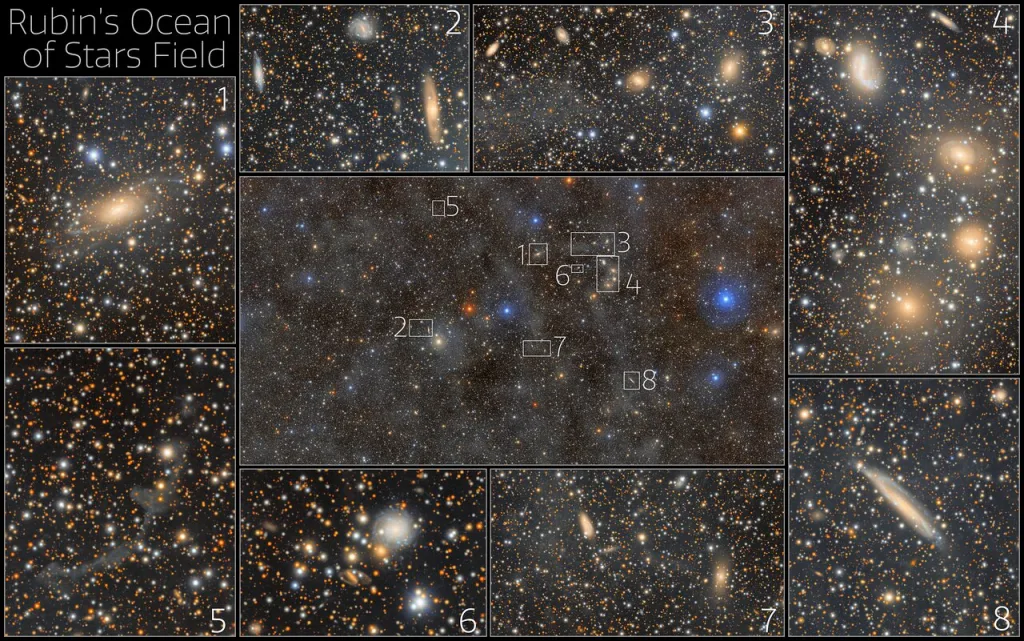
The Rubin Observatory COSMOS image has opened a remarkably wide and deep window into one of astronomy’s best-studied regions. Created with the observatory’s 3,200-megapixel LSST Camera, the panorama contains more than 500,000 galaxies and over 50,000 stars.
Scientists produced the image by stacking hundreds of separate observations. This method reveals objects that would remain too faint in one exposure. It also shows Rubin’s unusual strength. The observatory combines a huge field of view with the sensitivity needed to detect distant galaxies.
The result is more than a striking panorama. It demonstrates how Rubin will study galaxy evolution, dark matter, dark energy, and the changing night sky during its ten-year Legacy Survey of Space and Time.
What the Rubin Observatory COSMOS Image Shows
The COSMOS field has attracted major observatories for more than two decades. Hubble examined the region extensively between 2003 and 2005. Other telescopes later added observations in infrared, X-ray, and radio wavelengths.
Rubin’s new panorama records galaxies with many shapes, colors, sizes, and stages of development. Some appear as spiral systems. Others look smooth and elliptical. Several show signs of interaction or merging.
Many distant galaxies appear as small red points. Cosmic expansion has stretched their light toward longer wavelengths.
Light from the most distant systems began its journey billions of years ago. Therefore, the image presents a layered view of the universe across time rather than one shared cosmic moment.
More Than Half a Million Galaxies
The official release identifies more than half a million galaxies and over 50,000 stars in the combined image. That scale gives researchers a broad statistical sample within one familiar field.
Large samples help astronomers identify patterns that smaller datasets may miss. They can compare galaxies with different masses, environments, gas supplies, shapes, and levels of activity.
Rubin also provides wider context. Hubble and the James Webb Space Telescope can inspect smaller regions in finer detail. Rubin covers much more sky at once.
Scientists can therefore connect close-up observations with the larger structures surrounding each target. That combination could provide a more complete picture of how galaxies form and develop.
Why Astronomers Keep Returning to COSMOS
COSMOS stands for the Cosmic Evolution Survey. Scientists selected the field because observatories can study it effectively from both the ground and space.
It also lies away from crowded regions of the Milky Way. This position reduces interference from nearby stars, gas, and dust.
More than two million galaxies have already been identified across the wider COSMOS region. Researchers have studied the field at many wavelengths, creating an unusually rich archive of information.
This long observational history makes COSMOS an ideal testing ground for Rubin.
Researchers can compare Rubin’s measurements with earlier catalogs. They can also test new methods for finding, classifying, and measuring faint objects.
That work will help the astronomy community prepare for the much larger data stream Rubin will create during its decade-long survey.
Inside Rubin’s 3,200-Megapixel Camera
SLAC National Accelerator Laboratory led construction of the LSST Camera for the NSF–DOE Vera C. Rubin Observatory. It is the largest digital camera built for astronomy.
The camera weighs about 2,800 kilograms and is roughly the size of a small car. Its focal plane contains 189 individual imaging sensors. Together, they produce images with around 3.2 billion pixels.
Each exposure covers an area of sky about 45 times the apparent size of the full Moon. Rubin can also take a new image roughly every 40 seconds.
This mix of speed, coverage, and sensitivity separates it from telescopes designed mainly for narrow and highly detailed observations.
Over ten years, Rubin will repeatedly scan the visible southern sky. It will revisit surveyed regions hundreds of times. These observations will create a long record of changes in brightness, position, color, and appearance.
Turning a Still Image into a Cosmic Movie
The Rubin Observatory COSMOS image represents only the beginning. Its greatest scientific value will emerge as the observatory returns to the field again and again.
Repeated imaging allows scientists to identify objects that change. These may include variable stars, active galactic nuclei, supernovae, moving asteroids, and other temporary cosmic events.
Rubin’s data system can compare new images with earlier observations. It can then issue alerts when an object shows a significant change.
This time-based approach turns the sky into something closer to a movie. Traditional surveys often provide a detailed snapshot. Rubin adds variation, movement, and long-term development.
COSMOS is especially valuable because astronomers already know the positions and properties of many objects there. Rubin can now show how some of them change over days, months, and years.
Mapping Dark Matter with Distant Galaxies
Rubin’s wide view will also help scientists map dark matter. Dark matter does not emit or reflect light. However, its gravity bends light traveling from background galaxies.
Researchers can measure these subtle distortions through a process called gravitational lensing. A large and carefully measured galaxy sample improves the accuracy of those maps.
COSMOS offers a strong test field because scientists can compare Rubin’s results with information from other major observatories.
These comparisons may reveal how dark matter is distributed around galaxies and across larger cosmic structures.
Studying Dark Energy and Cosmic Growth
The same measurements can support dark energy research. Scientists can study how galaxies and galaxy clusters formed, expanded, and changed across cosmic history.
Those patterns may reveal how the universe’s expansion rate has evolved.
Rubin will not answer these questions with one image. Its real strength comes from millions of exposures, repeated observations, and consistent measurements across a vast area.
The COSMOS panorama shows that the observatory can already detect an enormous population of faint and distant systems. Future observations will make those measurements deeper and more precise.
Why the New COSMOS Panorama Matters
The new panorama shows what happens when depth, width, and time come together. Other observatories can reveal finer structures within smaller targets. Rubin places those targets inside a much broader cosmic landscape.
That makes Rubin highly complementary to Hubble, Webb, Euclid, and the Nancy Grace Roman Space Telescope.
Rubin can identify unusual objects and changing events across a large area. Other telescopes can then examine selected targets in greater detail.
The image also previews a major data challenge. Rubin will produce enormous catalogs containing billions of objects. Scientists will need advanced software, rapid processing systems, and coordinated follow-up observations to use that information effectively.
Rubin’s ability to observe the same sky repeatedly will also change how astronomers respond to new discoveries. Instead of waiting months for updated observations, researchers may receive alerts soon after an object changes.
Conclusion
The Rubin Observatory COSMOS image is an important demonstration of a new style of astronomy. It combines a 3,200-megapixel camera, a huge field of view, and repeated observations of the same sky.
Its more than 500,000 galaxies create a powerful laboratory for studying cosmic evolution. Researchers can compare galaxy types, investigate dark matter, and follow changing objects across time.
Future visits will add far more than extra detail. They will add the missing dimension of time.
As Rubin continues its ten-year survey, COSMOS will develop from a famous deep field into a closely monitored record of a changing universe.
Main Sources:
NSF NOIRLab — NSF–DOE Rubin Observatory Opens Deep Window on Famous Cosmic Field
https://noirlab.edu/public/news/noirlab2618/
SLAC National Accelerator Laboratory — Rubin Observatory News Collection
https://www6.slac.stanford.edu/lsst
Vera C. Rubin Observatory — Legacy Survey of Space and Time Begins
https://rubinobservatory.org/news/action-rubin-lsst-begins