
BY:SpaceEyeNews.
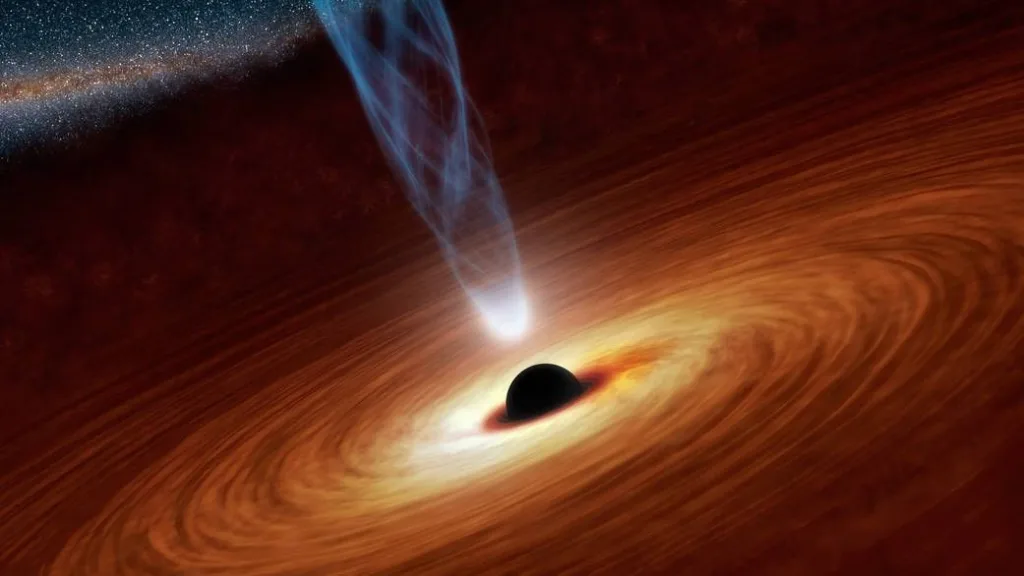
For decades, astronomers believed they had solved one of the greatest mysteries in our galaxy. At the center of the Milky Way sits Sagittarius A*, a compact object with a mass around four million times that of the Sun. The overwhelming scientific consensus has been that this object is a supermassive black hole. Now, however, the Sagittarius A dark matter theory is offering an alternative explanation that has captured the attention of researchers worldwide.
This new proposal does not dismiss decades of observations. Instead, it argues that those observations may also be explained by an extremely dense concentration of a special form of dark matter. If the idea proves correct, it could transform our understanding of both the Milky Way and dark matter itself. Although the black hole model remains the leading explanation, this alternative highlights how science constantly tests even its strongest theories.
Why the Sagittarius A Dark Matter Theory Emerged
The new hypothesis did not appear because astronomers suddenly lost confidence in black holes. Instead, it emerged because modern astronomy often seeks models that explain multiple cosmic mysteries at once.
Researchers have spent decades studying the stars that orbit extremely close to Sagittarius A*. These so-called S-stars move at remarkable speeds around an invisible object located at the Galactic Center. Their motion allows scientists to calculate both the mass and size of that central object with exceptional precision.
A Massive Object Is Beyond Doubt
Observations leave little room for doubt that something extraordinary exists at the center of the Milky Way.
The measurements reveal an object containing roughly four million solar masses packed into a region smaller than our Solar System. That combination naturally pointed astronomers toward a supermassive black hole because no other well-established object seemed capable of reaching such density.
For years, this interpretation successfully explained the available observations.
Gravity Reveals the Mass, Not the Identity
However, researchers point out an important distinction.
The orbits of nearby stars reveal the strength of gravity. They do not directly reveal the physical nature of the object producing that gravity.
In other words, astronomers know an extremely compact and massive object exists. The remaining question is whether that object must be a black hole or whether another exotic form of matter could produce nearly identical gravitational effects.
That question forms the foundation of the Sagittarius A dark matter theory.
How the Sagittarius A Dark Matter Theory Explains the Observations
The proposed model introduces a specific form of dark matter known as fermionic dark matter.
Unlike traditional descriptions of dark matter as a diffuse halo surrounding galaxies, this model suggests that the particles could also gather into an extremely compact central core. That dense core would occupy the same location currently assigned to Sagittarius A*.
One Structure Instead of Two
One of the most interesting aspects of the new model is its simplicity.
Instead of treating the central object and the galactic dark matter halo as separate components, researchers suggest they could be different parts of one continuous structure.
The dense central core would account for the enormous gravity observed near Sagittarius A*. At the same time, the surrounding halo would explain why stars farther from the Galactic Center continue orbiting faster than visible matter alone can explain.
If correct, one form of matter could account for two long-standing astronomical puzzles.
Matching the Motion of the S-Stars
The model also reproduces the measured orbits of the S-stars.
These stars complete their orbits in periods ranging from years to decades while traveling through the strongest gravitational field in the Milky Way.
Researchers found that their dark matter core produces stellar motions that closely resemble those predicted by the black hole model using today’s observational precision.
That agreement makes the proposal scientifically interesting rather than purely speculative.
Consistent With Gaia Measurements
The Sagittarius A dark matter theory also agrees with measurements collected by the European Space Agency’s Gaia spacecraft.
Gaia has mapped the positions and motions of more than a billion stars with unprecedented precision. Those observations help scientists study the Milky Way’s rotation curve.
For decades, astronomers have known that stars located far from the Galactic Center orbit much faster than visible matter should allow.
Dark matter has traditionally explained that discrepancy.
The new model extends that explanation by suggesting the same dark matter responsible for the galactic halo could also create the compact object at the center.
Why the Event Horizon Telescope Does Not End the Debate
Many readers may wonder how this new idea fits with the famous image of Sagittarius A* released by the Event Horizon Telescope in 2022.
At first glance, that image appears to settle the debate.
The reality is more subtle.
The Image Shows Surrounding Light
The Event Horizon Telescope did not photograph the object itself.
Instead, it captured radio emissions from extremely hot gas swirling around the central mass. Gravity bends that light into the bright ring now recognized around the world.
The dark region at the center appears because gravity redirects or captures light before it reaches Earth.
Different Objects Can Produce Similar Images
According to the researchers, a dense dark matter core can produce a surrounding ring that closely resembles the one expected around a black hole.
With current image resolution, both scenarios generate observational signatures that remain remarkably similar.
This does not prove the dark matter model.
Instead, it demonstrates that existing observations alone cannot completely eliminate the alternative explanation.
That distinction is central to understanding the Sagittarius A dark matter theory.
What Future Observations Could Reveal
Although today’s observations cannot distinguish the two models, astronomers already know where to look for answers.
Orbital Precession Could Provide the Key
The strongest test involves orbital precession.
As stars orbit the Galactic Center, their paths slowly rotate over time because of gravity.
A black hole and a dense dark matter core predict slightly different rates of precession.
The difference remains too small for current instruments to measure with complete confidence, but that situation may soon change.
The Next Generation of Telescopes
Several powerful observatories are expected to provide much more precise measurements.
The GRAVITY+ upgrade on the Very Large Telescope Interferometer will improve observations of stars near Sagittarius A*.
The Extremely Large Telescope, scheduled to begin scientific operations later this decade, will observe the Galactic Center with far greater sensitivity than existing ground-based facilities.
Meanwhile, future upgrades to the Event Horizon Telescope could deliver sharper images of the environment surrounding Sagittarius A*.
Together, these facilities may finally determine whether the central object truly possesses an event horizon or represents something entirely different.
What If the Sagittarius A Dark Matter Theory Is Correct?
The consequences would extend well beyond the Milky Way.
Rethinking Galactic Evolution
Astronomers currently believe supermassive black holes occupy the centers of most large galaxies.
If Sagittarius A* turns out to be a dense dark matter core instead, scientists would need to reconsider whether every galaxy actually hosts a black hole.
That would reshape many existing models of galaxy formation and evolution.
A New Window Into Dark Matter
Dark matter remains one of the greatest unsolved mysteries in modern physics.
Researchers estimate it makes up about 85 percent of all matter in the Universe, yet nobody has directly detected its particles.
If fermionic dark matter forms compact objects like the one proposed in this model, physicists would gain valuable clues about its mass, behavior, and interactions.
That information could guide future laboratory experiments searching for dark matter particles.
Cautious Optimism Across the Scientific Community
Independent astronomers describe the proposal as exciting because it offers a testable prediction rather than speculation alone.
At the same time, they emphasize that extraordinary claims require equally strong evidence.
The black hole interpretation still explains decades of observations extremely well.
The new model must survive increasingly precise observations before it can replace the current consensus.
Conclusion
The Sagittarius A dark matter theory has introduced one of the most fascinating debates in modern astronomy. Rather than rejecting decades of research, it offers an alternative explanation that matches many of today’s observations while making new predictions for tomorrow’s telescopes. The supermassive black hole model remains the strongest explanation for Sagittarius A*, but science advances by challenging even its most successful ideas. As new observatories begin exploring the Galactic Center with unprecedented precision, astronomers may soon discover whether the heart of the Milky Way contains the black hole we have long believed—or something even more extraordinary.
Main Sources:
- BBC Sky at Night Magazine (Original article)
https://www.skyatnightmagazine.com/news/milky-way-supermassive-black-hole-dark-matter-theory - Crespi, Argüelles et al. – A Dark Matter Alternative to Sagittarius A (preprint)
https://arxiv.org/abs/2510.19087 - Event Horizon Telescope Collaboration – Sagittarius A* Image
https://eventhorizontelescope.org/ - European Space Agency – Gaia Mission
https://www.esa.int/Science_Exploration/Space_Science/Gaia - European Southern Observatory – GRAVITY+
https://www.eso.org/public/teles-instr/paranal-observatory/vlti/gravityplus/ - European Southern Observatory – Extremely Large Telescope (ELT)
https://www.eso.org/public/teles-instr/elt/