
BY:SpaceEyeNews.
Saturn’s decagon has added a new puzzle to the planet’s atmosphere: a giant, evolving wave surrounding its south pole. Hubble observations reveal ten sides, giving scientists a southern counterpart to the familiar northern hexagon. Yet the discovery raises a question that its striking appearance cannot answer. Why has this pattern emerged now?
The discovery marks the first observation of a large, regular-sided jet pattern in Saturn’s southern hemisphere. Researchers see signs that the feature is strengthening. That offers a rare opportunity to follow a large atmospheric structure as it develops. Its changing form could help explain how Saturn creates and sustains these unusual patterns.
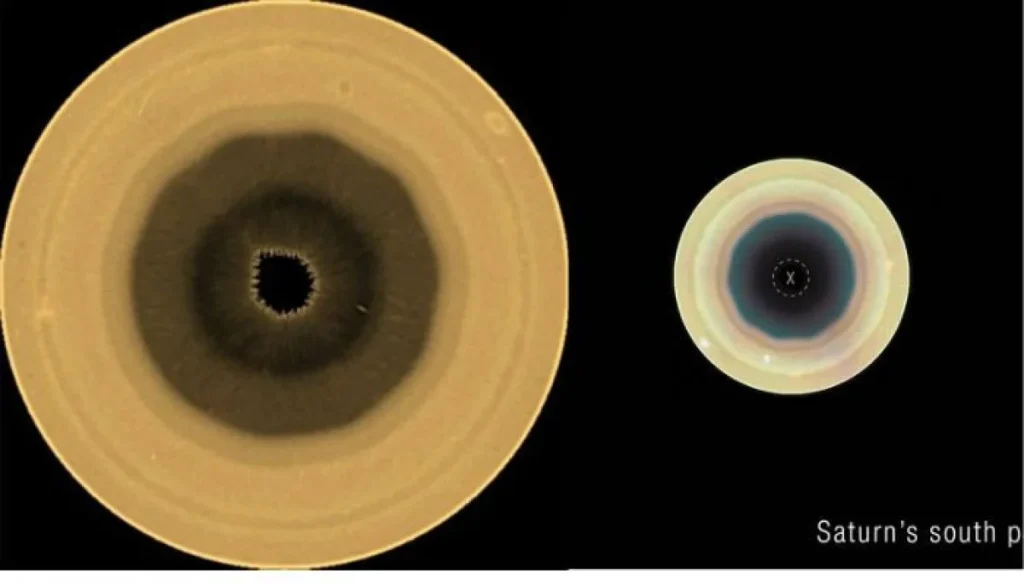
NASA Hubble spots strange 10-sided ‘decagon’ swirling around Saturn’s south pole .
How Scientists Identified Saturn’s Decagon
The investigation began with a subtle clue in images from Earth. In 2024, Agustín Sánchez-Lavega noticed an undulating band around Saturn’s southern polar region. Amateur astronomers Trevor Barry and Jean-Paul Oger also helped identify the feature.
Sánchez-Lavega works at Spain’s University of the Basque Country, which manages the Planetary Virtual Observatory Laboratory. Through this platform, observers worldwide contribute planetary images. Their combined observations gave the researchers material to investigate the developing structure.
Additional ground observations in 2025 strengthened the evidence. Meanwhile, Saturn’s changing seasonal orientation gradually brought its south pole into clearer view from Earth.
Hubble then provided sharper images without the blurring effects of Earth’s atmosphere. Researchers examined observations spanning several years and confirmed the feature’s presence back to 2023. The sequence matters: recognizing the pattern later allowed them to identify it in earlier images.
NASA announced the findings on September 2, 2026, alongside publication in Science Advances. The observations establish when the wave was present, although its exact formation date remains uncertain. NASA’s discovery announcement
What Hubble Reveals About the Polar Wave
Saturn’s decagon follows one of the planet’s powerful jet streams. Its outline traces a wave within the moving atmosphere, while observations at different wavelengths reveal another dimension: height.
Those wavelengths probe different atmospheric levels. When researchers compare the images, the decagon’s apparent position shifts slightly. Together, these observations indicate that the structure extends through multiple layers.
This finding gives researchers more to explain than the ten-sided outline alone. Any successful explanation must also account for the wave’s vertical structure and its relationship with the surrounding jet.
However, the observations do not yet provide a complete account of that relationship. Scientists still need to establish how the pattern develops and persists across those levels. Computer models and further measurements could help connect the visible shape with the atmospheric processes beneath it.
For now, Hubble supplies evidence of a structure with depth, alongside its distinctive geometry. ESA/Hubble’s explanation
Saturn’s Decagon and the Northern Hexagon
The obvious comparison involves the number of sides: ten in the south and six in the north. Their observed histories offer an equally useful distinction.
Astronomers have repeatedly observed the northern hexagon for more than four decades. Saturn’s decagon, meanwhile, appears to be strengthening. Amy Simon, an atmospheric scientist at NASA’s Goddard Space Flight Center, highlights this development as a rare research opportunity.
Following that change could help scientists investigate how a large atmospheric pattern becomes established. They can compare successive observations and examine whether its shape grows more consistent over time.
The northern hexagon provides a valuable reference for that comparison. However, a similar appearance does not establish an identical origin. Researchers must still investigate which processes the two structures share and which differences matter.
Their contrasting histories also raise a practical question: will the southern wave achieve comparable longevity?
Why Did the Southern Pattern Appear Now?
Scientists have searched for a southern counterpart to the hexagon in Hubble images since 1990. Earlier Cassini observations also failed to establish a comparable, persistent formation. That history makes the recent evidence particularly interesting. NASA’s account of the search
Still, a long search does not tell researchers exactly when the decagon formed. The available images confirm its presence by 2023. They leave its earlier development uncertain.
Seasonal visibility requires similar care. Saturn’s changing orientation helped observers see the southern region more clearly. That observational advantage does not, by itself, demonstrate that seasonal changes created the wave.
Several questions therefore remain open. What started the pattern? Why does it have ten sides? Which atmospheric conditions allow it to strengthen? Answering those questions requires evidence about the physical processes involved, beyond the discovery images themselves.
What Future Observations Could Reveal
Hubble’s Outer Planet Atmospheres Legacy program, known as OPAL, provides a foundation for continued study. It has photographed the outer planets annually for more than a decade.
That regular coverage allows researchers to place individual images within a longer record. A subtle feature in one year can become more meaningful when later observations reveal its development. The decagon shows why preserving and comparing those images matters.
Study co-author Mike Wong, from the University of California, Berkeley, emphasizes the value of discoveries built from years of observations. Such records help scientists follow seasonal changes, temporary storms, and slowly evolving atmospheric features.
The team plans to keep observing Saturn. Researchers also identify further Hubble and James Webb observations, together with computer modelling, as necessary steps.
Their central goal is to determine whether Saturn’s decagon settles into a stable configuration or continues changing. The results could improve understanding of giant-planet atmospheres and support comparisons with atmospheric behavior elsewhere, including Earth. ESA/Hubble’s research outlook
Saturn’s Decagon Offers a New Research Opportunity
Saturn’s decagon gives astronomers a developing feature to follow across future observations. Its geometry, vertical extent, and apparent strengthening provide several clues, while its origin remains unresolved.
The next stage will test how those clues fit together. Continued monitoring can establish whether the wave maintains its shape and how it changes over time. Each new observation will extend the record that scientists need to understand this unusual addition to Saturn’s atmosphere.
Main sources:
NASA — NASA’s Hubble Tracks New Decagon Encircling Saturn’s South Pole, September 2, 2026.
ESA/Hubble — Hubble Tracks New Decagon Encircling Saturn’s South Pole, September 2, 2026.
Universe Magazine — A Mysterious Decagon Has Been Discovered Above Saturn’s South Pole, your supplied source.