BY:SpaceEyeNews.
For years, the Saturn spin mystery looked like one of planetary science’s strangest problems. Saturn seemed to rotate at different speeds depending on how scientists measured it. That made little sense. A giant planet cannot simply change its spin rate from one era to another. Now, the James Webb Space Telescope has helped researchers find the missing answer. The signal was not coming from a changing planet. It was coming from Saturn’s aurora, its upper atmosphere, and a feedback loop that kept the illusion alive.
Why the Saturn spin mystery confused scientists for decades
The Saturn spin mystery goes back many years. Scientists tried to measure the length of Saturn’s day by tracking signals linked to the planet’s magnetic environment. That method worked well for some other giant planets. But Saturn kept producing results that did not stay fixed. Data from the Cassini mission in the 2000s suggested that Saturn’s apparent rotation period was shifting over time.
That result created a serious problem. A planet the size of Saturn does not just speed up and slow down on human timescales. Something else had to be affecting the signal. The real challenge was figuring out what that “something else” was. Researchers knew the observed change had to be indirect, but the system behind it remained unclear for years.
This was not a small technical issue. Saturn’s rotation rate matters because it helps scientists understand the planet’s deep interior, its magnetic field, and the way its atmosphere connects to the space around it. If the measurement itself was being distorted, then a core piece of Saturn science needed to be rethought.
That is what makes this new result so important. It does not just fix one odd number. It explains why the wrong number kept appearing in the first place.
Earlier work pointed away from Saturn’s true rotation
Before JWST entered the picture, researchers had already made major progress. A previous study led by Tom Stallard and colleagues showed that Saturn’s true spin was probably not changing at all. Instead, the misleading signal seemed to come from winds high in Saturn’s upper atmosphere. Those winds affected electrical currents tied to the aurora, which then altered the signal scientists were using as a clock.
That was a major breakthrough, but it still left one big question open. If upper-atmosphere winds were driving the false signal, what was driving the winds?
That missing link mattered. Without it, scientists had only half the answer. They knew the false reading came from the atmosphere, but they still did not know what powered the atmosphere strongly enough to create such a stable and long-lasting effect.
This is where the story becomes more interesting. The final answer did not come from looking deeper into Saturn. It came from studying the planet’s glowing northern aurora in far greater detail than ever before.
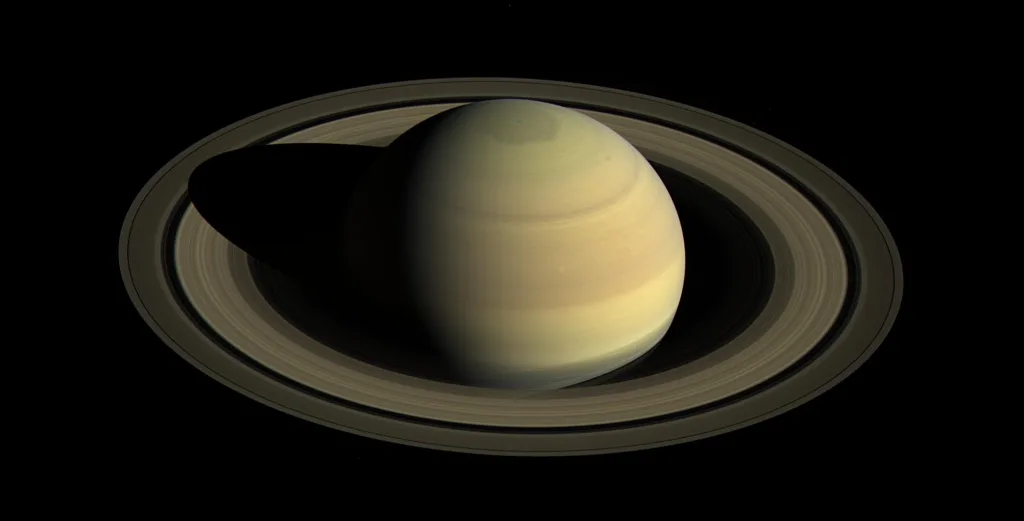
How JWST observed Saturn’s aurora in a new way
To solve the Saturn spin mystery, the research team used the James Webb Space Telescope to observe Saturn’s northern auroral region over a full Saturnian day. That gave them a continuous and highly detailed view of a part of the planet that had been difficult to map with enough precision before.
The team focused on infrared emissions from a molecule called trihydrogen cation, or H3+. This molecule forms in Saturn’s upper atmosphere and acts like a natural thermometer. By tracking its glow, scientists could map temperature and particle density across the auroral region with much greater accuracy than earlier instruments allowed.
That improvement was crucial. Earlier measurements had uncertainties large enough to blur the very differences researchers wanted to study. The new Webb data was far more precise, which meant the team could finally see the fine structure of heating and cooling across the auroral zone. Instead of broad hints, they now had a detailed map.
This is exactly the kind of job JWST does well. Although many people know Webb for its deep-universe discoveries, the telescope is also extremely powerful for planetary science in our own solar system. Its infrared capabilities let researchers track heat, chemistry, and atmospheric structure in ways that older tools often could not match. NASA and ESA have both highlighted Webb’s growing role in studying the giant planets, including Saturn.
The key discovery behind the Saturn spin mystery
Once the data came in, the pattern became much clearer. The researchers found that the temperature and density structures in Saturn’s auroral region matched predictions from earlier computer models. But they only matched if the main source of heat sat exactly where the strongest auroral energy entered the atmosphere.
That result changes the whole picture.
Saturn’s aurora is not just a beautiful light show above the planet’s poles. It is actively heating the atmosphere in specific places. That localized heating creates pressure differences. Those differences drive winds. The winds then help generate electrical currents that power the auroral system. In other words, the aurora helps energize the atmosphere, and the atmosphere helps sustain the aurora.
This is the missing mechanism scientists had been chasing. It means the Saturn spin mystery was really a problem of atmospheric physics and magnetospheric feedback, not a problem of Saturn’s actual rotation.
Saturn’s aurora behaves like a planetary heat pump
One of the most useful ways to explain the new result is through the idea of a planetary heat pump. That phrase comes straight from the research team’s interpretation of the system. The aurora deposits energy into the upper atmosphere. The atmosphere responds by generating winds. Those winds help create the electrical currents tied to the auroral pattern. Then the aurora continues to inject energy into the same system.
The result is a loop that feeds itself.
This matters because it explains why the misleading signal remained stable enough to fool scientists for so long. The system was not random. It was structured, self-reinforcing, and linked to Saturn’s broader magnetic environment. That is why it could imitate a rotation-based signal even though Saturn’s deep spin was not actually changing.
This feedback loop also helps explain why the effect lasted across long observing periods. It was not a brief atmospheric fluctuation. It was part of a deeper relationship between the atmosphere above Saturn and the magnetic region surrounding the planet.
Why the Saturn spin mystery matters beyond Saturn
The most exciting part of this result may be what it means for other worlds. The new study suggests that a giant planet’s atmosphere and magnetosphere can influence each other much more strongly than many people assumed. Instead of acting like separate layers, they can behave like a connected system that exchanges energy both ways.
That insight could matter for Jupiter, Uranus, and Neptune. It may also shape how scientists think about exoplanets with strong magnetic fields and dynamic upper atmospheres. When researchers study strange signals from distant planets, they may need to consider whether those signals reflect true internal rotation or a more complex atmosphere-space interaction. This Saturn result offers a useful warning: the most obvious interpretation may not be the right one.
The finding also adds to JWST’s value as a solar system observatory. Webb is often described as a mission built to study the early universe and distant exoplanets. That is true. But results like this show that it is also transforming the study of familiar worlds much closer to home. Saturn still holds major surprises, and Webb is proving that some of those surprises can only be solved with high-precision infrared observations.
A better way to think about Saturn’s changing signal
For a general audience, the easiest way to frame this story is simple: Saturn was not changing its spin. Scientists were reading a signal that had been distorted by the planet’s own auroral engine.
That distinction matters because it turns a confusing mystery into a much more elegant answer. The real story is not that Saturn broke the rules. The real story is that Saturn’s atmosphere, aurora, and magnetic environment are more tightly linked than researchers once realized. The planet was not behaving impossibly. It was behaving in a way that older observations could not fully untangle.
This is one of the best examples of how science often works. A puzzling measurement appears. A first explanation removes the impossible option. Then a better instrument arrives and reveals the full mechanism. In this case, JWST supplied that final step.
Conclusion: the Saturn spin mystery is solved, but the bigger lesson remains
The Saturn spin mystery is finally solved, and the answer is more interesting than a changing day length. JWST data shows that Saturn’s aurora heats the upper atmosphere, that heating drives winds, and those winds help generate the electrical currents that created the misleading signal in the first place. What looked like a rotating puzzle turned out to be an auroral feedback system.
That discovery closes a decades-long chapter in planetary science. It also opens a broader one. Saturn now offers a powerful example of how atmospheres and magnetospheres can work together as one connected engine. For researchers, that could reshape how other giant planets are studied. For readers, it is a reminder that even a familiar world like Saturn can still hide a deep and elegant secret in plain sight.
Main Sources:
Northumbria University: Scientists solve decades-long mystery about why Saturn appears to change its spin
NASA: Webb Captures Saturn in Infrared
NASA Science: NASA Webb, Hubble Share Most Comprehensive View of Saturn to Date
ESA Webb: Infrared and visible observations show layers and storms in the ringed planet’s atmosphere
Original shared article: