
BY:SpaceEyeNews.
A second-generation planet may be taking shape in astronomy’s understanding of what happens after a star grows old. Around the white dwarf HS 0209+0832, researchers have found an unusual chemical signature. It points to a possible world assembled from material its star released near the end of its life.
The evidence comes from archival Hubble observations, supported by other space telescopes. Published on October 5 in Nature Astronomy, the study presents a planet candidate. Its potential importance reaches beyond one unusual system: planet formation might sometimes begin again after a star’s main lifetime ends.
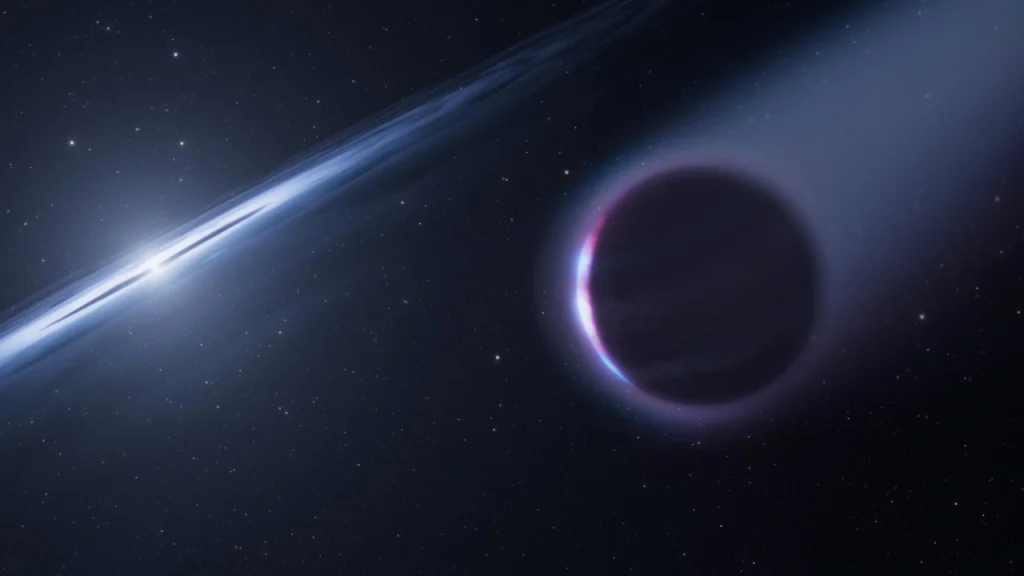
Second-Generation Planet Around White Dwarf HS 0209+0832.
Hubble’s Chemical Mystery Returns
The investigation began with a puzzle dating back to 1999. Hubble’s observations contained roughly 100 chemical features that astronomers could not identify. Those unexplained features remained available for later researchers to examine.
Jamie Williams, a doctoral researcher at the University of Warwick, revisited the observations with an updated atomic database. Many mysterious features matched niobium, an element that scientists had not previously identified in a white dwarf.
That result gave the team a fresh way to interpret the system. Instead of simply cataloging unexplained signals, researchers could investigate what produced the unusual mixture.
The breakthrough also highlights the lasting value of telescope archives. New reference data can reveal information that earlier analyses could not extract, even decades after an observation.
Why Niobium Changes the Story
Niobium alone does not prove that a second-generation planet exists. The element occurs in our solar system too. Here, its unusually high abundance forms part of a broader chemical pattern that needs an explanation.
The study describes enrichment in zinc, copper, and niobium, alongside low abundances of silicon and iron. Those latter elements commonly contribute to rocky planetary material. This combination differs from the familiar compositions of many objects in our solar system.
Researchers connect the unusual enrichment to processes operating during the original star’s late evolutionary stages. Neutron capture can build heavier elements during this period, enriching material that the star later releases.
The important clue therefore concerns the material’s history. Its composition suggests an origin in the aging star’s expelled layers, rather than an ordinary remnant from the system’s earliest days. www.nature.com
How a Second-Generation Planet Could Form
The proposed sequence starts when the aging star releases its outer material. Some of that material remains nearby in a disk. Within that reservoir, matter could gather into a new planet around the remaining stellar core.
Earth formed from material surrounding the young Sun. This candidate would represent a later round of planet formation, using ingredients supplied near the end of stellar evolution.
However, the observations do not show that assembly process unfolding. Researchers infer the proposed history from the chemical evidence and the system’s other properties.
Important details remain unresolved. Scientists still need to understand how these disks develop and which conditions allow them to produce planets. They also need to determine whether such systems represent rare exceptions or a wider population.
FUSE and TESS Strengthen the Evidence
Hubble provides the central chemical evidence, but two additional missions contribute different pieces of the puzzle. Together, their observations help researchers evaluate the proposed explanation.
Data from NASA’s retired Far Ultraviolet Spectroscopic Explorer, or FUSE, also reveal strong niobium signatures. This supports the identification made through Hubble’s archival observations.
Meanwhile, NASA’s Transiting Exoplanet Survey Satellite, known as TESS, monitored the white dwarf for four months. It detected recurring changes in brightness.
The team interprets those variations as supporting a nearby orbiting planet. The suggested orbital distance is approximately 6 million kilometers, or 3.7 million miles. That places the candidate much closer to its star than Mercury orbits the Sun.
These brightness changes provide supporting evidence. They do not amount to a direct image or a confirmed planetary transit. science.nasa.gov
A Giant World Returning Gas to Its Star
Researchers propose that the candidate is a gas giant roughly the size of Jupiter. That description remains an estimate within their interpretation, rather than a directly measured planetary portrait.
The relatively young white dwarf remains extremely hot. Its radiation could remove gas from the nearby planet’s atmosphere, creating an extended tail.
Escaping material might then gather into a disk around the star. Some could eventually reach the stellar surface, carrying the chemical ingredients that Hubble detects.
This provides a connection between the possible planet and the observed spectrum. Astronomers study light from the white dwarf, while the proposed planet supplies material that alters its chemical fingerprint.
The accompanying artwork illustrates this scenario. It does not show a photographed planet, tail, or surrounding disk.
What Future Observations Must Clarify
The next challenge is to test the explanation more thoroughly. Williams plans further Hubble investigations into how these systems form, evolve, and compare with other white dwarfs.
A stronger understanding will require more than identifying similar chemical features elsewhere. Researchers must connect those measurements to convincing formation histories. Comparing multiple systems could help reveal which signatures consistently accompany this proposed process. That broader sample would also show whether HS 0209+0832 occupies a distinctive place among white dwarfs.
The candidate’s future also remains uncertain. Atmospheric loss does not necessarily mean the entire planet will disappear. Cooling could eventually reduce the energy reaching it.
However, possible survival should not become a claim of habitability. The proposed object is a gas giant, and the observations provide no evidence of life. Its value lies in what it could reveal about planetary origins.
A Second Chapter for Planet Formation
This second-generation planet candidate offers an intriguing possibility: stellar evolution may sometimes supply the ingredients for another world. Its chemical signature gives researchers a way to investigate that possibility without seeing the planet directly.
For now, the distinction between evidence and interpretation matters. Further observations must test the proposed connection. Meanwhile, a decades-old Hubble mystery has opened a fresh question about how long planetary creation can continue.
Main sources:
NASA Hubble Mission Team — “Suspected Second-generation Planet Solves NASA Hubble Cold Case,” October 5, 2026.
https://science.nasa.gov/missions/hubble/suspected-second-generation-planet-solves-nasa-hubble-cold-case/
Nature Astronomy — “Discovery of a second-generation planet candidate accreting onto a white dwarf,” October 5, 2026.
https://www.nature.com/articles/s41550-026-02983-7
SciTechDaily — “NASA Hubble Cold Case: A Dead Star May Have Given Birth to a New Planet,” October 10, 2026.
https://scitechdaily.com/nasa-hubble-cold-case-a-dead-star-may-have-given-birth-to-a-new-planet/