BY:SpaceEyeNews.
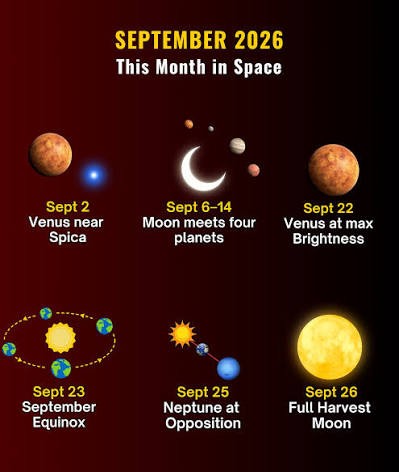
The September 2026 night sky will deliver a closely packed sequence of sights that almost anyone can enjoy. Between September 14 and 26, the Moon will guide observers toward Antares and the Milky Way. Venus will reach peak brilliance, while the equinox will mark a global seasonal shift. Finally, the Harvest Moon will rise beside Saturn and distant Neptune. Most of these events need no telescope, but choosing the right time and viewing direction will make a major difference.
September 2026 Night Sky: Follow the Moon From September 14–20
The Moon will become a useful celestial guide during the middle of September. From September 14 through 20, observers should look toward the southern evening sky about an hour after sunset. The Moon will appear in a different position each night as it moves against the background stars.
That movement will bring it close to Antares, the bright reddish star that marks the heart of Scorpius. Its warm color makes Antares easier to distinguish from many nearby stars.
The Teapot Points Toward the Milky Way
The Moon will also help observers find the Teapot, a recognizable star pattern in Sagittarius. Its stars form a shape resembling a handle, lid, body, and spout. Once identified, the pattern offers a path toward something much larger.
From a sufficiently dark location, a hazy glow may appear to rise from the Teapot’s spout like steam. This glow belongs to the Milky Way. Following it toward its thickest region points the eye toward the direction of our galaxy’s center.
Artificial lighting can hide this feature, even when the Teapot remains visible. A darker location will therefore provide the best opportunity.
International Observe the Moon Night Arrives on September 19
The September 2026 night sky also includes an event designed for worldwide participation. International Observe the Moon Night takes place on Saturday, September 19. NASA invites people to observe from home or join virtual and in-person activities.
The Moon will be near its first-quarter phase, making the evening convenient for observation. Sunlight will cross the lunar surface at an angle near the terminator, the boundary between the illuminated and dark regions. This lighting can make surface relief easier to notice.
NASA’s 2026 Moon maps identify maria, notable landforms, and several human landing sites. The maria are broad plains of solidified basaltic lava that early observers once mistook for seas. NASA says viewers can identify 15 of these dark plains during the event, using binoculars or even the unaided eye.
Venus Reaches Peak Brilliance After Sunset
One evening before the Moon event, Venus will create one of the month’s easiest sights. On September 18, the planet reaches peak brilliance for its current evening appearance. It will outshine every star around it.
Look west shortly after sunset. Venus will appear as an exceptionally bright point low above the horizon. Its brightness makes identification simple, but its low altitude creates a challenge. Buildings, trees, hills, or haze may block the view, and the planet will set relatively quickly.
An open western horizon will improve the experience. Observers should arrive before sunset, choose a clear position, and wait for the planet to emerge as the sky darkens. No telescope or binoculars are needed.
The Equinox Changes the Seasonal Balance
The September equinox follows only a few days later. It occurs at 00:05 UTC on September 23, which is still September 22 across much of the Americas. For Egypt and many locations east of Greenwich, it arrives on September 23. Both dates may therefore appear in observing guides.
At that moment, the center of the Sun crosses Earth’s equatorial plane. Astronomical autumn begins in the Northern Hemisphere, while astronomical spring begins in the Southern Hemisphere.
Day and night are close to equal around the equinox, but they are not precisely 12 hours everywhere. Earth’s atmosphere bends sunlight, and sunrise and sunset definitions also affect measured daylight. Afterward, daylight continues decreasing across the Northern Hemisphere and increasing across the Southern Hemisphere.
Harvest Moon Meets Saturn and Neptune
The September 2026 night sky reaches its brightest finale on September 26. The Harvest Moon will rise in the east shortly after sunset, accompanied by Saturn and Neptune. Together, the three objects will form a wide triangle.
The Moon will provide the easiest starting point. Saturn will also be visible to the unaided eye, appearing as a bright point nearby. Neptune presents a much greater challenge. At approximately magnitude 8, it is too faint for unaided viewing. Binoculars or a telescope will be required, along with dark skies and favorable conditions.
The full Moon itself can make faint Neptune more difficult to distinguish because of its strong light. Observers should first identify the Moon and Saturn, then use a reliable sky chart to locate Neptune’s expected position.
The term “Harvest Moon” refers to the full Moon closest to the September equinox. Although the name carries seasonal associations, the main attraction on September 26 will be the visual gathering. One bright lunar disk, one easily visible planet, and one distant binocular target will share the same broad region of sky.
A Month That Rewards Simple Skywatching
The September 2026 night sky offers more than one headline event. It creates a sequence that changes from evening to evening. The Moon leads toward Antares and the galactic center. Venus becomes the brightest point after sunset. The equinox changes the seasonal balance, and the Harvest Moon rises near two outer planets.
Most of the experience requires only clear weather, open horizons, and correct timing. Binoculars become necessary only for Neptune and can reveal more lunar detail. By returning outside on several key evenings, observers can turn familiar lights into recognizable landmarks and see how quickly the sky changes.
Main Sources:
NASA — What’s Up: September 2026 Skywatching Tips:
https://science.nasa.gov/solar-system/skywatching/whats-up-september-2026-skywatching-tips-from-nasa/
NASA — International Observe the Moon Night:
https://science.nasa.gov/moon/observe-the-moon-night/
NASA — Moon Maps for International Observe the Moon Night:
https://science.nasa.gov/moon/observe-the-moon-night/moon-map/
U.S. Naval Observatory — Earth’s Seasons:
https://aa.usno.navy.mil/data/Earth_Seasons