BY:SpaceEyeNews.
🌌 Introduction — A New Era for Small Magellanic Cloud Astrophotography
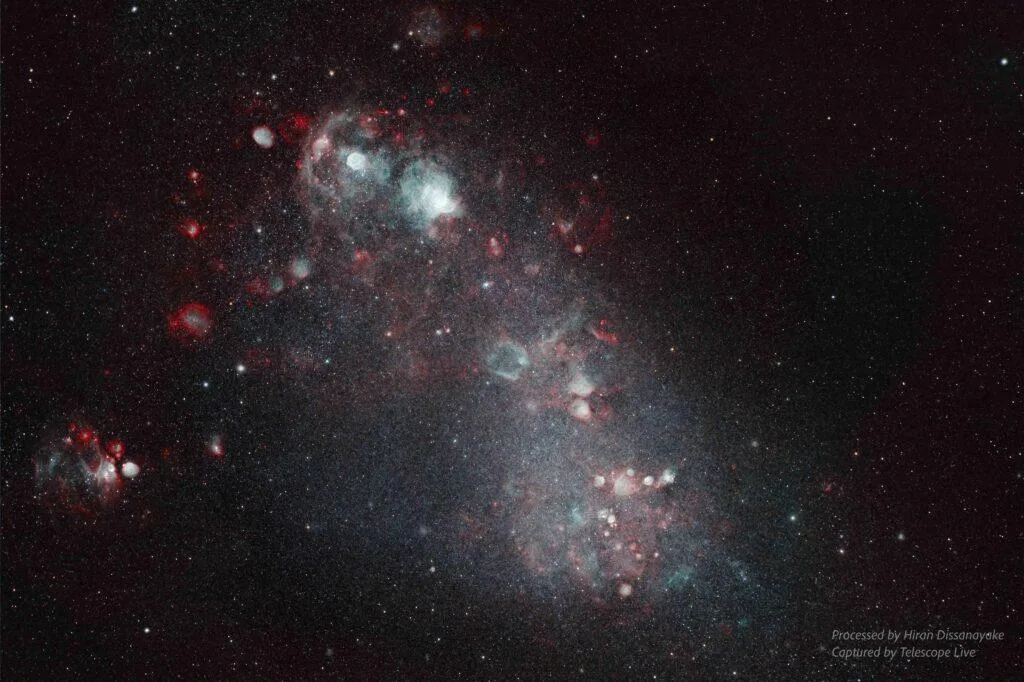
A galaxy captured in remarkable detail… without a space telescope. That is the reality behind the latest Small Magellanic Cloud astrophotography breakthrough. A ground-based image has achieved a level of clarity once associated only with orbital observatories.
This moment reflects more than technical progress. It signals a shift in how deep-space imaging is approached and who can take part in it. Access is expanding. Expectations are changing.
At the center of this development is the Small Magellanic Cloud, a nearby dwarf galaxy about 200,000 light-years away. Known for its faint glow in the night sky, it now appears with striking structure and depth.
For readers exploring similar breakthroughs, see our coverage on space imaging advances and next-generation observatories on SpaceEyeNews.
🌠 Small Magellanic Cloud Astrophotography Reveals Fine Structure
The latest Small Magellanic Cloud astrophotography result goes far beyond visual observation. What once appeared as a soft blur now reveals a complex and dynamic system.
🔭 A Closer Look at Galactic Detail
The image highlights:
- Dense clusters of stars
- Subtle dust patterns
- Variations in brightness across regions
These features provide insight into how galaxies evolve. The Small Magellanic Cloud remains a key object for studying interactions with the Milky Way and understanding stellar formation cycles.
✨ Why This Capture Stands Out
Clarity is only part of the story. The real significance lies in how that clarity was achieved. Comparable detail often requires large observatories or space-based instruments.
This time, it did not.
For related discoveries, explore our article on deep-sky observation techniques and how imaging methods continue to improve.
📸 How Ground-Based Astrophotography Achieved This Result
This achievement comes from Petr Horálek, working with support from NOIRLab.
🛠️ Tools and Technique Working Together
The setup remained surprisingly simple:
- A standard camera
- A telephoto lens
- A four-hour exposure session
Instead of relying on large telescopes, the process depended on long-exposure imaging. Light was collected over time, allowing faint details to emerge gradually.
🌍 Why Location Matters
The image was captured from Cerro Pachón in Chile. This region offers ideal conditions for astronomy:
- Minimal light pollution
- High altitude
- Stable atmosphere
These factors reduce distortion and enhance clarity.
⏱️ Precision Over Power
Time played a critical role. The extended exposure allowed enough light to build a detailed image. This approach demonstrates that technique and patience can rival scale.
Readers interested in similar methods can explore our guide to astrophotography fundamentals and evolving capture technologies.
🔬 Why This Astrophotography Breakthrough Matters
This result challenges a long-standing assumption. Deep-space clarity has often been linked to missions like the Hubble Space Telescope.
⚡ A Shift in Expectations
For years, the distinction was clear:
- Space telescopes delivered unmatched detail
- Ground-based systems had limits
That boundary is now less defined.
🌐 Expanding Access to Deep-Space Imaging
Modern tools and refined techniques are making advanced imaging more accessible. Skilled observers can now capture meaningful data without institutional resources.
👨🚀 From Enthusiasts to Contributors
The role of amateur astronomers is evolving. Many now contribute valuable observations, helping expand our visual understanding of space.
For more on this shift, see our analysis of citizen science in astronomy and how public contributions are shaping research.
🌍 NOIRLab and the Push for Public Engagement
The release of this image aligns with the outreach mission of NOIRLab.
🎯 Bringing Astronomy Closer to the Public
NOIRLab focuses on making complex science accessible through visual storytelling. High-quality imagery plays a central role in this effort.
🔭 Connection to Future Observatories
The initiative also connects to projects such as the Vera C. Rubin Observatory, which aims to expand large-scale sky surveys.
🌟 Inspiration Through Accessibility
Beyond research, these efforts encourage curiosity. They show that meaningful engagement with astronomy is possible from many vantage points.
For further reading, explore our feature on future sky surveys and global observatories.
🚀 The Future of Small Magellanic Cloud Astrophotography
This breakthrough reflects a broader transformation in astronomy.
📈 Technology Is Closing the Gap
Advancements in cameras, lenses, and processing techniques continue to improve image quality. The gap between ground-based and space-based results is narrowing.
🌌 A Growing Community of Observers
As tools become more accessible, more people are contributing to space observation. This expands both the volume and diversity of data.
⚖️ Complementing, Not Replacing, Space Telescopes
Ground-based imaging still has limits. Space telescopes remain essential for certain observations. However, the relationship is evolving into one of complementarity rather than separation.
For a deeper look, see our breakdown of space telescopes vs ground observatories.
🧠 Conclusion — A Defining Moment for Modern Astrophotography
This Small Magellanic Cloud astrophotography achievement represents more than a technical success. It marks a shift in capability and access.
Deep-space imaging is no longer confined to large institutions. With the right conditions, tools, and techniques, detailed observations are now within reach of a wider community.
The implication is clear. Astronomy is becoming more open, more collaborative, and more dynamic.
And as this trend continues, the next remarkable image may not come from orbit. It may come from right here on Earth.
🔗 Main Sources:
https://dailygalaxy.com/2026/04/camera-captured-neighboring-galaxy-detail/
https://noirlab.edu/public/news/