
BY:SpaceEyeNews.
The Small Magellanic Cloud has long been one of the Milky Way’s most familiar galactic companions. Astronomers have studied it for decades and believed they had a reasonable understanding of its structure and behavior. However, a new study has revealed that this nearby dwarf galaxy may not be behaving the way scientists once thought.
Instead of rotating in an orderly fashion, the Small Magellanic Cloud appears to be expanding under the influence of powerful gravitational forces from the neighboring Large Magellanic Cloud. The discovery comes from more than a decade of observations that tracked the motion of millions of stars. Those stellar movements now provide some of the clearest evidence yet that the galaxy is being reshaped by its larger companion.
The findings offer a rare opportunity to watch galaxy evolution unfold in our cosmic neighborhood.
Small Magellanic Cloud Reveals a Different Story
For years, astronomers assumed that the Small Magellanic Cloud behaved like many other dwarf galaxies. Earlier measurements suggested that its stars moved in a pattern consistent with rotation.
New observations tell a different story.
Researchers used data collected by the Visible and Infrared Survey Telescope for Astronomy (VISTA) in Chile. Over an eleven-year period, the telescope measured the positions and motions of millions of stars inside the galaxy.
The goal was to create the most detailed map ever produced of the galaxy’s internal stellar motions.
Instead of confirming rotation, the observations revealed something unexpected.
Many stars appear to be moving outward from the galaxy’s central regions. This pattern suggests that the galaxy is experiencing large-scale expansion rather than stable rotation.
That conclusion changes the picture dramatically.
Why VISTA Was Able to Detect the Difference
VISTA observes the universe in near-infrared light. This allows astronomers to see through some of the dust that can obscure stellar populations.
By combining observations collected across more than a decade, researchers achieved exceptional precision.
The long observation period made it possible to detect subtle stellar motions that would otherwise remain hidden.
As a result, astronomers gained a much clearer view of how stars move inside the Small Magellanic Cloud.
Evidence Points Directly to the Large Magellanic Cloud
The most surprising part of the discovery involves the direction of the stellar motions.
Researchers found that stars are moving outward along a broad axis stretching from southeast to northwest. When that axis is extended, it points directly toward the Large Magellanic Cloud.
That alignment is unlikely to be a coincidence.
Gravitational Forces at Work
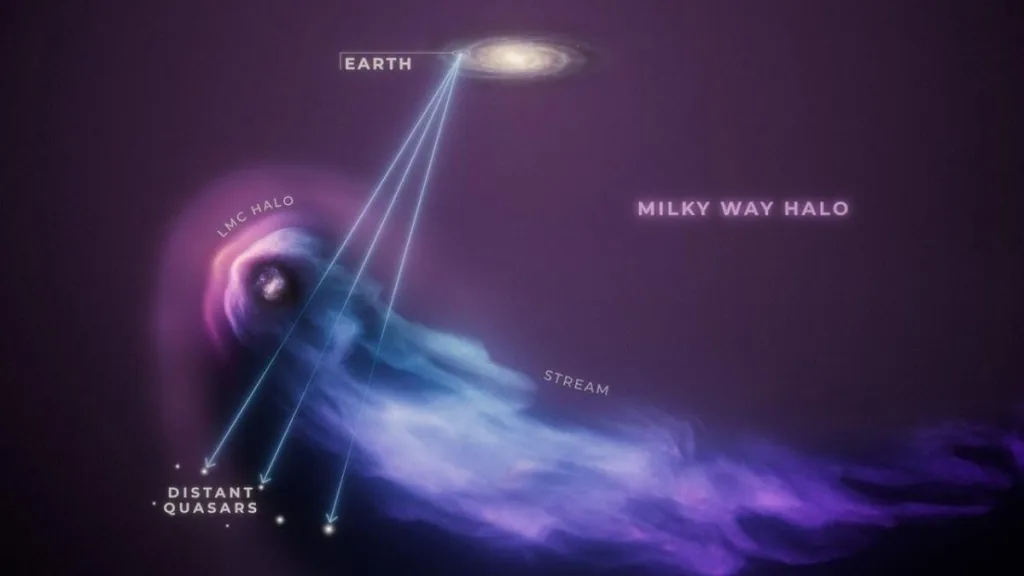
Galaxies constantly influence one another through gravity. When two galaxies pass near each other, tidal forces can stretch and distort their structures.
A similar process affects Earth’s oceans through the gravitational pull of the moon. On a galactic scale, the same principle operates over vastly greater distances.
In this case, astronomers believe the Large Magellanic Cloud has been exerting tidal forces on the Small Magellanic Cloud for billions of years.
Those forces appear strong enough to alter the motions of stars throughout the galaxy.
Stellar Motions Support the Theory
The observed stars move at an average speed of about 17 kilometers per second.
That speed may seem modest. However, over hundreds of millions of years, those stars can travel thousands of light-years.
Such movements gradually reshape the structure of an entire galaxy.
The data suggest that the Small Magellanic Cloud was likely more compact in the distant past. Over time, repeated interactions with its larger companion may have stretched it into the irregular shape astronomers observe today.
Why Previous Interpretations Were Incorrect
Scientific understanding evolves as better data become available.
Earlier observations lacked the precision needed to track stellar motions across the galaxy in such detail.
Because of those limitations, researchers interpreted the observed motions as evidence of rotation.
The new dataset paints a different picture.
Rotation Versus Expansion
A rotating galaxy displays a predictable pattern. Stars on one side move in one direction while stars on the opposite side move the other way.
The Small Magellanic Cloud does not show that behavior.
Instead, stars across large regions appear to move away from the galaxy’s center.
That pattern matches tidal expansion far more closely than rotational motion.
A New View of the Galaxy
The discovery challenges decades of assumptions.
Rather than being a stable rotating system, the galaxy appears to be responding to repeated gravitational encounters.
This new interpretation helps explain its unusual appearance.
It also provides a clearer understanding of how interactions between dwarf galaxies can transform their structures over time.
Ancient Stars Reveal an Older Mystery
The study uncovered another intriguing clue.
Researchers examined older red giant stars within the galaxy. These stars formed roughly two billion years ago.
Unlike younger populations, many of these older stars share a collective motion toward the north.
A Fossil Record of Past Events
Stars preserve evidence of ancient interactions.
Even after billions of years, their motions can reveal events that shaped a galaxy’s history.
The northward movement of these red giants suggests that another major gravitational encounter occurred long ago.
That event appears separate from the more recent influence of the Large Magellanic Cloud.
A Puzzle Beyond the Milky Way
Astronomers believe the Magellanic Clouds may be passing close to the Milky Way for the first time.
If that idea is correct, the interaction recorded by the red giant stars likely happened elsewhere.
This raises important questions.
What object influenced the Small Magellanic Cloud two billion years ago?
Was it another galaxy?
Could the Magellanic Clouds have experienced additional encounters before approaching the Milky Way?
Scientists do not yet have definitive answers.
Future observations may help solve the mystery.
What the Discovery Means for Galaxy Evolution
The new findings extend beyond the Magellanic Clouds themselves.
They offer valuable insight into how galaxies evolve through gravitational interactions.
Dwarf Galaxies Are More Dynamic Than Expected
Astronomers once viewed many dwarf galaxies as relatively simple systems.
Recent observations continue to challenge that assumption.
The Small Magellanic Cloud demonstrates that even modest galaxies can experience complex and long-lasting transformations.
Repeated encounters can alter their shapes, redistribute stars, and influence future star formation.
Understanding Galactic Growth
Large galaxies grow by interacting with smaller neighbors.
The Milky Way itself contains evidence of past mergers with dwarf galaxies.
Studying the Magellanic Clouds provides a nearby laboratory for understanding these processes.
Because the galaxies are relatively close, astronomers can observe individual stars rather than relying solely on large-scale structures.
That level of detail offers unique scientific value.
The Future of the Small Magellanic Cloud
The story is far from over.
Both Magellanic Clouds continue to travel through space while interacting with each other and with the Milky Way.
Computer simulations suggest that these interactions will continue for billions of years.
Continued Gravitational Influence
The Large Magellanic Cloud is expected to remain the dominant influence on its smaller companion.
Additional tidal effects could further reshape the Small Magellanic Cloud over time.
The galaxy may continue losing stars and gas as these interactions unfold.
A Future Merger with the Milky Way
Current models indicate that both Magellanic Clouds will eventually merge with the Milky Way.
That process will take billions of years.
Before then, astronomers expect many additional interactions between the two galaxies.
Each encounter will leave new signatures in the motions of stars.
Future observations may allow scientists to track these changes in unprecedented detail.
Conclusion
The Small Magellanic Cloud is revealing a far more dramatic history than astronomers once imagined. New observations show that its stars are not moving in a simple rotating pattern. Instead, many are traveling outward under the gravitational influence of the Large Magellanic Cloud.
The discovery reshapes our understanding of one of the Milky Way’s closest galactic neighbors. It also demonstrates how powerful tidal interactions can transform galaxies over billions of years. As astronomers continue studying the Small Magellanic Cloud, they may uncover even more clues about its past, its future, and the processes that shape galaxies throughout the universe.
Main Sources:
- Space.com
https://www.space.com/astronomy/galaxies/trouble-near-the-milky-way-the-large-magellanic-cloud-is-ripping-its-smaller-neighbor-galaxy-apart - European Southern Observatory (ESO)
https://www.eso.org - VISTA Magellanic Clouds Survey (VMC)
https://www.eso.org/public/teles-instr/paranal-observatory/surveytelescopes/vista/ - Leibniz Institute for Astrophysics Potsdam (AIP)
https://www.aip.de - Research team led by Sreepriya Vijayasree and Florian Niederhofer on the stellar kinematics of the Small Magellanic Cloud.