
BY:SpaceEyeNews.
SN 2023aeaf is giving astronomers a rare glimpse of a massive star’s final stages when the universe was about two billion years old. Its light traveled roughly 11.7 billion years before reaching the James Webb Space Telescope. Yet distance is only part of the story. The likely Type II supernova also carries clues about surrounding gas and stellar evolution in a metal-poor galaxy. Together, those clues address a deeper question: how closely did early massive stars resemble their modern counterparts?
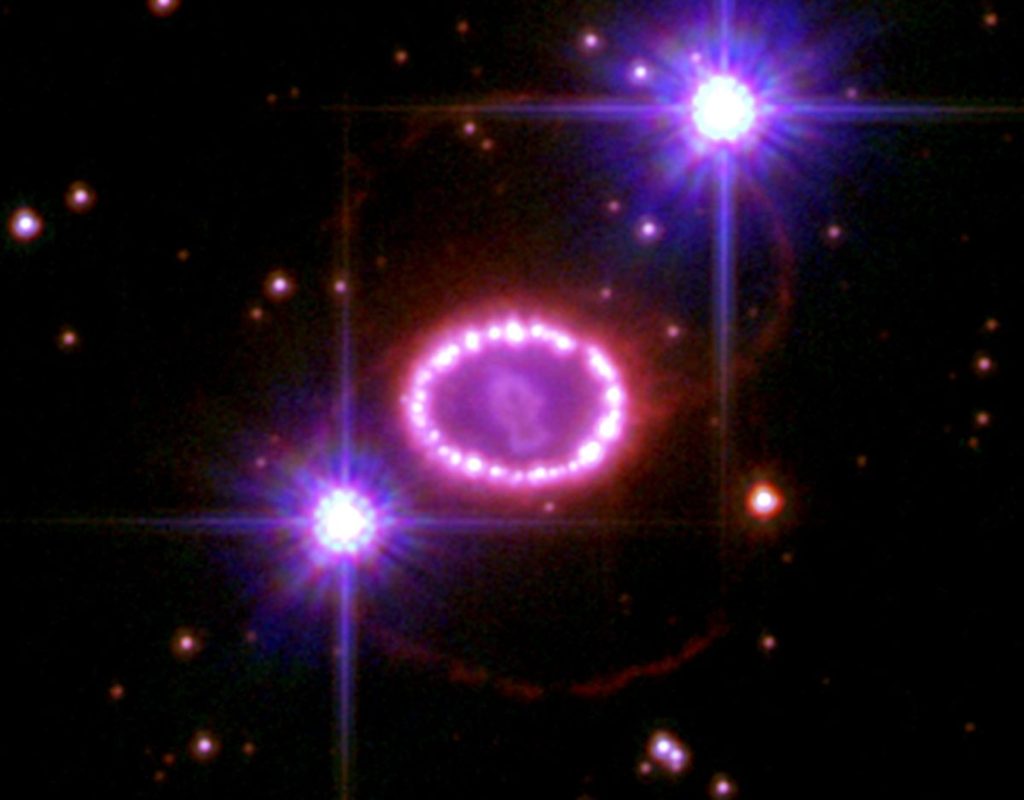
Type II supernova. Source: Wikipedia
How Webb Identified SN 2023aeaf
Detection in COSMOS-Web
Researchers found SN 2023aeaf in COSMOS-Web, a survey that repeatedly imaged a large region of the sky. Comparing images helped them isolate the changing source from its host galaxy.
Webb’s Near-Infrared Camera supplied brightness measurements across several filters. Follow-up observations with its Near-Infrared Spectrograph established a redshift of 3.195 through the host galaxy’s emission lines.
That measurement places the event in a small group of exceptionally distant supernovae with spectroscopic redshifts. It does not make this the most distant supernova ever observed.
Valeria Aparicio, affiliated with the University of Hawaiʻi, led the analysis. The team published its findings in The Astrophysical Journal.
A Likely Type II Supernova
The researchers compared changes in brightness and color with models representing several supernova categories. Type II models provided the strongest overall match, with a calculated probability of 97.2%.
However, that number depends on the models and assumptions within the classification method. It does not mean researchers obtained an unambiguous spectral identification.
The available spectrum showed no clearly identifiable supernova features. Hydrogen emission from the host galaxy may have concealed a corresponding signal from the transient. The published study’s abstract explicitly acknowledges this limitation.
Consequently, “likely Type II supernova” remains the accurate description. The distance measurement and the classification rest on different evidence. That distinction matters when interpreting everything that follows.
Clues About the Progenitor Star
Hot Emission and Cooling
The first observations captured unusually hot, blue emission. Modeling suggests an effective temperature above approximately 10,000 kelvin.
At the second observational epoch, the emission matched a cooler temperature near 7,000 kelvin. That change fits a transition toward the hydrogen-recombination plateau familiar from Type II supernovae.
During this phase, hydrogen recombines as expanding material cools, helping sustain the visible brightness. Here, the later observations support that interpretation without providing a continuous record of the transition.
About 126 days separated the two imaging epochs for observers on Earth. At the source, however, that interval corresponds to roughly 30 days because cosmic expansion stretches observed timescales. This spacing allows researchers to compare two distinct phases. It also leaves gaps that models cannot fully resolve, particularly around the earliest changes in brightness. These observation details explain why additional visits would improve the physical picture.
Evidence for Surrounding Gas
Using the STELLA simulation code, the team tested models with and without dense material surrounding the star. Interaction with a compact concentration of gas offers a plausible explanation for the early hot emission.
In this scenario, expanding stellar material transfers energy into gas that the star previously released. Researchers infer the surrounding material from its effect on the light, rather than imaging a resolved shell. The interaction adds light before the event settles into its cooler phase.
The preferred models suggest approximately half the Sun’s mass in surrounding material. They also favor a progenitor that began life with roughly 12 solar masses.
Neither estimate amounts to a direct measurement of the original star. Plausible models extend to approximately 24 solar masses, illustrating the uncertainty. The research paper’s modeling section stresses that limited observations prevent tight constraints.
For SN 2023aeaf, the strongest result is therefore the broader physical picture. Dense nearby gas can help explain the early emission, while later cooling resembles a more familiar Type II phase.
Inside a Metal-Poor Galaxy
The Host Galaxy’s Chemistry
The host galaxy provides another important piece of the investigation. Its spectrum and photometry indicate a low-mass, star-forming system with relatively little chemical enrichment.
The team’s modeling places its stellar mass near one billion solar masses. Its gas contains a much lower proportion of heavy elements than the Sun, consistent with a chemically unevolved environment.
“Metal-poor” does not mean metal-free. Nor does this observation establish that the progenitor belonged to the universe’s first generation of stars.
Instead, the galaxy offers a setting for testing stellar evolution under conditions less common in nearby supernova samples. Its chemical makeup helps researchers evaluate whether local examples provide reliable comparisons across cosmic history.
How Chemistry Influences Stars
Heavy elements influence how stars lose material through winds. With fewer such elements, weaker radiation-driven winds may allow massive stars to retain more hydrogen.
That possibility makes the surrounding gas especially interesting. Researchers need to understand how a star’s long-term evolution connects with material it releases before becoming a supernova.
This event cannot establish that connection by itself. The data do not determine precisely when the gas accumulated or how metallicity shaped the process.
Building a Larger Sample
A growing sample could reveal whether hot early emission and dense surrounding material commonly accompany distant Type II supernovae.
Selection effects also matter. Bright events are easier to detect across enormous distances, potentially skewing the examples astronomers can study.
With more observations, researchers could compare different populations and use their occurrence rates to investigate cosmic star formation. The goal extends beyond explaining one unusual source.
SN 2023aeaf: The Next Questions
SN 2023aeaf combines a confirmed redshift with evidence favoring a Type II origin, surrounding gas, and a metal-poor host. These findings offer a valuable test of massive-star evolution roughly two billion years after the Big Bang.
The remaining uncertainties are equally informative. Better sampling could sharpen estimates of stellar mass and trace the early interaction more closely. For now, Webb has supplied a detailed starting point for understanding how massive stars evolved across a very different cosmic environment.
Main Sources:
Aparicio and colleagues, The Astrophysical Journal — Analysis of a Type II Supernova Candidate at z = 3.19 from JWST’s COSMOS-Web Survey.
Author manuscript — Full research paper on arXiv.
University of Copenhagen — Official publication record and abstract.