BY:SpaceEyeNews.
A solar superflare could exceed anything instruments have directly measured from our Sun. Now, a study suggests that our star can create the conditions needed for such an event. The key evidence comes from an enormous sunspot group that crossed the solar surface in April 1947.
Researchers combined historical observations with modern flare measurements to estimate how much energy a region that large could release. Their findings strengthen the case for the Sun’s superflare potential. However, they offer no prediction of an approaching event, and they do not establish how often one might occur.
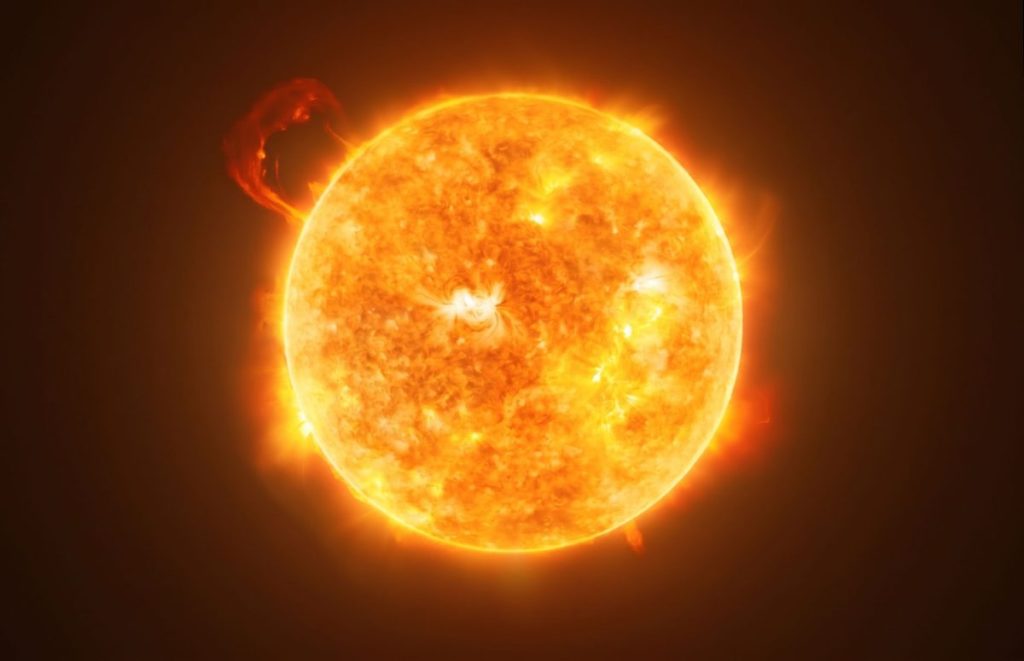
Solar flare. Illustrative image: Unsplash / NASA.
The 1947 Sunspot Behind the Discovery
The April 1947 sunspot group provides an extraordinary test of the Sun’s capabilities. It ranks as the largest group in the historical record examined by the researchers. Its exceptional scale raises a question: could the associated magnetic region support a solar superflare?
Sunspots reveal only part of that region. The surrounding active region contains a broader magnetic structure, which determines the energy available for a flare. Therefore, researchers needed to estimate more than the dark area visible in historical drawings.
The team used the old observations to assess the wider region and its possible energy output. Crucially, they were investigating what such a structure could produce under favorable conditions. They were not reconstructing a confirmed superflare from 1947.
The historical record matters because space instruments cover only a small fraction of the Sun’s history. Rare events may fall outside that observation window. Looking further back expands the range of solar conditions scientists can investigate, even when the surviving evidence remains incomplete.
That distinction keeps the finding grounded. An unusually large sunspot offers evidence of potential, but size alone cannot reveal its actual flare history.
How Researchers Calculated Solar Superflare Potential
Modern Observations Supply the Missing Clues
Direct measurements of the 1947 region’s flare energy do not exist. Instead, the researchers turned to observations from NASA’s Solar Dynamics Observatory between 2010 and 2016.
The underlying catalogue contains 3,137 flares, including 306 stronger M- and X-class events. These observations connect active regions with bright atmospheric features called flare ribbons. The ribbons trace areas involved in magnetic restructuring during a flare.
Larger ribbon areas generally correspond to greater energy release. By comparing ribbons with their surrounding active regions, the team could estimate how efficiently different regions participate in flares.
Looking Beyond Average Behavior
The researchers focused on unusually productive regions, rather than relying on average values. They then extended those relationships to much larger historical sunspot groups.
This approach estimates what could happen near the energetic extremes of observed behavior. It does not mean a large active region will automatically reach that level.
As checks, the team compared estimates with known events, including the July 2000 flare and reconstructions of the Carrington event. Agreement supports the method, although extrapolating beyond modern measurements still introduces uncertainty.
An Energy Estimate Reaching Superflare Levels
For exceptionally large and complex regions, the calculations allow flare energies of a few times 10³⁴ ergs. That reaches the range associated with superflares on Sun-like stars.
For comparison, 10³⁴ ergs equals 10²⁷ joules. The figure describes energy released as radiation across wavelengths. It does not describe the amount Earth would receive or the energy delivered to an electricity network.
This result challenges the idea that the Sun necessarily falls short of superflare energies. Some earlier calculations placed its maximum below that threshold. The new analysis indicates that rare magnetic configurations could allow more substantial releases.
Nevertheless, the estimate depends on assumptions about magnetic fields and energy conversion. Historical observations also provide less detail than modern instruments. A solar superflare estimate must account for those limits. The result therefore represents a plausible upper range, rather than a precise forecast for any individual sunspot group.
What a Solar Superflare Could Mean for Earth
Radiation and Plasma Have Different Effects
The consequences would depend on more than the flare’s energy. Solar radiation can disrupt radio communications, while an accompanying coronal mass ejection can carry plasma and magnetic fields toward Earth.
If that material reaches our planet, its magnetic orientation helps determine the strength of the resulting geomagnetic disturbance. Severe conditions can affect satellites, navigation, and electricity networks.
However, a major flare does not always produce a coronal mass ejection. In October 2014, a huge active region generated powerful flares while its overlying magnetic field confined the plasma.
Why Blackout Predictions Need Care
NOAA identifies possible grid collapse and blackouts among the effects of extreme geomagnetic storms. Yet the new study does not calculate damage to specific networks or predict recovery times.
Claims that this finding guarantees months without electricity would go beyond its evidence. Actual impacts would depend on the solar event, its interaction with Earth, and infrastructure conditions. The research examines the Sun’s energy potential, not a detailed disruption scenario.
Why the Frequency Remains Uncertain
The often-mentioned “once per century” figure comes from a separate study of stars resembling the Sun. It describes an average across a stellar sample, rather than an established timetable for our own star.
The new research does not resolve that uncertainty. Nor does a century-scale average imply regular spacing between events.
Natural records offer another route into the past. Tree rings and ice cores preserve isotopic changes associated with extreme particle events. However, those traces do not directly measure flare radiation or establish that a superflare accompanied each event.
Researchers still need to connect these historical clues with models of magnetic structures and energy release. That work could clarify both the Sun’s physical limits and the likelihood of reaching them.
A Clearer View of the Sun’s Limits
The 1947 sunspot group strengthens the case that a solar superflare lies within our star’s capabilities. It offers a historical anchor for testing events beyond modern experience. The remaining question concerns frequency: understanding what the Sun could produce is only one step toward assessing how often it might happen.
Main Sources:
- Original study: Empirical flare energy limits for the largest historical sunspots
- Max Planck Institute for Solar System Research: Sun: New Evidence of Superflares
- Max Planck Institute for Solar System Research: Superflares once per Century
- NOAA: Space Weather Scales
- NOAA: Coronal Mass Ejections
- Universe Magazine — Astrophysicists detect potential for a superflare on the Sun