
BY:SpaceEyeNews.
Introduction — Solar Wind Faster Than Expected Changes Everything
Solar wind faster than expected is forcing scientists to rethink how the Sun behaves. New data from the Proba-3 mission shows that slow solar wind near the Sun can reach speeds close to 300 miles per second. That is up to four times faster than earlier estimates. For years, models assumed a gradual start near the solar surface. This new evidence challenges that view. It also opens a new chapter in solar research and space weather prediction.
Solar Wind Faster Than Expected — What Proba-3 Discovered
A Clearer View of the Inner Corona
Solar wind faster than expected was detected in a region that has remained difficult to observe. The inner corona sits close to the Sun and is overwhelmed by intense light. Traditional instruments struggle to capture reliable data here.
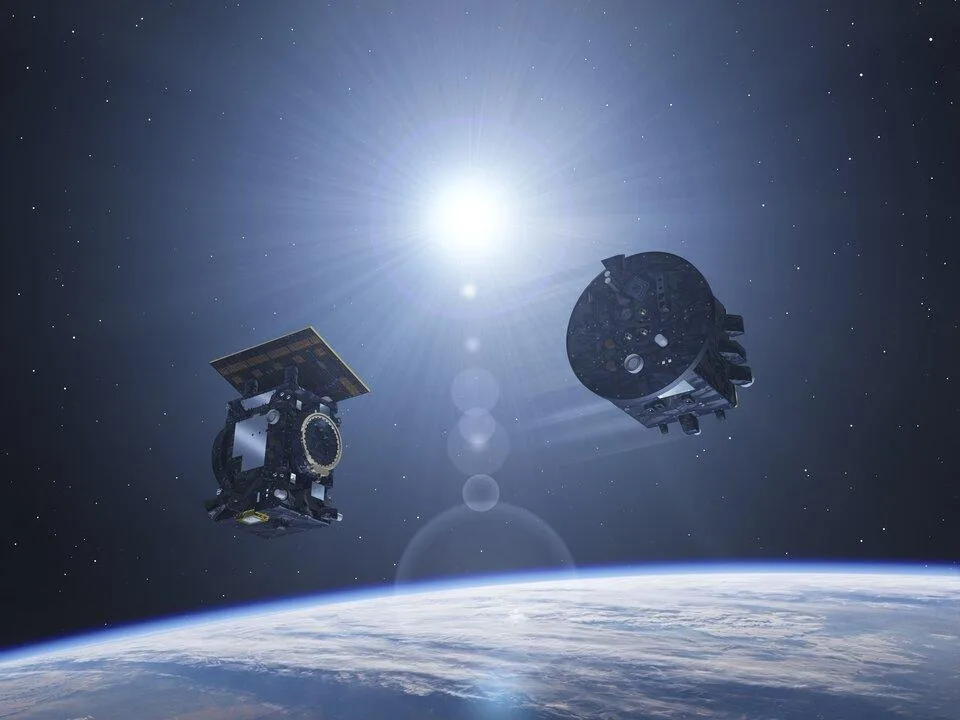
The European Space Agency addressed this challenge with a unique design. Proba-3 uses two spacecraft flying in precise formation. One blocks the Sun’s light, while the other observes the faint outer atmosphere. This setup creates a controlled solar eclipse in space.
Unexpected Speeds Near the Surface
This approach allowed scientists to track solar wind closer to its origin. The findings were striking.
- Expected speed: about 60 miles per second
- Observed speed: up to 300 miles per second
The difference is not small. It shows that solar wind accelerates much earlier than models predicted.
A Growing Body of Data
Since its launch in late 2024, Proba-3 has already produced valuable results.
- 57 artificial eclipses completed
- More than 250 hours of observation data
Each dataset adds detail to the Sun’s outer layers. Scientists can now follow how solar wind forms and evolves with greater clarity.
Solar Wind Faster Than Expected — A Shift in Solar Physics
Rethinking Established Models
Solar wind faster than expected challenges long-standing theories. Scientists have long separated solar wind into fast and slow streams. The slow component was thought to move gently near the Sun before gaining speed. That assumption is now under review.
Acceleration Happens Earlier
New observations suggest that acceleration begins much closer to the solar surface. The process is also more rapid than expected. This insight changes how energy transfer in the corona is understood.
Magnetic Fields as a Driving Force
The Sun’s magnetic field likely plays a central role. It is complex and constantly shifting. Magnetic interactions in the corona may push particles to higher speeds earlier in their journey.
New Questions Take Shape
The discovery opens the door to deeper investigation:
- What triggers this early acceleration?
- Does it occur across the entire Sun or in specific regions?
- How stable are these fast flows over time?
Each question points to gaps in current understanding.
Solar Wind Faster Than Expected — Why It Matters for Earth
More Complex Space Weather
Solar wind faster than expected directly affects space weather forecasting. Faster flows reduce reaction time. This makes predictions more challenging.
Impact on Satellites and Communication
Solar wind interacts with Earth’s magnetic field. Variations can influence:
- Satellites in orbit
- Navigation systems
- Communication networks
Reliable forecasts are essential. This new data shows that current models may need refinement.
Infrastructure and Preparedness
Geomagnetic activity can affect power systems. While not every event is severe, improved forecasting helps reduce risk. Understanding solar wind behavior is key to that effort.
Toward Better Prediction Models
With more accurate observations, scientists can improve their models. Proba-3 offers a new level of precision. Over time, this should lead to more reliable space weather forecasts.
Solar Wind Faster Than Expected — The Mission Is Just Beginning
Early Insights with Long-Term Value
Solar wind faster than expected comes from early mission data. More observations are already planned. Each new dataset will refine the picture.
Tracking Solar Wind in Real Time
Proba-3 enables continuous tracking of solar wind acceleration. This capability provides a dynamic view of solar activity. Scientists can observe changes as they unfold.
Expanding the Scientific Horizon
Future analysis may reveal patterns across different solar regions. It may also show how solar cycles influence wind behavior. These insights will deepen our understanding of the Sun.
A Foundation for Future Missions
The mission also demonstrates new techniques. Formation flying and eclipse simulation may shape future space research. The success of Proba-3 could influence how other stars are studied.
Conclusion — Solar Wind Faster Than Expected Redefines the Sun
Solar wind faster than expected is more than a surprising result. It marks a shift in how scientists understand the Sun.
Thanks to the Proba-3 mission, researchers can now observe the corona with greater clarity. They can track solar wind where it begins. This new perspective will reshape models and improve space weather forecasting.
As the mission continues, the Sun is proving once again that it still holds many unanswered questions.
Main Sources:
- https://dailygalaxy.com/2026/04/proba-3s-faster-than-expected-solar-wind/
- https://www.esa.int/ (European Space Agency official mission updates)
- https://iopscience.iop.org/journal/2041-8205 (Astrophysical Journal Letters)