BY:SpaceEyeNews.
🚀 Introduction — A New Energy Frontier for AI Infrastructure
Artificial intelligence is expanding fast, and energy demand is rising with it. In 2024, Meta Platforms consumed more than 18,000 gigawatt-hours across its data centers. That number will only grow as AI systems become more complex.
Now, a new approach is gaining attention—space-based solar power for AI data centers. Instead of relying only on ground-based energy, Meta is exploring a system that collects solar energy in orbit and delivers it to Earth around the clock.
The concept is simple in theory but ambitious in scale. If it works, it could remove one of the biggest limits facing AI growth: reliable, continuous power.
⚡ Why AI Needs a New Energy Model
AI Growth Is Reshaping Power Demand
AI systems require constant computing power. Training models, running inference, and managing global services all depend on energy. As a result, data centers are becoming central to global electricity demand.
Infrastructure is struggling to keep pace. Grid expansion takes time, while AI demand accelerates quickly. This gap creates pressure on companies that depend on stable power.
Limits of Ground-Based Solar Power
Solar energy is a key part of the solution, but it has constraints. It depends on daylight and weather conditions. At night, production stops completely.
Energy storage can reduce this issue, but batteries add cost and complexity. They also limit how far solar can scale efficiently. For systems that must run continuously, interruptions remain a challenge.
This is where orbital energy offers a different path. By moving solar collection into space, the system avoids the day-night cycle and delivers constant output.
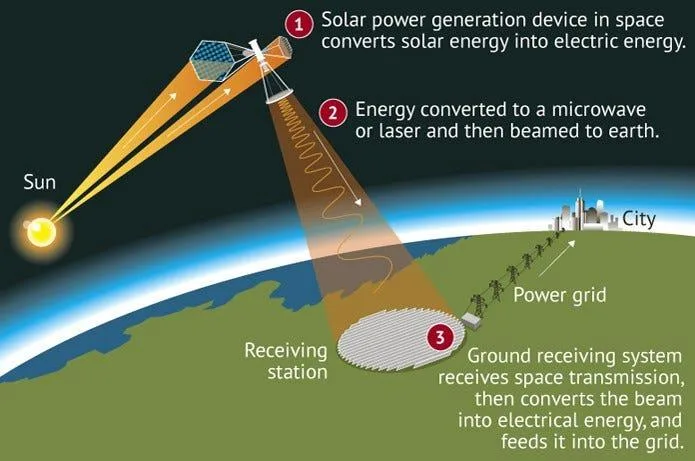
🛰️ How Orbital Solar Power Systems Work
From Space to Earth — A Continuous Energy Loop
The system developed by Overview Energy follows a structured process:
- Satellites collect solar energy in orbit
- Energy converts into infrared radiation
- A wide beam transmits energy toward Earth
- Ground stations convert the light into electricity
This loop enables continuous energy delivery. Unlike traditional solar systems, it does not depend on time of day.
Infrared Transmission and Safety Design
The system uses infrared radiation instead of focused beams. This design improves safety and scalability. The energy spreads across a wide area, reducing risk to people and aircraft.
Another advantage is compatibility. Existing solar farms can adapt to receive this energy, which simplifies deployment if the system scales.
Early Testing and Next Steps
Initial demonstrations have transmitted energy from aircraft to ground stations. These tests confirm the concept, but they are only a first step.
The next milestone is orbital testing. That phase will show whether the system can operate under real space conditions.
🌍 Scaling Orbital Energy for Data Centers
A Global Satellite Network in Orbit
The long-term vision includes a large constellation of satellites in geostationary orbit. At that altitude, each satellite remains fixed over a specific point on Earth.
This stability allows consistent energy delivery to ground stations. It also simplifies system coordination across regions.
The network could include around 1,000 satellites. Coverage would extend across major regions, including parts of North America and Europe.
Timeline Toward Deployment
The roadmap is already defined:
- 2028: First satellite launch for orbital testing
- 2030: Potential start of large-scale deployment
Each satellite is expected to operate for more than a decade. This creates a long-term energy layer that sits above Earth’s existing infrastructure.
Why Scale Matters for AI Energy
Large data centers require steady, high-capacity power. Small systems cannot meet that demand. This is why the project targets gigawatt-level output.
At full scale, the system aims to deliver up to one gigawatt of electricity. That level can support major AI operations and reduce dependence on traditional grids.
🤝 Meta’s Strategy and Calculated Approach
A Flexible Agreement Structure
Meta’s deal is structured as a capacity reservation. It secures access to future energy without committing to full payment upfront.
This approach allows flexibility. The company can evaluate performance before scaling investment. It also limits risk while keeping access to a potential breakthrough.
New Metrics Reflect a New Industry
The project introduces a new term: the “megawatt photon.” It measures how much light is required to generate one megawatt of electricity.
This reflects how early the sector is. Standards are still forming, and companies are defining how to measure efficiency and output.
Growing Interest from Big Tech
Energy demand is not unique to Meta. Other technology companies face similar challenges. As a result, interest in orbital energy solutions is increasing.
If successful, this approach could become a shared solution across the industry.
⚠️ Challenges That Could Shape the Outcome
Technical Barriers Still Exist
Several key challenges remain:
- Maintaining high energy conversion efficiency
- Ensuring stable and accurate transmission
- Protecting satellites over long operational lifetimes
Each step must work reliably for the system to succeed.
Cost and Infrastructure Complexity
Building and launching a large satellite network requires significant investment. Manufacturing at scale also presents challenges.
On the ground, infrastructure must adapt. Solar farms need systems that can convert incoming infrared energy effectively.
Limited Proof in Space Conditions
So far, testing has not reached orbit. Aircraft demonstrations provide insight, but they do not replicate space conditions.
The first orbital mission will be a critical milestone. It will determine whether the concept can move beyond theory.
🔮 Future Impact on Energy and AI
Extending the Power Grid into Space
If successful, orbital systems could become part of global energy networks. Power would no longer depend only on Earth-based sources.
This shift would change how energy is generated and distributed.
Unlocking Continuous AI Operations
Reliable energy is essential for AI. With constant power supply, data centers could operate without interruption.
This would support faster development and more advanced systems.
A New Space-Based Industry
The concept echoes the early days of satellite communications. What began as an experiment became essential infrastructure.
A similar path could emerge here. Orbital energy could develop into a major global industry.
🧠 Conclusion — A Defining Test Ahead
The idea of space-based solar power for AI data centers represents a major shift in how energy could be produced and delivered. By collecting solar power in orbit, it removes key limitations and offers continuous output.
At the same time, the concept remains unproven at scale. Technical, economic, and operational challenges must still be addressed.
The upcoming orbital test will be a defining moment. If successful, it could reshape both energy systems and AI infrastructure. If not, it will still push innovation forward and refine future approaches.
🔗 Main Sources:
- https://universemagazine.com/en/solar-power-from-orbit-meta-signs-agreement-to-power-ai-data-centers/
- https://www.nasa.gov/directorates/stmd/space-based-solar-power/
- https://www.esa.int/Enabling_Support/Space_Engineering_Technology/SOLARIS