BY:SpaceEyeNews.
A Starlink near miss just put a spotlight on a problem that’s been building quietly for years: Earth’s most popular orbits are getting crowded, and coordination does not always keep up.
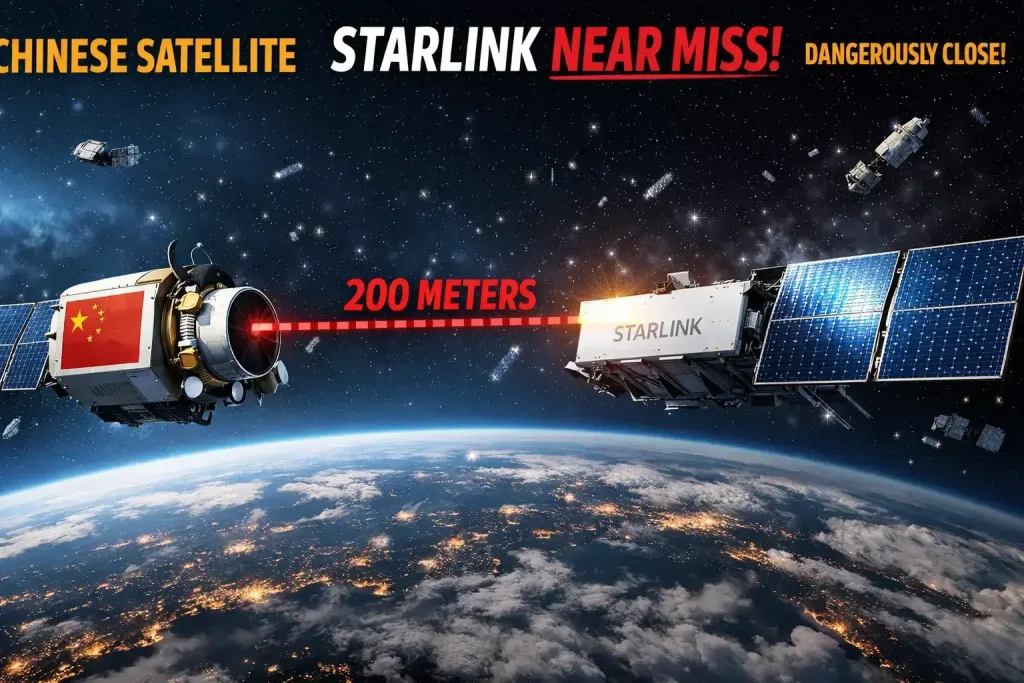
In this case, SpaceX says a satellite released from a Chinese launch came within about 200 meters of STARLINK-6079 at roughly 560 km altitude. SpaceX framed the event as a coordination failure. CAS Space, the launch provider, replied that it follows mandatory space-awareness procedures and is reviewing the details. Space+2X (formerly Twitter)+2
Nothing “broke” in the sense of hardware damage. But the conversation around space traffic management just got louder—and for good reason.
Starlink near miss: what SpaceX says happened
SpaceX’s public account came from Michael Nicolls, the company’s Vice President for Starlink Engineering. In a post on X dated Dec. 12, 2025, he said that one of the satellites deployed from a Jiuquan launch passed within 200 meters of STARLINK-6079 and that SpaceX was not aware of coordination or deconfliction beforehand. X (formerly Twitter)+1
Nicolls is not a random commentator. He leads Starlink engineering and constellation operations, according to the U.S. Office of Space Commerce profile describing his role. space.commerce.gov
The launch context: Kinetica-1 and nine deployed satellites
The satellite that approached Starlink came from a Kinetica-1 (Lijian-1) mission operated by CAS Space, launched from the Jiuquan area. China Daily reported the mission deployed nine satellites, including six Chinese multifunctional satellites, plus payloads for the UAE (Earth observation), Egypt (scientific), and Nepal (educational). chinadaily.com.cn+1
SpaceX’s statement did not name which of the nine spacecraft made the close pass. That detail matters because “responsibility” can sit in different places depending on which vehicle it was and how it was operated after separation.
What we still don’t know (and why that’s normal)
This Starlink near miss has a few unanswered questions that are common in fast-moving space incidents:
- Which satellite among the nine approached Starlink-6079. Space+1
- Whether Starlink-6079 maneuvered during the event, or whether the objects simply passed near each other without action. Space
- Whether the close approach resulted from post-deployment behavior, not the launch window itself.
Those gaps do not invalidate the concern. They simply define what analysts and the public will watch for next: operator updates, tracking confirmations, and any technical clarifications.
CAS Space responds: mandatory procedures and an ongoing review
CAS Space responded on X after the SpaceX post. The company said it selects launch windows using a ground-based space awareness system to avoid known satellites and debris, called it a mandatory procedure, and said its team was in contact to gather more details while it works to identify what happened. X (formerly Twitter)
That response is important because it shows how two statements can both be true:
- A launch provider can do pre-launch screening properly.
- A close approach can still occur after satellites separate and begin drifting, spacing out, and adjusting into their early orbits.
Launch-window screening vs. what happens after separation
Launch-window planning mainly addresses a narrow question: “Is the rocket’s ascent and initial deployment likely to create an immediate conflict with tracked objects?”
But orbital safety doesn’t end at deployment. After separation, satellites often enter a “settling” phase. They may:
- Spread out along an orbit.
- Stabilize attitude and power.
- Perform early orbit trimming.
- Transition into their operational profiles.
A close approach can happen during that post-deployment period, especially in popular altitude bands like the 500–600 km range referenced in SpaceX’s statement. Space+1
Why operators sometimes see different pictures
Here’s the core friction point. SpaceX emphasized “coordination” and “deconfliction.” CAS Space emphasized “space awareness” and “launch window selection.” X (formerly Twitter)+1
Those terms overlap, but they are not identical.
- Space awareness often means tracking and screening with available catalogs.
- Coordination usually means direct operator-to-operator data sharing, especially for timely trajectory updates.
If one side expects direct sharing and the other relies on standard screening, both may feel they did “the right thing.” The near miss shows why the industry is struggling to align expectations.
Why this Starlink near miss matters right now
A near miss like this matters because the trend line is clear: there are more satellites, more launches, and more operators. That combination creates more “close approach” opportunities, even if everyone acts responsibly.
Orbit crowding is no longer a theory
Space.com summarized the scale shift with a simple comparison: there were fewer than 3,400 functional satellites in 2020, and about 13,000 five years later. It also noted that SpaceX operates roughly 9,300 Starlink satellites. Space
When a single company operates such a large share of active spacecraft, Starlink becomes a kind of “weather vane” for orbital risk. If Starlink sees more near-misses, it often reflects a wider environment change, not only one event.
Starlink’s maneuvering record shows how frequent conjunctions are
Space.com also reported that Starlink satellites performed about 145,000 avoidance maneuvers in the first half of 2025. Space
That number matters for two reasons:
- It signals how often satellites now need to adjust to predicted close passes.
- It highlights an uneven reality: not every satellite can maneuver as readily, or as autonomously.
So even if Starlink can react quickly, the broader system still depends on shared information to prevent repeated close calls.
The weak link: sharing trajectory data in near real time
Nicolls framed the issue as “most of the risk” coming from a lack of coordination between operators. X (formerly Twitter)
In practical terms, coordination usually comes down to a few things:
- Sharing accurate trajectory data (often called ephemeris).
- Responding quickly when a predicted close approach appears.
- Agreeing on who moves, when, and how to confirm separation.
When any one of those steps is inconsistent, the “uncertainty bubble” around satellite location becomes the real risk driver. A reported 200-meter separation sounds precise, but uncertainty margins can be meaningful in LEO depending on tracking sources and timing. That is exactly why operators push for direct sharing.
What “better coordination” can look like without slowing space down
A common misconception is that safety requires slowing launches. In many cases, it does not. It requires standardized behavior and clearer expectations.
1) Shared standards for close-approach messaging
Operators benefit when everyone uses consistent alert thresholds and response timelines. A simple rule set helps:
- When to notify another operator.
- What data format to share.
- How to confirm a maneuver plan.
The Starlink near miss puts pressure on the industry to make those steps routine, not optional.
2) Clear handoff between launch providers and satellite operators
CAS Space described itself as the launch services provider and said it would help identify details. X (formerly Twitter)
That hints at a broader process improvement: formal “handoff” checkpoints.
- The launch provider has the best view of deployment timing and initial orbit.
- The satellite operator has the best view of the spacecraft’s behavior afterward.
When those responsibilities blur, coordination slows down. When they connect cleanly, situational awareness improves.
3) Making space safety accessible for smaller missions
China Daily’s payload list included international satellites for the UAE, Egypt, and Nepal. chinadaily.com.cn+1
That matters because many missions today are not mega-constellations. They are small national, academic, or scientific projects. Those teams may not have large tracking budgets or 24/7 operations centers.
If the space community builds coordination systems that only big players can use, near misses will keep happening. Good policy needs to scale down as well as up.
What to watch next after the Starlink near miss
The short-term story will likely move in three ways.
Follow-up details from the involved parties
SpaceX has already defined the core claim: close approach distance, altitude band, and the absence of known coordination. X (formerly Twitter)+1
If CAS Space publishes more detail—such as timing after deployment, which satellite it was, or whether any planned maneuvers occurred—that will shape how the community interprets this event. X (formerly Twitter)
Independent tracking confirmations
In many cases, third-party tracking firms and public satellite catalogs help validate timing and proximity. Even if the public never sees a perfect reconstruction, tracking confirmation often narrows uncertainty. It also helps identify whether the event stemmed from initial deployment geometry or later orbit adjustments.
Pressure for stronger space traffic management
This incident landed in a year where space activity has been exceptionally high. Space.com noted 2025 milestones and the pace of launches across providers. Space+1
As more constellations expand, the practical incentive to coordinate grows. Operators want fewer surprise conjunctions. Regulators want fewer headline incidents. And customers want reliable services.
Conclusion: a Starlink near miss as a turning point moment
This Starlink near miss did not create damage, outages, or a lasting operational crisis. But it delivered something almost as valuable: a clear, public example of why orbital coordination has to mature.
SpaceX says a newly deployed satellite passed within 200 meters of Starlink-6079 near 560 km altitude, and it highlighted the need for better operator-to-operator communication. X (formerly Twitter)+1 CAS Space said it uses mandatory space-awareness procedures for launch windows and is reviewing the situation. X (formerly Twitter) China Daily documented the international nature of the launch payloads, which underlines how many countries now share these same orbital lanes. chinadaily.com.cn+1
The takeaway is simple: space is now shared infrastructure. The next stage of progress won’t come only from rockets and satellites. It will come from coordination that is routine, fast, and trusted.
Main sources:
- Space.com report by Mike Wall (Dec. 2025) Space
- Michael Nicolls (SpaceX) public post on X X (formerly Twitter)
- CAS Space statement on X X (formerly Twitter)
- China Daily coverage of the Kinetica-1 / Lijian-1 Y11 launch payloads chinadaily.com.cn+1
- U.S. Office of Space Commerce profile confirming Nicolls’ role space.commerce.gov